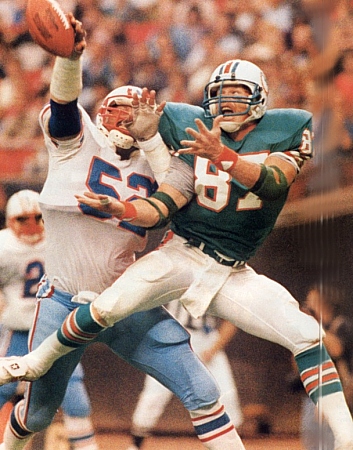
Tuesday, October 21, 2008

JACK TATUM


Jack Tatum
5'10" 200
Safety
Oakland Raiders
1971 - 1980
10 Seasons
136 Games Played
37 Interceptions
10 Fumble Recoveries
900 Return Yards
1 Touchdown
5 Pro Bowls


John David Tatum was a first round draft pick of the Oakland Raiders in 1971. He was the 19th player picked overall. Tatum did not start playing organized football until his tenth grade year. By his senior year in high school, Tatum was a high school All American. Tatum was recently named one of New Jersey's top ten high school defensive players of the century. Tatum went to college at Ohio State University. Two legends there would help change his path. Woody Hayes was planning to use Tatum as a running back, when his assistant coach, Lou Holtz, persuaded Hayes to move Tatum into the Safety position. Jack was used in several various ways in the Buckeyes defensive schemes. He would cover the other teams best receiver, and also play Linebacker. In his first game, as a Buckeye, Tatum knocked the opposing teams starting tight end and running out from the game. Jack was All Big Ten from his sophomore year until his senior year, and was a two time All American. He helped Ohio State get to two National Championship games in his collegiate career, winning once. Ohio State lost just two games in Tatum's three seasons playing. In his senior year, Tatum was named the National Defensive Player of the Year, and was a top finalist for the Heisman Trophy. Jack Tatum is a member of the the Ohio State Hall of Fame and the College Football Hall of Fame. Current Ohio State head coach Jim Tressel has instituted a "Jack Tatum Hit of the Week Award," given to the player who had the most impressive defensive hit of the game.


Tatum made an immediate impact upon his arrival in the NFL. One game, he knocked out two Baltimore Colts from the game. Hall of Fame Tight End John Mackey was one of the players. He intercepted 4 passes that year, and returned them for 136 yards. Tatum intercepted 4 passes the next year as well, gaining 91 yards on returns. He also set an then NFL record by returning a fumble 104 yards for the only touchdown of his NFL career. By 1973, Tatum was one of the most feared and respected Free Safeties in the NFL. He missed the first game of his career that year, but was named to his first Pro Bowl squad. Tatum would go on to be named to the Pro Bowl team until 1977. In 1977, Tatum snared 6 interceptions, and returned them for a career high 146 yard. He was a key ingredient to the Raiders team that would go on to win Super Bowl XI. Tatum would go on to intercept 5 passes over the course of the next two seasons. Tatum would then be traded to the Houston Oilers prior to the 1980 season. Jack responded by intercepting a career high 7 interception for 100 yards, despite not starting one game. He helped the Oilers win the AFC Central Division Championship. Houston, coincidentally, would then lose to the Wild Card Oakland Raiders in the first round. Tatum retired after that game. His 164 yards returned via fumbles ranks 16th All Time in NFL history, and his 736 yards returned by interception ranks 38th All Time in NFL history. Tatum's 636 yards rank first in Raiders history. It is 12 yards more than Dave Grayson, the player Jack replaced at Free Safety. No matter how one looks at Tatum, he in part of some of some of the most memorable moments in the NFL's history. The famous "Immaculate Reception", at the end of a playoff game in 1972, started when Tatum laid out Pittsburgh's John Fuqua. Most fans recall Hall of Fame Running Back Franco Harris gathering the caromed ball and taking it for a game winning touchdown.


In Super Bowl XI, Vikings Wide Receiver Sammy White was leveled by Tatum on a crossing pattern, but the Vikings Great held onto the ball.


During a 1978 pre-season game, Tatum hit New England Wide Receiver Darryl Stingley in a play that would paralyze Stingley for life.


Tatum happened to play on a team that was called the "Bad Boys" of the 1970's NFL. It was a unique roster full of characters. Tatum was nicknamed the "Assassin" due to his hard hitting ability. The hit on Stingley, coupled with the Raiders already established reputation, gave Jack an unfair label of being a dirty player. He was vilified by casual observers, and anti-Raider media types after this play. Tatum once said, “I always wanted to hit someone hard, and if they got hurt, that was just part of the game. But you always wanted them to be ok.” Tatum admitted his hitting prowess "borderlines on felonious assault." The game was much rougher back then. Yet the media continues to try to spin this fabricated tale that Jack was a cheap short artist. "They said on ESPN that I hit Stingley in the back and that's just a lie," Tatum said. "It's amazing to me that they lie like that when they can just look at the hit. They have it on tape." As you can see in the picture, the hit was clean. Even then-Patriots Head Coach Chuck Fairbanks said the hit was far from dirty. Propaganda machines like ESPN are probably a big factor as to why Tatum has yet to be inducted into Canton. Many media types try to say Jack is remorseless about this play. Tatum has expressed sorrow on televised interviews, only to have that part edited out. "I feel sorry for what happened to him," said Tatum, "I tried to apologize to him a number of times, but people around him wouldn't let that happen." Idiots like Sports Illustrateds Paul Zimmerman, a voter, are other big reasons why Tatum has yet to be inducted into the Pro Football Hall of Fame. It is sick, and unfair, that Tatum is being labeled for one play. A play no one wants to remember in its reality, rather to fabricate this villainous imagery. This play is the main reason the NFL went from the 10 yard chuck rule to the current 5 yard rule. Tatum is still part of the NFL today as part of the Uniform Code Enforcement Team, commonly known as the “fashion police". There needs to be one major enforcement. This on the media who lie. Jack Tatum may have hit guys hard, but that is the way the game was played then. He played within the rules. He was not flagged nor fined for his hit on Stingley. That is the reality. Tatum is a player many look up to. Hall of Famer Ronnie Lott is on record for idolizing Tatum. That is a reality. It is time for the voters to do away with spun fabrications and deal with reality. Just look at his statistics if you want to have disdain for his impact. Jack Tatum deserves his place in Canton.


Notable Players Drafted In 1971 (* Denotes Canton Inductee)

1. Jim Plunkett, QB, New England
2. Archie Manning, QB, New Orleans
3. Dan Pastorini, QB, Houston Oilers
4. J.D. Hill, WR, Buffalo
6. John Riggins, RB, NY Jets *
8. Frank Lewis, WR, Pittsburgh
9. John Brockington, RB, Green Bay
10. Isiah Robertson, LB, LA Rams
14. Clarence R. Scott, DB, Cleveland
15. Vern Holland, OT, Cincinnati
17. Norm Thompson, DB, Saint Louis Cardinals
20. Jack Youngblood, DE, LA Rams *
21. Bob Bell, DT, Detroit
22. Don McCauley, RB, Baltimore Colts
27. Julius Adams, DE, New England
34. Jack Ham, LB, Pittsburgh *
35. Dwight Harrison, DB, Denver
39. Wilbur Young, DE, Kansas City
43. Dan Dierdorf, OT, St. Louis Cardinals *
45. Phil Viilapiano, LB, Oakland
48. Charlie Weaver, LB, Detroit
56. Lynn Dickey, QB, Houston Oilers
57. Jim Braxton, FB, Buffalo
63. Dave Elmendorf, DB, LA Rams
64. Tony McGee, DE, Chicago
67. Ken Anderson, QB, Cincinnati
68. Charlie Hall, LB, Cleveland
71. Bob Newton, G, Chicago
75. Willie Parker, C, San Francisco
77. Bill Gregory, DE, Dallas
79. Lyle Alzado, DE, Denver
86. Gerry Mullins, G, Pittsburgh
98. Don Morrison, OT, New Orleans
99. Joe Theismann, QB, Miami
104. Dwight White, DE, Pittsburgh
106. Larry Brown, OT, Pittsburgh
107. Donnie Green, OT, Buffalo
111. Ray Jarvis, WR, Atlanta
115. Bryant Salter, DB, San Diego
120. Mike Adamle, RB, Kansas City
123. Bob Moore, TE, Oakland
134. Willie Alexander, DB, Houston
136. Phil Wise, DB, NY Jets
142. Doug Dieken, OT, Cleveland
147. Mel Gray, WR, St. Louis
148. Ray Brown, DB, Atlanta
160. Bob Chandler, WR, Buffalo
161. Harold Carmichael, WR, Philadelphia
179. John Watson, G, San Francisco
191. Mike Sensibaugh, DB, Kansas City
199. Ron Yankowski, DE, St. Louis
203. Ernie Holmes, DT, Pittsburgh
206. Ron Jessie, WR, Dallas
212. Floyd Rice, LB, Houston
230. Vern Den Herder, DE, Miami
262. Bob Pollard, DE, New Orleans
268. Mike Wagner, FS, Pittsburgh
272. George Starke, OT, Washington
276. Nate Allen, DB, Kansas City
292. Rich Sowells, DB, NY Jets
297. Jeff Severson, DB, Washington
304. Tom Blanchard, P, NY Giants
305. Horace Jones, DE, Oakland
322. Dan Ryczek, C, Washington
330. Dave Roller, DT, NY Giants
352. Rick Kingrea, LB, Cleveland
361. Bill Dunstan, DT, San Francisco
388. Jeff Wright, S, Minnesota
418. Randy Vataha, WR, LA Rams
441. Don Nottingham, FB, Baltimore

Monday, October 20, 2008

DICK LeBEAU

Dick LeBeau
6'1" 185
Cornerback
Detroit Lions
1959 - 1972
14 Seasons
185 Games Played
62 Interceptions
9 Fumble Recoveries
4 Touchdowns
3 Pro Bowls


Charles Richard LeBeau was a 5th round draft pick of the Cleveland Browns in the 1959 draft. He was the 58th player picked overall. He went to college at Ohio State University. There, he played under Woody Hayes as both a Running Back and Cornerback. He was a key member of the Buckeyes 1957 National Championship team. During that season, he had one of the best games of collegiate career against arch rival Michigan University. He scored two touchdowns in the Buckeyes 31-14 win.


LeBeau did not make the Browns team, and was cut in training camp. He would then be picked up by the Detroit Lions. He played 6 games in his rookie year, mostly on special teams. He did recover the first fumble of his career that season. In 1960, LeBeau earned the starting job at Cornerback opposite newly acquired Hall of Famer Dick "Night Train" Lane. The Lions defense also had Hall of Fame MLB Joe Schmidt, Hall of Fame Defensive Tackle Alex Karras, Hall of Fame Safety Yale Lary and Pro Bowl Safety Terry Barr. LeBeau picked off 4 passes. The next 3 seasons, LeBeau and Lane formed the best Cornerback tandem in the NFL. LeBeau picked off 3 passes in 1961, then 4 in 1962. He scored the first two touchdowns of his career that year, by interception and fumble recovery. In 1963, LeBeau picked off 5 passes and returned them for 158 yards. He also returned one interception 70 yards for a touchdown. LeBeau would then make his first of 3 consecutive Pro Bowl appearances in 1964. That season also marked Larys last in the NFL, and Lane played only 7 games. LeBeau still managed 5 interceptions that year. 1965 was the last year for both Lane and Schmidt. LeBeau picked off 7 passes and returned one for the last touchdown of his career. 1966 would be LeBeaus last Pro Bowl season, when he intercepted 4 passes. LeBeau stayed steady the next several years. He picked off 4 passes in 1967, opposite of Hall of Fame Cornerback Lem Barney under new coach, and former team mate, Joe Schmidt. LeBeau and Barney would then team up for the next 3 years as one of the best CB tandems in the league. LeBeau then had 5 picks in 1968. In 1969, he snatched 6 interceptions. 1970 saw Dick LeBeau have a career high 9 interceptions. At 34 years old in 1971, LeBeau would intercept 6 passes. 1972 would be the last year as a Detroit Lion for LeBeau and Schmidt. LeBeau was moved to Free Safety that year, and would not intercept a pass for the first time since his rookie season. He did recover the last fumble of his career that year.


Dick LeBeau only retired from the NFL as a player after 1972. He went into coaching in 1973 for the Philadelphia Eagles as a Secondary Coach. He stayed with the team until 1975. He then held the same duties with the Green Bay Packers from 1976 to 1979. In 1980, he moved to the Cincinnati Bengals. He served as a Secondary Coach, and as Defensive Coordinator with the Bengals until 1991. LeBeau then served as the Defensive Coordinator for the Pittsburgh Steelers from 1992 to 1996. This is when LeBeau would gain notoriety for inventing the now commonly used "Zone Blitz" defense. The Steelers defense featured such greats as Hall of Fame Cornerback Rod Woodson, All Pro Linebackers Greg Lloyd, Hardy Nickerson, Levon Kirkland, Chad Brown, Kevin Greene, Jason Gildon and Strong Safety Carnell Lake. They would go to the Super Bowl after the 1995 season. In 1997, LeBeau returned to the Bengals as a Defensive Coordinator. He would then be named Head Coach of the Bengals in 2000, and held that job until 2002. LeBeau then worked for the Buffalo Bills in 2003. He returned to the Pittsburgh Steelers in 2004, and is still the Defensive Coordinator of the Steelers today. In 2005, the Steelers won Super Bowl XL. Dick LeBeau is one of the most respected coaches in NFL history, obviously, and is called "Coach Dad" by his players. Dick LeBeaus playing career alone should have him inducted into Canton by now. If inducted, he would be the first player from the 1959 NFL Draft to make it. He is a member of the Detroit Lions Legends. His 62 interceptions are the most in the history of the Detroit Lions.


If you just look at his coaching career alone, he is worthy of induction. If you put both factors together, it is a no brainer. I cannot fathom what the voters hold up is. There in NO QUESTION about it, Dick LeBeau belongs in the Pro Football Hall of Fame right now!


Notable Players Drafted In 1959 (None are a Canton Inductee Yet)


2. Dick Bass, FB, Los Angelos Rams
3. Bill Stacy, DB, Chicago Cardinals
5. Dave Baker, DB, San Francisco
6. Nick Pietrosante, FB, Detroit
15. J.D. Smith, OT, Philadelphia
17. Bob L. Harrison, LB, San Francisco
19. Mike Rabold, G, Detroit
21. Rich Petitbon, DB, Chicago Bears
22. Buddy Dial, WR, NY Giants
23. Dick Shafrath, OT, Cleveland
25. Bowd Dowler, WR, Green Bay
26. Wray Carlton, RB, Philadelphia
28. Emil Karas, LB, Washington
29. Eddie Dove, DB, San Francisco
34. Joe Morrison, RB, NY Giants
35. Fran O'Brien, OT, Cleveland
41. Monte Clark, DT, San Francisco
44. John Tracey, LB, LA Rams
47. Dave Lloyd, LB, Cleveland
49. Bob Wetoska, OT, Washington
53. John Wooten, G, Cleveland
80. Eddie Meador, DB, LA Rams
102. Bobby Joe Green, P, San Francisco
119. Bob Zeman, DB, Cleveland
123. Art Powell, WR, Philadelphia
125. Harry Jacobs, LB, Detroit
141. Mike Connelly, C, LA Rams
164. Joe Robb, DE, Chicago Bears
167. Elbert Dubenion, WR, Cleveland
173. Bruce Maher, DB, Detroit
177. Roger LeClerc, LB, Chicago Bears
209. Joe Kapp, QB, Washington
219. Alan Miller, FB, Philadelphia
223. Dave Kocourek, TE, Pittsburgh
242. Dale Memmelaar, G, Chicago Cardinals
249. Donnie Stone, RB, Chicago Bears
250. Jim Fraser, LB, Cleveland
266. Fred Glick, DB, Chicago Cardinals
313. Timmy Brown, RB, Green Bay
319. Charley Tolar, FB, Pittsburgh
331. Ron Hall, DB, Pittsburgh
353. Jim Colclough, WR, Washington

Thursday, October 16, 2008

ROBERT BRAZILE

Robert Brazile
6'4" 244
Linebacker
Houston Oilers
1975 - 1984
10 Seasons
147 Games Played
13 Interceptions
7 Pro Bowls


Robert Lorenzo Brazile, Jr. was a first round pick by the Houston Oilers in 1975. He was the sixth player picked overall. Picked just before him was his college teammate Walter Payton.

Brazile was rated as the premier collegiate linebacker in 1974 while playing at Jackson State. He started his collegiate football career as a tight end, but switched to linebacker during his sophomore year. Brazile was called "Mr. Versatile", a moniker he earned because of his ability to excel at either the inside or outside linebacker slot.

He helped lead Jackson State to two Southwestern Athletic Conference championships in 1972 and 1973. Brazile is a member of the Jackson State Sports Hall of Fame, the SWAC Hall of Fame, and the Mississippi Sports Hall of Fame.

Brazile was part a deal former Oilers coach Sid Gillman had made at the end of 1973. The Oilers acquired Kansas City's 1975 first round selection, along with nose tackle Curley Culp, for defensive end John Matuszak.

New head coach/general manager Bum Phillips switched Houstons base defense from the from a 4-3 to a 3-4. Brazile is credited by many to be most important in making the 3-4 popular by his ability to rush the quarterback from his outside linebacking position.

Brazile was the NFL's Defensive Rookie of the Year award in 1975. He was named to the Pro Bowl in each of his first seven seasons. Brazile was a key member of Oilers teams that went to back-to-back AFC Championship games in 1978 and 1979.

In 1984, Braziles wife died in a car wreck. He retired immediately from the NFL. Brazile was chosen on the 1970's NFL All-Decade Team. He is the only linebacker from that team not in Canton.

Many may remember his moniker in the NFL. Brazile was nicknamed "Dr. Doom" by his team mates after being tossed out of a game in his rookie year for hitting Washington Redskin Quarterback Billy Kilmer in the head. Some may recall the time he bulldogged Dallas Cowboys Hall of Fame Running Back Tony Dorsett by the facemask.

Brazile was a viscious hitter. He was equally excellent is pass coverage and run support as he was rushing the passer. He didn't always play on good teams, so he wasn't given the nation wide notice, during that era, he deserved.

Since the NFL did not record sacks as a statistic until 1982, his impact on the game may not be fully realized by newer fans. Those who saw Brazile play knew he was always one of the better defensive players in the NFL in his era year in and year out. Robert Brazile deserves to be inducted into the NFL Hall of Fame. Ask his peers.


Notable Players Drafted In 1975 (* Denotes Canton Inductee)

1. Steve Bartkowski, QB, Atlanta
2. Randy White, MLB, Dallas *
4. Walter Payton, RB, Chicago *
8. Gary Johnson, DT, San Diego
11. Dennis Harrah, OT, LA Rams
16. Russ Francis, TE, New England
17. Louis Wright DB, Denver
18. Tom Henderson, LB, Dallas
20. Doug France, OT, LA Rams
22. Mike Williams, DB, San Diego
26. Dave Brown, DB, Pittsburgh
28. Monte Jackson, DB, LA Rams
30. Louis Kelcher, DT, San Diego
31. Mike Hartenstein, DE, Chicago
33. Fred Dean, DE, San Diego *
36. Fred Solomon, WR, Miami
53. Mike Washington, DB, Baltimore
70. Bob Breunig, LB, Dallas
82. Tony Peters, DB, Cleveland
85. Cleveland Elam, DE, San Francisco
95. Rich Upchurch, WR, Denver
105. Roosevelt Leaks, RB, Baltimore
108. Mike Thomas, RB, Washington
116. Steve Grogan, QB, New England
120. Pat McInally, WR, Cincinnati
121. Rubin Carter DT, Denver
135. Bob Avellini, QB, Chicago
164. Ricky Young, RB, San Diego
176. Pat Haden, QB, LA Rams
199. Steve Foley, DB, Denver
216. Mike Strachan, RB, New Orleans
228. Dallas Hickman, DE, Washington
253. Roland Hooks, RB, Buffalo
262. George Martin, DE, NY Giants
291. Doug Plank, DB, Chicago
420. Roland Harper, RB, Chicago


Monday, October 13, 2008

ED WHITE

Ed White
6'1" 269
Offensive Guard
Minnesota Vikings
1969 - 1985
17 Seasons
241 Games Played
4 Pro Bowls


Edward Alvin White White was drafted in the second round of the 1969 AFL/NFL draft by the Minnesota Vikings. He was the 39th player picked overall. Ed Whites high school stadium is named Ed White Stadium. In college, White played for the University of California, Berkeley Golden Bears. He was a Noseguard for the famous "Bear Minimum" defense that allowed opponents an average of only 3.6 yards per play. White was selected a consensus All-American player in 1968 for defense. White was also used as a receiver and quarterback on occasion. Ed White was inducted into the University of California, Berkeley Athletics Hall of Fame in 1993. White is also a member of the East-West Shrine Game Hall of Fame, Breitbard Hall of Fame, and College Football Hall of Fame.


White was then switched to Left Offensive Guard, against his wishes, after being drafted. He earned the starting job mid-way into his second year. He also ended up playing Defensive Tackle towards the end of the 1970 season, after injuries ravaged the defensive line. White would go on to team with Hall of Fame Left Tackle Ron Yary, and Center Mick Tingelhoff, to give the Vikings one of the best offensive lines in the NFL during the 1970's. The Vikings would appear in four Super Bowls during Whites tenure in Minnesota. Three appearances were between 1973 to 1976. The Vikings won the last NFL Championship in 1969, before the NFL-AFL merger. In 1974, he was named the the UPI 2nd team all-conference, and was named by the Newspaper Ent. Association's 1st team All-NFL. Before 1975, White was switched to Right Guard and was named to his first Pro Bowl that year. He would be named to the Pro Bowl the following two seasons as well. In 1977, White was injured and was only able to start 8 games. Before the 1978 season, he was traded to the San Diego Chargers for running back Rickey Young. He would earn his last Pro Bowl nod in 1979, and was one of the first players to be named to the Pro Bowl from both the AFC and the NFC in his career. White played with the Chargers until 1985. When injuries hit the Chargers offensive line in 1984, White ended up starting at Right Tackle for 13 games. White would then be moved to Left Guard for his final NFL season, and started every game. He was named the Chargers Offensive Lineman of the Year from 1983 to 1985. Ed White was inducted into the San Diego Charger Hall of Fame in 2004.


Ed White was more than a versatile athlete. He was extremely athletic, and incredibly strong. White was the the NFL arm–wrestling champion as well. White has said he hasn't lost an arm-wrestling match since he was in high school to a man 200 lbs heavier than him. White was also noted for his exceptional intelligence on the field. He came from an educated family, and his brother is a world renown expert and physician in anesthesiology. Ed White is an artist who also holds a degree in landscape architecture. White has often said he disliked playing on the offensive side of the line, and thought he would have been a much better player on defense. Still, he was one of the best in his era. Many of his contemporaries have long said Ed White belongs in Canton. White also made his team mates better just by practicing against him daily. Hall of Fame DT Alan Page, Gary "Big Hands" Johnson, Louie Kelcher, and Hall of Fame DE Fred Dean all have praised White for making them better players. He is universally considered as one of the finest offensive line coaches on any level of the game. White has both college and pro coaching experience as he spent seven seasons in the NFL, working with the San Diego Chargers from 1986-87 and 1989-91, the Los Angeles Rams in 1988 and 1998 with the St. Louis Rams. He also spent four seasons as the offensive line coach of San Diego State under Ted Tollner from 1994 to '97. While with the Aztecs, he developed several lightly recruited players into accomplished collegians, including NFL first round draft choice Kyle Turley with the New Orleans Saints and Ephraim Salaam with the Atlanta Falcons. Both were rookie starters in the NFL. White returned to Cal to coach the offensive line from 1999-2001. White was called by Turley, "the best coach I ever had at any level." White has recently coached at San Diego State in 2005. Ed White was one of the most complete Offensive Guards in the NFL throughout his career. Stats for guys who play his position are ignored by most. The most a fan notices a Guard is when he makes a mistake. A big mistake has been made for years, and still continues on to this day. The culprits are those who vote for the Pro Football Hall Of Fame. Ed White may not be remembered by many of them, but he is certainly respected by those who played against him, or watched him play. It is time to correct the mistake of not having inducted Ed White into Canton.


Notable Players Drafted In 1969 (* Denotes Canton Inductee)


1. O.J. Simpson, RB, Buffalo *
2. George Kuntz, OT, Atlanta
4. Joe Greene, DT, Pittsburgh *
7. Ted Kwalick, TE, San Francisco
11. Bill Stanfill, DE, Miami
13. Fred Dryer, DE, NY Giants
14. Rufus Mayes, OT, Chicago
15. Ron Pritchard, LB, Houston Oilers
16. Gene Washington, WR, San Francisco
18. Bob Babich, LB, San Diego
19. Roger Wehrli, CB, St. Louis Cardinals *
20. Ron Johnson, RB, Cleveland
21. Bob Klein, TE, LA Rams
24. Calvin Hill, RB, Dallas
26. Dave Foley, OT, NY Jets
31. Bill Bergey, LB, Cincinnati
32. Mike Montler, C, Boston Patriots
33. Ted Hendricks, LB, Baltimore *
34. Altie Taylor, RB, Denver
37. Bob Heinz, DT, Miami
41. Bobby Douglass, QB, Chicago
42. Warren Bankston, RB, Pittsburgh
45. Richard Neal, DE, New Orleans
47. Jim Yarbrough, OT, Detroit
48. Ed Podolak, RB, Kansas City
50. George Bueler, G, Oakland
56. Jon Kolb, C, Pittsburgh
58. Carl Garrett, RB, Boston Patriots
59. Larry Walton, WR, Detroit
61. Bill Thompson, DB, Denver
63. Eugene "Mercury" Morris, RB, Miami
65. Elbert Drungo, OT, Houston Oilers
69. Bill Bradley, S, Philadelphia
80. Bob Kuechenberg, OG, Philadelphia
81. Jim Mitchell, TE, Atlanta
93. Charlie Joiner, WR, Houston *
96. Roy Gerela, K, Houston
99. John Zook, DE, LA Rams
101. Jack Rudnay, C, Kansas City
120. Earl Edwards, DT, San Francisco
124. Fair Hooker, WR, Cleveland
126. Bob Stein, LB, Kansas City
135. Ken Riley, QB, Cincinnati
139. Harold McLinton, LB, Washington
191. Larry Brown, RB, Washington
192. James Harris, QB, Buffalo
238. L.C. Greenwood, DE, Pittsburgh
250. David Chapple, P, San Francisco
262. Jeff Van Note, LB, Atlanta
273. John Fuqua, RB, NY Giants
283. Sweeny Williams, DE, Dallas
314. Wade Key, G, Philadelphia
337. Carl Mauck, LB, Baltimore
338. Steve O'Neal, P, NY Jets
364. Roger Finnie, OT, NY Jets
379. Don Herrman, WR, NY Giants
401. Lloyd Mumphord, DB, Miami

Friday, October 10, 2008

LOUIS WRIGHT

Louis Wright
6'2" 200
Cornerback
Denver Broncos
1975 - 1986
12 Seasons
166 Games Played
26 Interceptions
11 Fumble Recoveries
512 Return Yards
4 Touchdowns
5 Pro Bowls


Louis Donnel Wright was drafted in the first round of the 1975 draft by the Denver Broncos. He was the 17th player picked overall. Wright first went to college at Arizona State University, but then transferred to San Jose State University. Wright was also a noted track star at SJSU. The long jump was his best event. Wright's San Jose State best of 25-feet-7 ranks in the top-five in school history. He also won two letters in track and once ran the 100 in 9.6 seconds. Wright started at Cornerback in his two years at SJSU, and intercepted 3 passes in his career there. After he finished his San Jose State career, he played in the 1974 East-West Shrine Game and 1974 Senior Bowl. Louis Wright is a member of the San Jose State University Hall of Fame.


Wright started all 11 games that he played in his rookie year. He intercepted 2 passes and recovered one fumble. In 1977, he had 3 interceptions for 128 yards. He also scored the first touchdown of his career. Wright was a key member of the "Orange Crush" defense that went to Super Bowl XII. Wright would garner his first Pro Bowl nod that year as well. Wright would make the Pro Bowl in each of the next 2 seasons as well. In 1979, Wright took a fumble 82 yards for a touchdown. In 1980, Wright was named to the UPI All-Conference Second Team. He ended up missing half on 1981 due to an injury, but still was named to the UPI All-Conference Second Team. Wright came back at full health for 1982 with 2 interceptions. Wright snared a career high 6 interceptions in 1983, and was named to the Pro Bowl team. In 1984, Wright would return a fumble for a touchdown and was named to The Sporting News All-NFL First Team, Pro Football Weekly All-NFL First Team, Pro Football Weekly All-Conference First Team, UPI All-Conference Second Team, and Newspaper Ent. Association All-Conference Second Team. 1985 saw him intercept 5 passes, and score the last touchdown of his career. Wright also made his last Pro Bowl team that year as well. Wright played his last season in 1986. He picked off 3 balls, and helped lead the Broncos to Super Bowl XXI. Louis Wright is a member of the Denver Broncos Ring of Fame.


Louis Wright was a shutdown Cornerback the day he walked onto an NFL field. Teams would hardly throw the ball to his side of the field. Wright was also a hard hitter, and was one of best run supporting Cornerbacks of his era. He was vital to the "Orange Crush" defense. Hall of Famer Stan Jones coached a line that featured Lyle Alzado and Rubin Carter. Tom Jackson and Randy Gradishar were top notch Linebackers. Strong Safety Billy Thompson was also great. The Broncos were #1 in the NFL against the run in 1977. Louis Wright was consistently excellent. His 163 starts rank seventh on All-Time in Broncos history. Opponents feared him. He is the greatest defensive back in the history of the Denver Broncos. Many of his contemporaries feel he was the best Cornerback in the AFC, if not the entire NFL, during his career. He was big, and fast. He wasn't one to blow his own horn, and has flown under the radar of the Hall of Fame voters since he has retired. Recreational football fans may look at his stats and not be impressed, but tackles were not a recorded statistic throughout much of Wrights career. He was always amongst the teams leaders in tackles, which is impressive when you consider how much teams tried to avoid him. If you were blessed enough to have seen Louis Wright play, then you would agree he deserves induction into Canton.


Notable Players Drafted In 1975 (* Denotes Canton Inductee)

1. Steve Bartkowski, QB, Atlanta
2. Randy White, DT, Dallas *
3. Ken Huff, G, Baltimore Colts
4. Walter Payton, RB, Chicago *
6. Robert Brazile, LB, Houston Oilers
8. Gary "Big Hands" Johnson, DT, San Diego
9. Mike Fanning, DT, LA Rams
10. Jimmy Webb, DT, San Francisco
11. Dennis Harrah, G, LA Rams
14. Glenn Cameron, LB, Cincinnati
16. Russ Francis, TE, New England
18. Thomas Henderson, LB, Dallas
20. Doug France, OT, LA Rams
22. Mike H. Williams, CB, San Diego
24. Neal Colzie, S, Oakland
25. Mike Mullaney, TE, Minnesota
26. Dave Brown, CB, Pittsburgh
28. Monte Jackson, CB, LA Rams
30. Louie Kelcher, DT, San Diego
31. Mike Hartenstine, DE, Chicago
33. Fred Dean, DE, San Diego *
36. Freddie Soloman, WR, Miami
38. Doug English, DT, Detroit
47. Bill Bain, OT, Green Bay
48. Leroy Jones, DE, LA Rams
53. Mike Washington, CB, Baltimore
55. Gary Burley, DE, Cincinnati
58. Willard Harrell, RB, Green Bay
63. Elois Grooms, DE, New Orleans
68. Richard Wood, LB, NY Jets
70. Bob Breunig, LB, Dallas
73. Mike Fuller, S, San Diego
77. Bo Harris, LB, Cincinnati
82. Tony Peters, S, Cleveland
85. Cleveland Elam, DT, San Francisco
90. Pat Donovan, OT, Dallas
95. Rick Upchurch, WR, Denver
98. Rod Perry, CB, LA Rams
105. Roosevelt Leaks, FB, Baltimore
108. Mike Thomas, RB, Washington
110. Revie Sorey, G, Chicago
116. Steve Grogan, QB, New England
117. Steve Freeman, DB, New England
120. Pat McInally, WR, Cincinnati
121. Rubin Carter, DT, Denver
122. Jeff West, P, Cincinnati
132. Fulton Kuykendall, LB, Atlanta
135. Bob Avellini, QB, Chicago
136. Billy Shields, OT, San Diego
141. Horace King, RB, Detroit
158. Jim Obradovich, TE, NY Giants
164. Rickey Young, RB, San Diego
171. Mark Cotney, DB, Houston
173. Mike Hegman, LB, Dallas
176. Pat Haden, QB, LA Rams
194. Leonard Thompson, WR, Detroit
199. Steve Foley, S, Denver
228. Dallas Hickman, LB, Washington
248. Ken Schroy, DB, Philadelphia
253. Roland Hooks, RB, Buffalo
257. Joe Danelo, K, Miami
259. Steve Sylvester, C, Oakland
262. George Martin, DE, NY Giants
263. Jeff Merrow, DE, Atlanta
271. John Sawyer, TE, Houston
290. Dick Ambrose, LB, Cleveland
291. Doug Plank, S, Chicago
311. Autry Beamon, DB, Minnesota
313. John Roman, OT, Baltimore
330. Herbert Scott, G, Dallas
349. Joe Fields, C, NY Jets
380. Brison Manor, DE, NY Jets
384. Art Kuehn, C, Washington
420. Roland Harper, RB, Chicago

Tuesday, October 7, 2008

RAY GUY

Ray Guy
6'3" 195
Punter
Oakland Raiders
1973 - 1986
14 Seasons
207 Games Played
1049 Punts
44,493 Yards
42.4 Yard Average Per Punt
7 Pro Bowls


William Ray Guy was a first round draft pick of the Oakland Raiders in the 1973 draft. He was the 23rd player picked overall. Ray attended college at the University of Southern Mississippi. There, he set school records in placekicking, punting and as a defensive back. He finished with a career punting average of 44.7 yards a kick, which is the highest average in NCAA history for punters with 200-249 attempts in their careers. Guy was the NCAA punting champion in 1972 with a 46.2 average. He averaged 45.3 and 42.9 in his other seasons. Guys 8 interception in one season is still a Golden Eagles record. Guy is 2nd All Time in school history with 18 career interceptions. His 268 interception return yardage is currently the 3rd most in school history. Guy also set a then NCAA record when he kicked a 61 yard field goal, and still ranks fourth in school history in the most field goals made in a career. In 1972, he was a member of The Sporting News, Football Writers Association, Walter Camp, Gridiron, Football News, Playboy and Associated Press All-America teams as a Safety and Punter. Guy was named Most Valuable Player of the 1972 College All-Star game, in which college all-stars played the current Super Bowl champion. Ray was also outstanding in baseball. He struck out 266 players in 220.2 innings, and threw 14 complete games in 31 total games in his career. He was drafted by Major League Baseball for 3 straight years. Ray Guy is the first Golden Eagle to ever play in the NFL. He is also the first player to have his jersey retired in school history. Guy is not only a member of Southern Mississippi's All Century Team, but he is also a member of the schools Hall of Fame, the Mississippi and Georgia Sports Halls of Fame, and the National High School Sports Hall of Fame. Guy is also the first punter to ever be inducted into the College Football Hall of Fame. Ray Guy is considered the greatest Punter to have ever played college football, and has a trophy named after him. The Ray Guy Award is given annually to the best collegiate punter in the nation.


Ray Guy is the first punter to ever be drafted in the first round by the NFL. His impact was immediate. He was named to the Pro Bowl as a rookie, when he averaged 45.3 yards per punt. Guy would be named the Pro Bowl Punter every year up until 1978. At the 1976 Pro Bowl, Ray Guy became the first punter to hit the Louisiana Superdome video screen. In 1979, he was named to the UPI All Conference Second Team, and the Newspaper Ent. Association All-NFL Second Team. He was named to his final Pro Bowl in 1980 after averaging 43.6 yards per punt. He also booted a career long punt of 77 yards that year. For some unknown reason, he was not named to the 1981 Pro Bowl, despite punting a career high 96 times and having a 43.7 average. He was named to the UPI All Conference Second Team. Guy booted the ball over 70 yards in 4 of his seasons, and kicked 5 over 60 yards in one season alone. His shortest season long was 57, in the strike shortened 1982 season. That season also was the only season of his career when he did not average over 40 yards per punt, finishing with a 39.1 average. Guy ended the last 3 years of his career averaging 90 punts per season, when he retired after the 1986 season. Ray Guy did more than just punt for the Raiders. He threw 3 career passes, completing 2 for 54 yards. His first career pass was intercepted. Guy also rushed for 43 yards on 11 attempts. In 1976, Guy was asked to kick an extra point, but missed. Ray only had 3 punts blocked in his entire career, and never had a punt returned for a touchdown. He led the NFL in punting three times also. He also kicked off for aging kicker George Blanda, a Hall of Famer.


Ray Guy was an integral part of the Raiders. He also was on 3 Super Bowl winning teams in Oakland during his career. The highlight of his Super Bowls was in 1983. His punt in Super Bowl XVIII pinned Washington inside their 12 yard line, which led to a Raiders touchdown via a turnover the next play. Ray was also named the punter on the National Football League's 75th Anniversary Team, the Super Bowl Silver Anniversary Team and as a member of the NFL 1970's All Century team. He was recently inducted into the Bay Area Sports Hall of Fame.


If you saw Ray Guy, you must be scratching your head right now as to why he isn't yet in Canton. His punts were legendary. Other teams would test the balls that he punted for helium, due to the heights his punts attained. I had thought, after seeing Kicker Jan Stenerud inducted in 1991, that the voters were FINALLY recognizing the importance of special teams. In 1994, Guy was the first punter to be nominated, but he still has not been elected. I find myself often questioning the football knowledge of the voters. Some claim to be "purists", saying that specialist do not belong because they only get on the field for a few plays each game. Still, isn't Cantons reason for existence based upon what players do once on the field? There is NO DOUBT that Ray Guy helped the Raiders win many games. Even if you disregard his statistics, you cannot look past his impact on football at all levels. Wake up the voter in the media that represents your area. Ray Guy deserves his place in the Pro Football Hall of Fame right now!


Notable Players Drafted In 1973 (* Denotes Canton Inductee)

1. John Matuszak, DE, Houston Oilers
2. Bert Jones, QB, Baltimore Colts
3. Jerry Sisemore, OT, Philadelphia
4. John Hannah, G, New England *
5. Dave Butz, DT, Saint Louis Cardinals
6. Charle Young, TE, Philadelphia
8. Wally Chambers, DT, Chicago
9. Otis Armstrong, RB, Denver
10. Joe Ehrmann, DT, Baltimore
11. Sam Cunningham, FB, New England
12. Chuck Foreman, RB, Minnesota
13. Burgess Owens, DB, NY Jets
15. Isaac Curtis, WR, Cincinnati
19. Darryl Stingley, WR, New England
20. Billy Joe Dupree, TE, Dallas
24. J.T. Thomas, DB, Pittsburgh
26. Joe DeLamielleure. G, Buffalo *
28. Guy Morriss, C, Philadelphia
29. Derland Moore, DT, New Orleans
30. Greg Pruitt, RB, Cleveland
31. Cullen Bryant, RB, LA Rams
35. Mike Barnes, DT, Baltimore
36. Barney Chavous, DE, Denver
37. Ron Jaworski, QB, LA Rams
40. Brad Van Pelt, LB, NY Giants
41. Willie Harper, LB, San Francisco
42. Jim Youngblood, LB, LA Rams
49. Monte Johnson, LB, Oakland
53. Harvey Martin, DE, Dallas
54. Paul Howard, G, Denver
55. Randy Logan, DB, Philadelphia
56. Brad Dusek, LB, New England
63. Terry Metcalf, RB, Saint Louis
64. Dan Fouts, QB, San Diego *
71. Jim Laslavic, LB, Detroit
78. Leon Gray, OT, Miami
79. Gregg Bingham, LB, Houston
88. Tom Jackson, LB, Denver
91. Dick Jauron, DB, Detroit
92. Perry Smith, DB, Oakland
93. Andy Dorris, DE, Cleveland
103. Jeff Yeates, DE, Buffalo
106. Dave Reavis, OT, Pittsburgh
107. Allan Ellis, DB, Chicago
109. Tom Brahaney, C, Saint Louis
110. Wallace Francis, WR, Buffalo
111. Don Strock, QB, Miami
115. Cody Jones, DT, LA Rams
118. Brent McClanahan, RB, Minnesota
156. Ed Newman, G, Miami
157. Shelby Jordan, T, Houston
166. John Grant, DT, Denver
189. Ray Oldham, DB, Baltimore
192. Loren Toews, LB, Pittsburgh
217. Lyle Blackwood, DB, Denver
245. Ken Stone, DB, Washington
248. Nick Mike-Mayer, K, Atlanta
249. Lenvil Elliott, RB, Cincinnati
270. Dan Neal, C, Baltimore
281. Carl Barisich, DT, Cleveland
288. Joe Lavender, CB, Philadelphia
289. Paul Orndorff, RB, New Orleans (WWE Hall of Fame)
300. Garry Puetz, G, NY Jets
302. Boobie Clark, RB, Cincinnati
308. Larry McCarren, C, Green Bay
342. Ray Hamilton, DT, New England
353. Brian Kelley, LB, NY Giants
429. Dave Winfield, TE, Minnesota (MLB Hall of Fame)

Sunday, October 5, 2008

CLAUDE HUMPHREY

Claude Humphrey
6'4" 252
Defensive End
Atlanta Falcons
1968 - 1981
13 Seasons
171 Games Played
126.5 Sacks
11 Fumbles Recovered
1 Touchdown
2 Safeties
2 Interceptions
6 Pro Bowls


Claude B. Humphrey was selected in the first round of the 1968 NFL Draft with the 3rd overall choice by the Falcons. He went to college at Tennessee State University. There Humphrey was initially a Offensive Tackle, but was switched to Defensive End in his freshman year, where he became a 3-time All-American. His collegiate stats are unavailable because the school states they are, " in the process of cataloging and annotating records from past seasons now." Claude Humphrey is in the Tennessee State University Hall of Fame, the Georgia Hall of Fame, the Atlanta Sports Hall of Fame, the Tennessee Hall of Fame, and his high schools Hall of Fame. Humphreys college and high school both retired his jersey.


Humphrey started right away for Atlanta and was named the NFL's Defensive Rookie Of The Year in 1968. In 1976, Humphrey unofficially recorded a career high 15 quarterback sacks because sacks were not recognized by the NFL at that time.. In addition Humphrey was named to the Pro Bowl 6 times between 1970-'74 and in 1977. Humphrey was long recognized as one of the best Defensive Ends in his era, but had played on some mediocre Falcons squads. The 1971 season was their first with a winning record. He retired from the Falcons with 12 games left on the 1978 schedule, saying he felt unappreciated. He once lamented, "In 1969, the Vikings came to town and I scored the winning touchdown (on a fumble return), sacked the quarterback twice, and didn't even get a game ball. They gave the punter a game ball". Humphrey is still the Falcons All Time Sacks Leader with 94.5. He would then be traded to the Philadephia Eagles for two 4th round draft picks. He chose the Eagles because Marion Campbell, who had been his head coach in Atlanta from 1974 to 1976, was the defensive coordinator of Philadelphia. Humphrey said, "I just wanted to reunite with Marion and see if he couldn't help boost my career at that time." It worked, because Humphrey finished second in sacks and led the team with 31 quarterback hurries in 1979. In 1980 Humphrey enjoyed a stellar season as a designated pass rusher, recording a team high 14-1/2 sacks, helping the Eagles become NFC Champions and earn a ticket their first Super Bowl in the franchises history. Humphrey was a member of an excellent defense that had such NFL greats as Bill Bergey, Carl "Big Daddy" Hairston, Herm Edwards, and more. Humphrey finished out his career with the Eagles from 1979-'81.


Claude Humphey was a consistent, and constant force. He had to deal with at least a double team on every snap of the ball. The opponents gameplan, during his Atlanta years, was to try to contain him specifically. Hunphrey still managed to average 10 QB sacks a year, despite only have played 4 games in 1978. Many fans, during that era, missed out on his exploits due to the Falcons overall woes. The lack of publicity had him respected by his peers only, for the most part. This fact is certainly prevelant in the Atlanta Falcons own front offices. For some reason, Humphrey has not yet been inducted into the Falcons Ring of Honor. Atlanta showed me how much they care about their own team history recently. I had called to get some information on a few Falcons greats from the 60's and 70's. Atlanta has LOST most of their files and records after they moved offices. Shameful! Claude Humphrey has been a finalist for induction into Canton thrice, but there is no excuse for the hold up. Claude Humphrey should have been inducted into the Pro Football Hall of Fame many years ago.


Notable Players Drafted In 1968 (* Denotes Canton Inductee)

1. Ron Yary, OT, Minnesota *
2. Bob Johnson, C, Cincinnati
4. Russ Washington, DT/ OT, San Diego
8. Larry Csonka, FB, Miami *
9. Haven Moses, WR, Buffalo
11. Greg Landry, QB, Detroit
13. MacArthur Lane, RB, St. Louis Cardinals
14. Tim Rossovich, LB, Philadelphia
15. Forrest Blue, C, San Francisco
23. John Williams, OT, Baltimore Colts
26. Bill Lueck, G, Green Bay
31. Curley Culp, DT, Denver
33. Charlie West, DB, Minnesota
42. Bob Atkins, DB, St. Louis
43. Bill Lenkaitus, C, SanDiego
47. John Garlington, LB, Cleveland
48. Mike Livingston, QB, Kansas City
52. Ken Stabler, QB, Oakland
69. Skip Vanderbundt, LB, San Francisco
73. Dick Anderson, DB, Miami
74. Charlie Sanders, TE, Detroit *
77. Elvin Bethea, DE, Houston Oilers *
80. Art Shell, OT, Oakland *
81. Dick Himes, OT, Green Bay
82. Paul Robinson, RB, Cincinnati
84. Jess Phillips, RB, Cincinnati
98. Johnny Fuller, DB, San Francisco
105. Jim Beirne, WR, Houston
110. Charlie H. Smith, RB, Oakland
117. Mike Bragg, P, Washington
118. Jim Kiick, RB, Miami
124. Mark Nordquist, G, Philadelphia
127. Cecil Turner, WR, Chicago
130. Blaine Nye, G, Dallas
156. Essex Johnson, RB, Cincinnati
159. D.D. Lewis, LB, Dallas
167. Oscar Reed, RB, Minnesota
176. Bob Brunet, RB, Washington
181. Willie Holman, DE, Chicago
190. George Atkinson, DB, Oakland
222. Paul Smith, DT, Denver
249. John Outlaw, DB, Boston Patriots
261. Tommy Hart, DE, San Francisco
275. Greg Brezina, LB, Atlanta
277. Marv Hubbard, RB, Oakland
288. Henry Davis, LB, NY Giants
289. Rich Coady, C, Chicago
291. Dennis Partee, K, San Diego
297. John Pergine, LB, LA Rams
301. Bob Trumpy, TE, Cincinnati
305. Jim Cheyunski, LB, Boston
317. Jeff Queen, RB, San Diego
323. Harold Jackson, WR, Los Angeles Rams
330. Charlie Greer, DB, Denver
351. Dean Halverson, LB, LA Rams
357. Marlin Briscoe, WR, Denver
375. Robert Holmes, RB, Kansas City
417. Rocky Bleier, RB, Pittsburgh
428. Larry Cole, DE, Dallas
441. Bob Lee, QB, Minnesota