Showing posts with label Cincinnati Bengals. Show all posts

Saturday, April 16, 2011

The Best Middle Linebackers Not In Canton


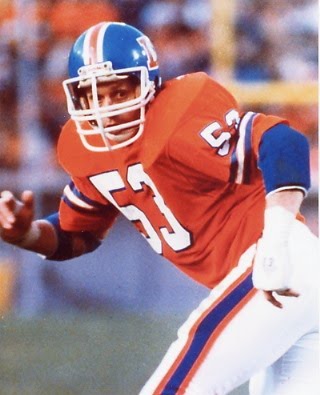
Randy Gradishar
6'3" 233
Linebacker
Denver Broncos
1973 - 1984
Ten Seasons
145 Games Played
20 Interceptions
4 Touchdowns
7 Pro Bowls
1978 NFL Defensive Player of the Year


Randolph Charles Gradishar was drafted in the first round of the 1973 draft by the Denver Broncos. He was the 14th player chosen overall.

He attended college at Ohio State University under legendary coach Woody Hayes. Hayes, who sent over 98 players to the professional football level in his Hall of Fame career, called Gradishar the finest linebacker he ever coached.

Not only is he a member of the schools All-Century Team and their Hall of Fame, but Radish is also a member of the College Football Hall of Fame. An excellent student in college, he is also inducted into the GTE Academic Hall of Fame and is on the ABC Sports All-Century team.

Denver brought him along slowly in his rookie year, starting just three of 14 games behind veteran Ray May. May was the 1971 NFL Man of the Year and a member of the Super Bowl V champion Baltimore Colts.

He started every game the next year, the last season the Broncos would run a base 4-3 defense during his tenure with the club. He was named to the Pro Bowl after grabbing three interceptions and taking one in 44 yards for a touchdown. He scored once again the following year off of another three picks and had seven quarterback sacks.

Denver went into the 1977 season running the 3-4 defense under coach Joe Collier. With players like Gradishar, Louis Wright, Tom Jackson, Bill Thompson, Reuben Carter, Bob Swensen, Lyle Alzado, and Barney Chavous, the Broncos had one of the most feared defenses in all of football history.

They were dubbed the "Orange Crush", and a soft drink named after them soon became very popular. Five members of the defense was named to the Pro Bowl that year and four were named First Team All-Pro, including Gradishar.

They led Denver to a 12-2 record and an appearance in Super Bowl XII. Though they lost the game, the defense left a permanent mark on NFL history with their excellence by allowing just 10.6 points per game that year.

Radish may have had his finest season the following year, where he was named NFL Defensive Player of the Year by both the Associated Press and UPI. He also was named the winner of the George Halas Award and Linebacker of the Year by Football Digest.

Denver's defense was second in the league in points allowed, and Gradishar was one of five Bronco defenders to go to the Pro Bowl.

Football Digest named him NFL Linebacker of the Year again in 1979. He was once again selected to the Pro Bowl.

Though he failed to make the Pro Bowl in 1980, he did take one interception a career long 93 yards for the last touchdown of his career. He was also named First Team All-NFL by the Sporting News.

Gradishar made the Pro Bowl the next three years before retiring after the 1983 season. He never missed a game in his entire career, an amazing feat for someone playing such a violent position where he had to give up his body on virtually every play to prevent the opponents from success.

Not only was he durable, very intelligent, quick on his feet, and a big hitter, but Gradishar was also a masterful technician. He had the innate ability to diagnose a play and was seldom fooled.

This, along with his foot speed, allowed him to defend just about any opponent on a pass play. This ability allowed Denver the luxury of blitzing their outside linebackers, knowing he could cover their assignments.

His specialty may have been the short-yardage situation. With a superb ability to sift would-be blockers, he often filled the holes the opposing running backs would run to. Though he didn't have the toothless snarl of Jack Lambert or easily seen nastiness of Dick Butkus, he was just as good as those two Hall of Famers.

Some of the best running backs in NFL history, Walter Payton and Tony Dorsett, are on record espousing his tremendous hitting ability. "The chance for a real good shot comes very seldom, but when it's there I take full advantage of it." Gradishar once said.

There have been few linebackers to take the gridiron on his level. He is a member of the Broncos Ring of Honor and Colorado Sports Hall of Fame. Why he has yet to be inducted into the Pro Football Hall of Fame is beyond bewildering. He has been a finalist twice and a semi-finalist four times.

Now he is in a gigantic pool of candidates in the Seniors Committee list. Though he should have long been inducted before he made it that far, he is caught in a quagmire of a selection process where no more than two candidates yearly can just make it to the final vote process.

It would behoove Canton to double that, allowing the Seniors Committee to try to induct at least four each year. The backlog of excellent players is too long, and it is frustrating seeing lesser modern players go in as superior players are caught in a numbers crunch that is much harder to win than a slots machine jackpot at a casino.

Watching a player as great as Randy Gradishar wait this long to get his deserved respect truly shows the ineptness of the Canton voter.

Though no one can question the recent inductions of linebackers like Andre Tippett, Ricky Jackson, and Derrick Thomas, no one would ever say that any were better football players than Gradishar.

Though deserving, it is a travesty the much more deserving Gradishar continues to wait on his rightful placement in the hallowed walls of Canton.


Tommy Nobis
6'2" 240
Linebacker
Atlanta Falcons
1966 - 1976
11 Seasons
133 Games Played
5 Pro Bowls
1966 NFL Rookie of the Year


Thomas Henry Nobis Jr. was the first draft pick ever by the expansion Atlanta Falcons in the 1966 NFL draft. He was also the first player chosen overall.

Nobis is a legend in Texas. He was was the only sophomore starter on the Longhorns' 1963 National Championship team.

No bis averaged nearly 20 tackles per game at Texas, and was a two-way player on teams that were ranked first in the nation at some point during each of his three years.

He graced the covers of Life, Sports Illustrated and Time magazines. Nobis won the Knute Rockne, Outland, and Maxwell Awards and finished seventh in the Heisman voting.

Nobis was selected to the Football News All-Time All-America Team, Sports Illustrated's All-Century Team, and the Walter Camp Football Foundation All-Century Team.

He is also a member of the Texas and Georgia State High School Halls of Fame, Thomas Jefferson High School Alumni Hall of Fame, the San Antonio Hall of Fame, the Longhorn Hall of Honor and the National Football Foundation College Hall of Fame.

Nobis started right away for the Falcons, and was very busy on a new team that struggled to a 3-11 record.

He set a Falcons record, that still stands today, when he amassed 294 tackles. It may be an NFL record, but that stat is unofficial and kept by individual teams.

He was named to the Pro Bowl and was the 1966 NFL Rookie of the Year.

Nobis intercepted the first three passes of his career the next season, and returned one for a touchdown. He was also selected to his second Pro Bowl and only First Team All-Pro honor.

In 1968, he was named to his third Pro Bowl, as the struggling Falcons went through a coaching change by hiring Hall of Famer Norm Van Brocklin after the third week of the season.

Nobis was injured in the fifth game of the following year, and missed the rest of the season. He came back in 1970 and was named to the Pro Bowl. He then was injured in the fourth game of the following season, and missed the rest of the year.

Nobis would only miss two games for the rest of his career. He made his last Pro Bowl in 1972, and also scored the last touchdown of his career.

The 1973 season would be the best record the Falcons had during Nobis' career. They went 9-5. Atlanta won 50 games in his eleven seasons.

His number 60 the first number retired by the team, and he is a member of the Falcons' Ring of Honor, Georgia Sports Hall of Fame, and the Atlanta Sports Hall of Fame.

He has also been named the NFL Man of the Year (Dodge and Vitalis), and Joseph P. Kennedy, Jr. award, due to his work with the Special Olympics as a member of the Falcons front office, and in his own foundation.

Nobis is on the NFL's All-1960s team, which is quite an accomplishment if you consider he didn't even play half of the decade.

It is TRULY astounding that 'Mr. Falcon' still has yet to be inducted into Canton. While he played on many lousy teams, but he was outstanding.

Atlanta got little publicity during his time as a player, but the voters cannot use this as an excuse. These voters are supposed to represent the whole NFL, not just the media driven franchises.

They are supposed to be experts, or at least this is what their positions as voters implies. The exclusion of Nobis for all of these years belies that thought.

Tommy Nobis epitomizes what a Hall of Fame football player is supposed to symbolize. Both on and off the field. It is truly disgraceful, and disrespectful, that he is not in Canton.
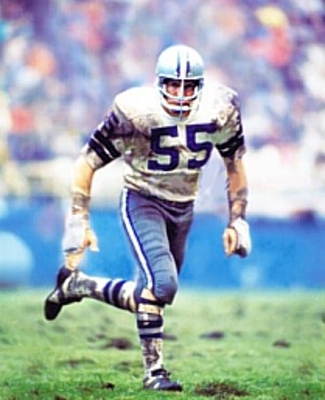


Lee Roy Jordan
6'1" 221
Linebacker
Dallas Cowboys
1963 - 1976
14 Seasons
186 Games Played
32 Interceptions
18 Fumble Recoveries
3 Touchdowns
1 Safety
5 Pro Bowls


Lee Roy Jordan was the Dallas Cowboys first draft pick of the 1963 draft. He was the sixth player chosen overall. Jordan was already a gridiron legend in college, after a spectacular career at Alabama University.

In his last game with Alabama in the Orange Bowl against Oklahoma University, Jordan piled up a whopping 30 tackles and was named the games MVP. He is a member of the Alabama Hall Of Fame and the College Football Hall Of Fame.

He only suited up for seven games in his rookie year, but started each game at outside linebacker on the left side. He ended up swiping three interceptions and recovering a fumble.

He was moved to middle linebacker in 1966 and would stay there the rest of his career. This was the time the famous "Doomsday Defense" was at its beginnings, and Jordan was the leader.

He picked off one pass that year and returned it 49 yards for a score that year. Jordan had three interceptions the next year for a career best 85 yards, while scoring another touchdown and recording a safety.

The Cowboys would end up making it to the 1967 NFL Championship Game before losing to the Green Bay Packers in the famous "Ice Bowl". He was named to the first of three consecutive Pro Bowls that season.

Jordan ended up playing in Super Bowl V, the first Super Bowl after the NFL/ AFL merger. The Cowboys ended up losing in the waning seconds to the Baltimore Colts in a game dubbed "The Blunder Bowl" because it was a game that featured 11 turnovers by both teams and 10 penalties against Dallas.

Jordan had two interceptions and a career best three fumble recoveries in 1971. The Cowboys would go on to beat the Miami Dolphins 24 - 3 in Super Bowl VI. It is the only Super Bowl where a team was prevented from scoring a touchdown.

Jordan had two more swipes in 1972, then had a career high six interceptions in 1973. In one game against the Cincinnati Bengals, Jordan picked off three passes in a five-minute span.

He took one ball for a 31 yard touchdown, and was named to the Pro Bowl after the season. He made his final Pro Bowl in 1974 after getting two interceptions.

The 1975 season saw Jordan tie his career high of six interceptions, while leading the Cowboys to Super Bowl X. The Cowboys ended up losing a close game to the Pittsburgh Steelers. Jordan again started every game in 1976, but did not record any turnovers for only the second time of his career.

He then retired after that season as the franchises all-time leader in tackles, and his 32 interceptions are still tied for the third most ever by a linebacker in NFL history. Jordan is a member of the Cowboys Ring Of Fame.

There are a few theories as to why Jordan still awaits his call to Canton. One is that he was a member of a fantastic defense that featured Hall Of Fame Defensive Tackle Bob Lilly, along with such greats as George Andrie, Chuck Howley, Jethro Pugh, Charlie Waters, Cornell Green, and Cliff Harris.

Then there is some that say is was because of the genius diagramming of Hall Of Fame Coach Tom Landry that the "Doomsday Defense" was so effective.

Others believe that the voters have some anti-Cowboys bias from that era as well. Maybe all those points have some validity, but you cannot ignore the facts that Jordan has placed in front of all to see through his play on the field.

He was a true leader who always gave it everything he had on every play without fail. Not only was he a tackling machine, but the man helped get the ball back for his teams offense over 50 times in his career.

Jordan gathered a turnover in every 3.72 games he played in his career, an outstanding percentage. His three interception game was named one of the ten most memorable moments in the history of Texas Stadium in 2008.

Not a big man in size or stature, Jordan's heart was immeasurable, and he was one of the top linebackers in the NFL almost every year that he played.

When you see the late Derrick Thomas of the Kansas City Chiefs inducted, though deservedly so, it can make one wonder. Thomas was known for just rushing the passer, and was not the complete player that Jordan was.

Lee Roy Jordan certainly is deserving of being inducted into the Pro Football Hall Of Fame.
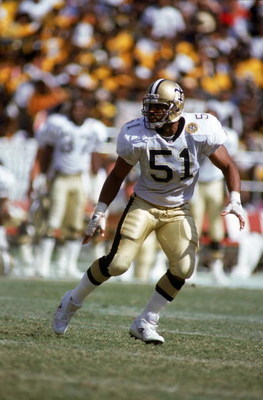


Sam Mills
5'9" 229
Linebacker
New Orleans Saints
1986-1997
12 Seasons
181 Games Played
23 Fumbles Recovered
4 Touchdowns
5 Pro Bowls


Samuel Davis Mills Jr. went undrafted in 1981, then tried out with the Cleveland Browns and was cut. He then tried out with the Toronto Argonauts of the Canadian Football League and was cut again.

The United States Football League began playing in 1983 and Mills tried out for the Philadelphia Stars. Not only did he make the team, he became an instant success. Nicknamed the "Field Mouse", the 5'9" Mills was known for his leadership and intensity both on and off the field.

The USFL folded after 1985, but it did have many successes. Six members of the USFL are inducted into the Pro Football Hall of Fame, including four players. Mills played in the USFL Championship Game all three seasons, winning twice. He is a member of the USFL All-Time Team, and was named All-USFL, their version of the Pro Bowl, all three years.

David Dixon created the USFL. He also was instrumental in bringing the Saints to New Orleans. His connections with the USFL proved to be valuable when that league folded as he signed many former USFL personnel.

He hired Jim Mora Sr. as his head coach, Bobby Hebert as his starting quarterback, Chuck Commiskey as a starting offensive guard, Buford Jordan as the starting fullback, Antonio Gibson as the starting strong safety, Mel Gray as the return specialist, and Mills and Vaughn Johnson as his starting inside linebackers. Mora had coached Mills, Commiskey, and Gibson in the USFL.

The Saints already had Hall of Famer Ricky Jackson at one outside linebacker slot, and had just drafted future Pro Bowler Pat Swilling to bookend him. Teamed with Mills and Johnson, New Orleans has one of the best linebacker corps in NFL history. The group was so devastating that they were called "The Dome Patrol".

Mills was the leader of the group and made his first Pro Bowl in his second season. He was always around the ball and averaged almost 100 tackles a year in his nine season with the Saints. He also took two fumble recoveries in for touchdowns and made the Pro Bowl four times total.

When his contract expired in 1994, the Saint allowed the 36-year old to leave despite the fact he had just piled up a career high 155 tackles that year for them. Mills signed with the expansion Carolina Panthers determined to show he had a lot of football still in him. He became an instant hero for the Panthers.

The 1996 season was one of his best. He was named to the Pro Bowl and was also given his only First Team All-Pro honor. Mills had a career best 5.5 sacks to go with 122 tackles and became the oldest player in NFL history to recover a fumble and return it for a score.

He retired after the 1997 season and became a linebackers coach for Carolina. He found out he had intestinal cancer and only had a few months to live in 2003, but kept coaching and pleading for his players to "keep pounding". This inspired Carolina to reach Super Bowl XXXVIII that year.

Mills died in 2005 and the Panthers have a statue of him outside of their stadium in his honor. He is a member of the Panthers Hall of Honor, the Saints Hall of Fame, the Louisiana Sports Hall of Fame, the Sports Hall of Fame of New Jersey, and the College Football Hall of Fame.

There is still a good chance Mills will be inducted into the Pro Football Hall of Fame one day. Though critics may say his five Pro Bowls with the NFL isn't enough for induction, that means they are discounting what he did in the USFL.

The USFL was professional football, and Mills was a huge star in that league. The building in Canton has the words Pro Football" engraved on their buildings, signs, and letterheads everywhere. The USFL obviously had tremendous impact and influence on the NFL as well.

His is a story of perseverance. The "American Dream" that became reality. Even if Mills never gets into Canton, he is probably the greatest inside linebacker the Saints franchise ever had wear their jersey.
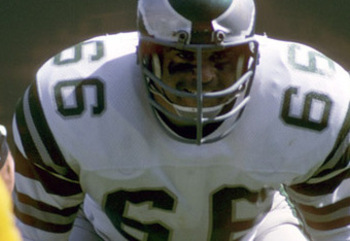


Bill Bergey
6'4" 243
Philadelphia Eagles
1969-1980
12 Seasons
159 Games Played
27 Interceptions
21 Fumble Recoveries
5 Pro Bowls


William Earl Bergey was drafted by the Cincinnati Bengals in the second round of the 1969 AFL draft out of Arkansas State and was an AFL All-Star in his first year. Bergey started for the Bengals for five years.

He was traded to the Philadelphia Eagles in 1974 for two first-round and one second-round draft picks because he had signed a "futures contract" with the World Football League.

The WFL folded, so he went to Philadelphia. With the Eagles, Bergey went to four straight Pro Bowls, and became the highest-paid defensive player in the league.

He earned Eagles MVP status three times. Bergey recorded 233 tackles in a single season with the Eagles. After Philadelphia lost to Oakland in Super Bowl XV, Bergey retired in 1980 with 48 turnovers, which means he got the ball back for his teams every 3.3 games.

Bergey is a member of the Bengals 40th Anniversary Roster, the Eagles Honor Roll, and the city of Buffalo's Hall of Fame. Though he was excellent in Cincinnati, it was with Philadelphia he enjoyed his best years in the NFL.

In his five years with the Bengals, Bergey had 9 interceptions and 6 fumble recoveries.

He accumulated 18 interceptions and 15 fumble recoveries in seven seasons as an Eagle.

He was a tackling machine that allowed fellow Eagle linebackers John Bunting, Frank LeMaster and Jerry Robinson to excel.

When you talk of the rich history of the Eagles, names like Van Buren, Bednarik, McDonald, White, Montgomery, Carmichael, and Bill Bergey roll off the tongues of most die hard Philly fans.

He may not get into Canton, but he is a Hall of Fame player in my book.
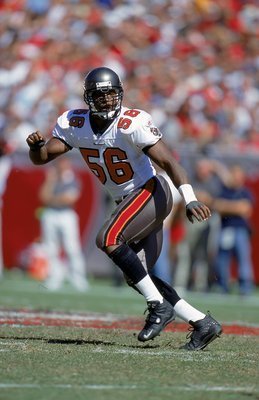


Hardy Nickerson
6'2" 230
Linebacker
Tampa Bay Buccaneers
1987-2002
16 Seasons
225 Games Played
1990s All-Decade Team
5 Pro Bowls


Hardy Otto Nickerson was drafted in the fifth round of the 1987 draft by the Pittsburgh Steelers. After spending his rookie year as a reserve, he soon moved into the starting lineup and became a solid member of the team.

He signed with the Buccaneers as a free agent in 1993, and blossomed in the 4-3 base defense that head coach Tony Dungy ran. He was named First Team All-Pro and to the Pro Bowl in his first season after setting a team record with a whopping 214 tackles that still stands today.

Though he never exceeded 147 tackles in a season for the rest of his career, Nickerson was the fiery, intelligent leader of the defense and was called "The Dragon" by teammates and fans.

In 1996, he went to the Pro Bowl again, something he would continue to do until 1999. He also was named First Team All-Pro in 1997, and was honored with the Byron "Whizzer" White NFL Man of the Year Award for his work in the community and country.

He became a free agent after his last Pro Bowl season of 1999, so he signed a contract with the Jacksonville Jaguars. He got hurt after six games, missing the rest of the season.

The 2001 season saw him get a career high three interceptions and nine defended passes. He then signed with the Green Bay Packers in 2002, then retired at the end of the season.

Nickerson is a member of the NFL 1990's All-Decade Second Team. No other Buccaneers middle linebacker has more tackles than him and he has the third most in team history.

His getting inducted into Canton may seem a long shot to some, but Nickerson's career stacks up next to some of the greatest middle linebackers in NFL history. His longevity also shows how tough he was and how much he had.
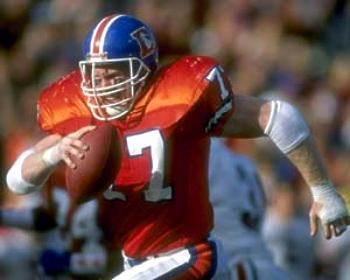


Karl Mecklenburg
6'3" 240
Linebacker
Denver Broncos
1983-1994
12 Seasons
180 Games Played
79 Sacks
6 Pro Bowls


Karl Bernard Mecklenburg was drafted in the 12th round of the 1983 draft by the Denver Broncos, the 310th player chosen overall. He made the team as a rookie, but started out playing defensive end.

He was able to work his way on the field by impressing the coaches with his determination. After getting a pair of sacks as a rookie, he was used as a pass rush specialist the next year and got seven more. He also picked off two passes and returned them for 105 yards.

Denver knew they had to find a way to get Mecklenburg on the field, and they also wanted to upgrade their linebacking unit. Joe Collier, the Broncos legendary defensive coordinator, decided to try him at inside linebacker.

Though he split time with incumbent starter Rick Dennison, Mecklenburg was still able to rack up a career high 13 sacks. He was named First Team All-Pro and to the Pro Bowl despite starting just nine games.

He took over as a full-time starter in 1986 and was named First Team All-Pro and to the Pro Bowl again after getting 9.5 sacks. Denver would reach the Super Bowl, but lost.

The Broncos would go back to the Super Bowl in 1987 and 1989, but lost each time. Mecklenburg was a big reason for their success. In 1987, he went to the Pro Bowl after getting the last three interceptions of his career.

He was named First Team All-Pro and to the Pro Bowl in 1989 after scoring the first touchdown of his career, which came off of a fumble recovery. He scored off another fumble the next year, as well as recording a safety.

From 1986 to 1997, Mecklenburg was one of the best linebackers in all of football. He wasn't just a pass rusher, though he did pile up 55.5 sacks over that time, but he was also a tackling machine.

Starting in 1986, Mecklenburg had at least 100 tackles every year until 1986 except for the 97 he had in the strike shortened 1987 season. He had 99 tackles in 1997. After getting 68 in 1998, his lowest total as a full-time starter, he retired.

Nicknamed the "Albino Rhino" by teammates, he has the second most tackles and sacks in Broncos history. His 180 games played are the third most ever as well.

No other Broncos linebacker has been to the Pro Bowl six times, and his three First Team All-Pro nods are tied as the second most in franchise history. He is a member of the Broncos Ring of Honor.

Mecklenburg was a winner, as shown by his helping Denver reach the Super Bowl three times. His was career not expected, so the term "self-made man" certainly applies in his care.

Through determination, he ended his career on the same level as Randy Gradishar. Many consider Gradishar the greatest Broncos linebacker ever, but Mecklenburg is not far behind.

Besides missing seven games in 1988, and one the next year, he took the field every time his team did. Consistent, tough, and fiery, Karl Mecklenburg had a career certainly worthy of induction into the Pro Football Hall of Fame.


Jessie Tuggle
5'11" 230
Linebacker
Atlanta Falcons
1987-2000
14 Seasons
209 Games Played
6 Touchdowns
5 Pro Bowls


Jessie Lloyd Tuggle Jr went undrafted in 1987 despite having a career at Valdosta State University that had him inducted into the College Football Hall of Fame. He signed with Atlanta and soon found himself starting at left inside linebacker after 1980 NFL Defensive Rookie of the Year Buddy Curry went down with a career-ending injury.

He split time with Joel Williams the next year, starting in eight games. He was still able to rack up 103 tackles and score a touchdown off of a fumble recovery. Atlanta then handed him the job full-time the rest of his career, and he missed just three starts over that time.

After getting 183 tackles in 1989, he had 201 tackles and a career high five quarterback sacks the next year. He also took a fumble 65 yards for a touchdown.

He followed that up in 1991 with a career-best 207 tackles, and scored again off of a fumble recovery. He also had his first career interception.

The 1992 season saw him finally get recognized as a Pro Bowler after somehow not being named in either of his two previous stellar seasons. He had 193 tackles, and interception, and he scored off a career-long 69 yard fumble recovery.

After getting 185 tackles the next year, he returned to the Pro Bowl in 1994 after getting 93 tackles. The 1994 season was the last time he exceeded 100 tackles, when he had 111.

He also had a career high three interceptions, the last of his career. One was returned for a touchdown, and he made the Pro Bowl again.

After making the Pro Bowl in 1997, he made his last Pro Bowl the next year. He also scored his last touchdown, which happened off of a fumble recovery.

The Falcons would reach Super Bowl XXXIII, their only championship appearance in franchise history, but lost.

He had 3.5 sacks in 1999, but missed two games. After missing half of the 2000 season, he retired with a Falcons record of 1,640 tackles.

His five fumble recoveries for touchdowns was an NFL record until Jason Taylor of the Miami Dolphins surpassed it by one in 2009.

"The Hammer" has his jersey retired by the Falcons, and he is a member of the team's Ring of Honor.

Tommy Nobis may be the best Falcon middle linebacker ever, but Tuggle is right up there with him. Being the ultimate team player that he was, Tuggle still has a shot at induction into the Pro Football Hall Of Fame.
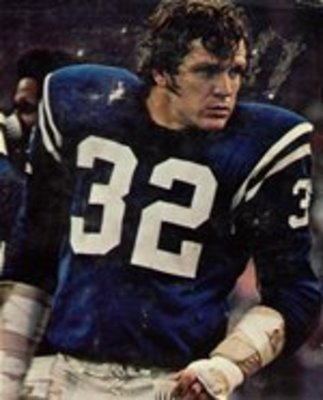


Mike Curtis
6'3" 232
Linebacker
Baltimore Colts
1965-1978
14 Seasons
166 Games Played
25 Interceptions
3 Touchdowns
4 Pro Bowls
1970 AFC Defensive Player of the Year


James Michael Curtis was drafted in the first round of the 1965 NFL Draft by the Baltimore Colts. He initially played fullback and even ran the ball six times as a rookie, as well a catching a pass.

The Colts switched him to linebacker the next year, where he played on the weak side. Though he started seven games in 1966, he did score off a fumble recovery. He got hurt in the third game of 1967, missing the rest of the year.

Curtis rebounded strong in 1968, helping lead the Colts to Super Bowl III after being named First Team All-Pro and to the Pro Bowl. In Baltimore's first playoff game against the Minnesota Vikings, Curtis took a fumble 60 yards for a touchdown.

He had an interception in the Colts 34-0 win over the Cleveland Browns in the NFL Championship and helped hold Cleveland's powerful running game to 58 yards.

Baltimore switched him to middle linebacker in 1969. Curtis responded by being named First Team All-Pro. He got a career best five interceptions in 1970, helping the Colts win their division.

After getting an interception in a first round win over the Cincinnati Bengals, he picked off another pass in Super Bowl V as the Colts defeated the Dallas Cowboys 16-13.

He was named the AFC Defensive Player of the Year by the NFL 101 Club for all of his accomplishments that year.

He was a captain on the Colts most of his time with them, known for his intensity and mean streak. Many called him the meanest player of his era.

He made the Pro Bowl in 1971 and 1974 again for Baltimore, and was named the team MVP in that 1974 season. He got hurt in 1975 and was able to play just six games.

The Colts left him exposed to the expansion draft, so the Seattle Seahawks grabbed him. He was moved to outside linebacker again, where he started every game.

Curtis, who grew up in suburban Maryland, asked to be traded closer to home. Seattle acquiesced by dealing him to the Washington Redskins before the 1977 season. Curtis retired after 1978.

Many fans who saw him play think Curtis is one of the most underrated middle linebackers of his era, in spite of the many accolades he attained. They point to Hall of Famers like Willie Lanier and Nick Buoniconti being in his way of more Pro Bowl accolades.

The fact is that Curtis was more than a vicious hitter who brought violent collisions. He was very athletic, being one of the very first players to ever retire with at least 20 interceptions and sacks in a career.

His 21 interceptions with Baltimore is still the third most ever by a Colts linebacker. His presence also helped fellow linebackers, and Colts legends, like Stan White and Hall of Famer Ted Hendricks be even more effective.

As the years pass, his chances for going into Canton dwindle. Yet Mike Curtis certainly did have a career worthy of induction into the Pro Football Hall of Fame.

Sunday, December 27, 2009

The Greatest Washington Redskins Not In Canton


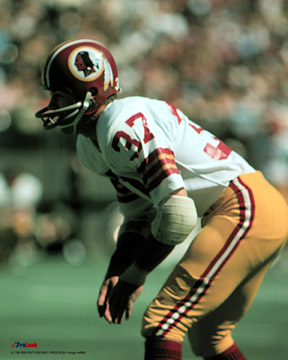
Chris Hanburger
Washington Redskins
Linebacker
6'2" 220
1965 - 1978
14 Seasons
187 Games Played
19 Interceptions
5 Touchdowns
9 Pro Bowls
1972 NFC Defensive Player of the Year


Christian G. Hanburger was an 18th Round draft choice of the Redskins in 1965, played right away and was in the Pro Bowl by his second year in the league.

He would then begin a string of Pro Bowl appearances until 1969. He then resumed that string in 1972 until 1976. Sacks and tackles were not recorded in those days, but Hanburger was a play maker. He is considered one of the best of his era. He was known for his blitzing ability and pass coverage.

Ever the complete player, he returned three fumbles for touchdowns, third most in NFL history, in his career to go with two more on interceptions.

In 1972, Hanburger captained the Over The Hill gangs defense to a Super Bowl appearance, and was named the NFC Defensive Player of the Year.

Hanburger was known not only for good speed, but his exceptional quickness. He had the innate ability to diagnose a play before the ball was hiked. He often would cover the other teams tight end and peel off to knock passes down meant for wide receivers. Coach George Allen liked to have a safety first defense, leaving the rest to Hanburger and his fellow linebackers.

Chris Hanburger's nine Pro Bowl appearances are still the most by any player in the entire history of the Washington Redskins. His four First Team All-Pro honors is tied with Hall Of Famer Sammy Baugh as the most ever by any Redskin.

He is a member of the Redskins Ring Of Fame and 70 Greatest Redskins Team.

The game was played different for the most part in his era. The running game was most teams primary weapon. Tackling with sound fundamentals was a must then. Few players lead with their heads for "kill shots" because they would be injured much faster than today with innovations of modern technology on equipment nowadays.

It also should be remembered that players then did not command the same level of salaries that they do today. Most players would work a second job in the off season, compared to the luxury players have today to train whenever they choose to.

As a kid, I once heard a long time local media type say that he figured Hanburger had over 50 quarterback sacks in his career. This, coupled by the facts that are allowed in the record book truly says that there is NO DOUBT that Chris Hanburger SHOULD BE in the NFL Hall of Fame.

You can help Chris get his respect by signing this petition : http://www.ipetitions.com/petition/chrishanburgerhof/


Pat Fischer
5'9" 170
Cornerback
1961 - 1977
17 Seasons
213 Games
56 Interceptions
941 Yards
4 Touchdowns
3 Pro Bowls


Patrick Fischer was a 17Th round draft choice of the Saint Louis Cardinals in 1961. He returned a few punts and kick offs in his Cardinal career, as well as catching one pass for 22 yards in his rookie year. He made two Pro Bowls in 1964 and '65 for Saint Louis.

He signed with Washington as a free agent in 1968, and made the 1969 Pro Bowl team. He was the teams shut down cornerback on the 1972 Super Bowl team. NFL Films listed Fischer as the Redskins All-Time Neutralizer in the 1980's.

Fischer is still all over the Cardinals record books. He is fifth most interceptions with 29, fifth in interception return yardage with 529, third in interceptions returned for touchdowns with three, third in consecutive games with an interception by accumulating five, ninth longest for the longest interception return for a touchdown when he took it 69 yards in 1967.

In 1964 he returned two interceptions for touchdowns, which ranks second in Cardinals history. Fischer also ranks third for most interceptions in a season for the Cardinals, when he snared 10 in 1964.

He also ranks seventh in Redskin history with 27 interceptions, and fourth ain interception return yardage with 412. When he retired, Fischer had played in a then-NFL record for games played by a cornerback with 213.

Fischer may appear small to those who never saw him play, but those who did know better. His battles with Philadelphia Eagles 6'8" wide receiver Harold Carmichael were legendary. Fisher often was also matched up against Dallas Cowboys wide receiver "Bullet" Bob Hayes, the fastest man in the world at one time.

He was a rough "bump and run" style defender full of tricks. One common move he would use was, if an opponent had to catch a pass over his head, Fischer would punch him in the gut or jaw. He made many plays versus the pass, but also excelled in run support.

Teams would often work away from Fischer and Ken Houston, when passing, due to their propensity of returning interceptions for touchdowns for the Redskins. Pat Fischer played in an era where defenders had to work harder. The 10 yard chuck rule was not changed to 5 yards until the 1979. Wide receivers also had to work harder to get open in that era.

The rushing attack was the primary weapon, and run support from defensive backs was a must in that era. Players like Deion Sanders may have been relegated to only punt return duty back then, possibly nickel back. Fischer also excelled on special teams, which was a must for head coach George Allen and special teams coach Marv Levy, who are both in the Pro Football Hall Of Fame.

He is a member of the Redskins Ring Of Fame and 70 Greatest Redskins Team.

Fischer had an excellent career. Is it worthy of Canton? After seeing how long it took a superstar like Emmitt Thomas to get in, and how a long list of former great cornerbacks like Louis Wright, Ken Riley, Lester Hayes, and others are not in yet, it may be a long shot.

Still, after looking at how his numbers compare with those cornerbacks that are inducted, there is no doubt in my mind that Pat Fischer should be in the Pro Football Hall of Fame.
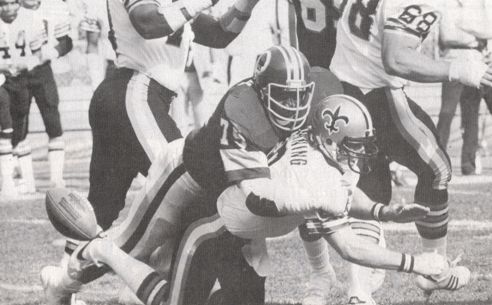


Jerry Smith
6'3" 208
Tight End
1965- 1977
13 Seasons
168 Games Played
421 Receptions
5,496 Yards Receiving
60 Touchdowns
2 Pro Bowls


Jerry was drafted in the ninth round of the 1965 draft by Washington and wasn't used much by the head coach, Otto Graham, in his rookie year. He caught 19 passes for two touchdowns that year. Charley Taylor, then a halfback, was the primary weapon. Jerry was a back up wide receiver initially, but with two Hall of Famers, Taylor and Bobby Mitchell, as the primary targets of the newly acquired Hall of Fame QB Sonny Jurgensen, Graham decided to move Smith to tight end.

Jerry was used much like you now have seen Sterling Sharpe or Antonio Gates used. This was a trend setting move that allowed Smith to explode onto the NFL scene. In his second season, Smith caught 54 balls for 686 yards and six TD's. Smith had his best season as a pro in his third year. He caught 67 passes for 849 yards and 12 TD's.

He then caught 45, 54, and 43 passes the next three years to go with 24 TD's. Smith was hurt early in 1971 and only managed 16 catches with one score. He was never quite the same again.

In the Redskins Super Bowl year of '72, Smith did catch seven touchdowns on only 21 receptions. The following year he did not get into the end zone on 19 catches.

Finally showing signs of health in 1974, Smith caught 44 passes for 554 yards with three touchdowns from Billy Kilmer, who never threw to the TE much. The next year Smith caught 31 balls for 391 yards and three touchdowns.

Injuries besieged Smith in his final two years, and with newly acquired Jean Fugett now starting, Smith managed eight catches for 2 scores.

Smith retired with a then-NFL record 60 touchdown catches for tight ends. He finished second All-Time behind Mike Ditka for receptions and yards receiving by a tight end.

To this day, he ranks first in Washington Redskin history for tight ends in catches, yards receiving and touchdowns. He is also tied with three others with 12 TD's caught in a season. He is tied with ten other Redskins with three touchdowns in one game, something he did twice.

His team record 67 catches, in 14 games, for a tight end in a single season was surpassed by Chris Cooley, in 16 games, in 2005. Smith still ranks third in Redskin history in touchdown catches, and fourth in receptions overall in Redskins history.

While Smiths statistics may pale in today's modern game, one must remember that the NFL "chuck" rule was 10 yards in his playing days. It was a much rougher game as well back then. Clotheslines were frequent, as were players diving at each others knees. If Smith had the luxury of only a 5 yard chuck rule, his statistics surely would have increased.

Smith may never be inducted into Canton. He died at the age of 43 in 1986 of AIDS. He never had told anyone that he was a homosexual, but was outed by former team mate and lover, running back David Kopay (the first NFL player to announce his being gay) shortly after Smiths death. Kopay has asserted the NFL's homophobia in those days was so prevalent, that once he had announced he was gay, several coaching offers were rescinded.

Not that much has changed nowadays, as Jeremy Shockey's comments on the Howard Stern show revealed, but there is a hope that the NFL Senior Committee can look past the mans lifestyle and the politics involved.

Smith retired with superior stats comparatively to Hall of Fame tight ends such as John Mackey. He retired only 6 catches short of Ditka's then-NFL tight end reception record as well.

He is a member of the Redskins Ring Of Fame and 70 Greatest Redskins Team.

Jerry Smith may be a controversial subject to some. Even after everything that can be said for, or against him, his statistics tell a steadfast story. Smith was lauded by Sports Illustrated as a top pass catching tight end during his era. His legend on the gridiron still shines bright today, 31 years after his retirement. Maybe some will say he is on the fringe for induction, or that I'm being biased due to the Redskins being my favorite team as well.

Maybe these things are true.

Still, in my eyes, Jerry Smith belongs in the Pro Football Hall of Fame.


Russ Grimm
6'3" 273
Guard
1981-1991
11 Seasons
140 Games Played
4 Pro Bowls


Russell Scott Grimm was a third round draft pick by the Redskins in the 1981 draft. He played 14 games that year, and started in 11 of them. This was during a time where a young group of blockers would bond under the leadership of coach Joe Bugel and veteran offensive tackle George Starke to form one of the greatest offensive lines in NFL history. This was when "The Hogs" were born.

This nickname was given to them as they prepared for the 1982 season by Bugel. The season was shortened to nine games because of a players strike, and the WildCard Redskins blew right through the playoffs riding the backs of the Hogs. Washington then won their first Super Bowl, thanks to the blocking of the unit and the running of Hall Of Famer John Riggins.

Grimm made his first Pro Bowl in 1983, and the Redskins returned to the Super Bowl before losing to the Los Angeles Raiders. It was the first of his four consecutive Pro Bowl nods, and the first of three straight First Team All-NFL honors.

He also was a versatile athlete who was listed as the teams emergency quarterback. The 1987 season showed off his athleticism, when he had to start five games at center for the injured Jeff Bostic, then was injured himself. The Redskins went on to win their second Super Bowl.

He battled through injuries the next three years, and started in 24 of the 32 games he was able to play. After starting in just one games in 1991, he retired after the Redskins won their third Super Bowl in ten years that season.

Since his retirement, he has gone on to become one of the top offensive line coaches in the league. His name has come up often when teams are considering who to hire as a head coach. He has also been a finalist for induction into the Pro Football Hall Of Fame four times so far, and hopefully will soon find his way in Canton.

Russ Grimm is usually the first person thought of when "The Hogs" are discussed. He was a gritty blue collar player who was a key component of the Redskins famed counter trey play. His ability to pull was the primary reason the play was unstoppable, even though opponents knew it was coming.

He is a member of the Redskins Ring Of Fame, and is one of the 70 Greatest Redskins.


Gene Brito
6'1" 226
Defensive End
1951 - 1960
Nine Seasons
97 Games Played
47 Receptions
2 Touchdowns
5 Pro Bowls


Genaro Herman Brito was drafted in the 17th round of the 1951 draft by the Redskins. He was a 26 year old rookie, having spent time in the Armed Forces defending the United States in World War II.

The Redskins used him on offense a lot in his first two years, and Brito grabbed 47 passes and two touchdowns over that time. Disenchanted with his role, he then went to play for the Calgary Stampeders of the Canadian Football League with Redskins quarterback Eddie LeBaron. He was named to the All-Conference Team in his lone season with them.

Both players returned to the Redskins in 1955, and Washington put Brito exclusively at defensive end for the rest of his career. He was named NFL Player of the Year by the Washington D.C. Touchdown Club that year, and would go to the Pro Bowl in each of the five seasons he played in Washington.

He was named MVP of the 1958 Pro Bowl, the first Redskin to ever accrue that honor.

Brito was considered on of the best defensive lineman of the 1950's. Hall Of Famer Paul Brown once wanted to put a Cleveland jersey on him because "Brito was more in my backfield than his own". He also received the Presidential “Seal of Approval” from both Richard M. Nixon and John F. Kennedy for his high level of play at the end position. Both presidents referred to him as their favorite player.

He was so popular that he hosted a television show called "The Gene Brito Show", which was shown just before the actual games were played. He is considered one of the first players in NFL history to do this.

He joined the Los Angeles Rams in 1959, but was only able to play two games because of injuries. He returned in 1960 to play 11 games and was named Second Team All-NFL. He then retired.

Gene Brito is a member of the Redskins Ring Of Fame and 70 Greatest Redskins Team, and his three First Team All-NFL accolades are the second most in franchise history. No other defensive end in team history has appeared in as many Pro Bowls as he did in his career. He is one of the most popular Redskins ever, and their best defensive end ever. He is certainly worthy of induction into Canton.


Lemar Parrish
5'11" 181
Cornerback
1970 - 1982
13 Seasons
166 Games Played
47 Interceptions
13 Fumble Recoveries
13 Touchdowns
8 Pro Bowls


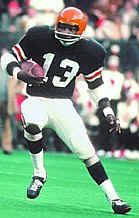
Lemar was drafted in the seventh round of the 1970 draft by the Cincinnati Bengals. He was incredible in his rookie season, getting five interceptions, and scoring a touchdown on both a punt return and kickoff return. He averaged 30.1 yards per kick return and also scored on a blocked field goal return. He would go to the Pro Bowl in each of his first two seasons.

He followed that up next season with seven interceptions. He took one interception 65 yards for a touchdown, and one fumble for a touchdown. In 1972, Parrish picked off five passes and took two in for touchdowns. He also returned a punt for a touchdown. In 1973, he has two interceptions and returned a fumble for a touchdown.

The 1974 season saw Parrish returned to the Pro Bowl by setting a still standing Bengals record with an NFL leading 18.8 yards per punt return average. He also scored two touchdowns on punt returns. One went for 90 yards and is presently the second longest in Bengals history. He also recovered a fumble and took it 47 yards for a touchdown.

He would go to the Pro Bowl every year up until the 1977 season. In 1977, Parrish had three interceptions and took one in for the last touchdown of his career.

After the 1977 season, Parrish was traded to the Redskins, after a contract dispute, with defensive end Coy Bacon by the Bengals to Washington for the Redskins’ first-round pick in the 1979 draft. That first-round pick ended up being the 12th overall selection, which Cincinnati used to pick running back Charles Alexander out of Louisiana State.

Parrish was not asked to return kicks on the Redskins, yet still made a immediate impact on the Redskins defense his first year with four interceptions. The next year, he had nine interceptions and was named First Team All-NFL and to the Pro Bowl.. He followed that up with seven interceptions in 1980, and was named to his last Pro Bowl. Parrish left the Redskins after 1981, and joined the Buffalo Bills in 1982. He retired after that year.

Lemar Parrish is the Bengals All-Time leader in touchdowns scored by "return or recovery" with 13. This is still tied third All-Time in NFL history with two others. His two interceptions returned for TDs is still tied for the most in a game, with many others in NFL history. He was also the only player in Cincinnati history ever to score two "return or recovery" touchdowns in a single game, which he did separate 3 times.

When he retired, his three fumble returns for touchdowns tied an NFL record. He still fourth All-Time in Bengals history for interceptions in a career, and second in touchdowns scored by interception.

His four punt returns for touchdowns ranks first in Cincinnati Bengals history. He also is first in career average for kickoff returns with 24.7, touchdowns in a season on kick off returns, interceptions made in one game, and touchdowns returned via interceptions in a season and a single game.

He ranks second in Bengals history with 130 punt returns, and punt return yardage in a season and career. He is third in franchise history in interception return yardage in a career. His 95 yard kick off return currently is the sixth longest in Bengals history.

Parrish did not win the 1970 Rookie of the Year Award probably because the Bengals had two players win the award the two previous seasons, even though he had a superior season to the winner, 49ers CB Bruce Taylor.

Lemar Parrish is a member of the Cincinnati Bengals 40th Anniversary Team.

Parrish epitomized the definition of "play maker" in his career. He was a shut down cornerback who teams tried to avoid. He would make the opponents cringe when he was asked to return kicks or punts. Parrish teamed with Ken Riley to form, perhaps, the best cornerback duo in the NFL in the 1970's.

He was also noted for his ability to stop the run, which is something he had to supply often due to the Bengals porous front seven. Safety Tommy Casanova was a beneficiary of this cornerback tandem, and made 3 Pro Bowls from 1972 to 1977. Casanova retired after Parrish left the Bengals.

Teams could not beat the Bengals by passing the ball, but they would win by running the ball up the middle. The Bengals often challenged the great Steelers teams of the 1970's, but would come up short. The pass defense was never the reason.

While with the Redskins, Parrish also made fellow cornerback Joe Lavender a better player. Lavender made the Pro Bowl twice in his career, the same years that Lemar did. Parrish was a complete player. He could do it all. His penchant for taking the ball to the end zone was prodigious. He made his teams better, his teammates better, and now is teaching his students to be better.

Every year of his career saw him intercept at least one ball, except for his 1974 Pro Bowl season. To be named to the Pro Bowl by your peers, despite having no interceptions, truly shows his greatness and is an example of how opposing teams feared him. The following two Pro Bowl years of 1975 and '76 are further examples to make this fact concrete, because he had three interceptions total over this time.

I find it amazing to see Lemar Parrish yet to be inducted into Canton. Recent inductee Roger Wehrli went in with finally, so hopefully the voters are going to right long standing wrongs. It would be fitting to see Parrish and Riley inducted together.


Len Hauss
6'2" 235
Center
1964-1977
14 Seasons
196 Games Played
5 Pro Bowls


Leonard Moore Hauss was drafted in the ninth round of the 1964 draft by the Redskins. He soon earned a starting job by the fourth game of his rookie year, and would hold onto it the rest of his career. Hauss never missed a game in his entire career. His 14 years with the team is tied as the third most in franchise history.

He made his first Pro Bowl in 1966, then would make it three straight seasons between 1968 to 1970. The 1972 season was his last as a Pro Bowler, but he remained an upper echelon player for years in a decade where great NFC centers like Mick Tinglehoff, Jeff Van Note, Forrest Blue, and others were perennial Pro Bowl players as well.

When he retired after the 1977 season, he was the only center in Redskins history to attain five Pro Bowl honors. Jim Schrader is second with three Pro Bowls.

There is no doubt that Len Hauss is the greatest center in team history. He is a member of the Redskins Ring Of Fame, and is one of the 70 Greatest Redskins.


Coy Bacon
6'4" 270
Defensive End
1968 - 1981
14 Seasons
180 Games Played
130 Sacks
2 Touchdowns
3 Pro Bowls


Leander McCoy Bacon was an undrafted rookie signed by the Los Angeles Rams right before the 1968 season. Bacon had just come from playing in the Continental Football League. Coy had signed with the Charleston Rockets in 1966, after leaving Jackson State University upon completion of his sophomore year. While playing with the Rockets, Coy was named an CFL All-Star in 1966. Other NFL luminaries like Bill Walsh, Ken Stabler, and Garo Yepremian also were in the Continental Football League. .


Coy joined a Rams team that had one of the best defensive lines in football, featuring Hall Of Famers Deacon Jones and Merlin Olsen. They were called "The Fearsome Foursome", and Bacon played just seven games as a reserve in his rookie year.

He cracked the starting lineup the next year, and started 13 games at defensive tackle. He was moved to defensive end in 1970, recorded 20 sacks,and took a fumble 14 yards for a touchdown. Bacon then had 21 sacks and intercepted a pass the next year. He made his first Pro Bowl Team in 1972, and then was traded to the San Diego Chargers after that season as part of a blockbuster deal.

He picked off a pass that year for San Diego, and took it 80 yards for a touchdown. Bacon also led the Chargers in sacks in two of his three seasons with them.

Right after the 1975 season, the Chargers traded Bacon to the Cincinnati Bengals for Hall Of Fame Wide Receiver Charlie Joiner. Coy responded with 21.5 sacks, 2 fumble recoveries for 48 yards and a safety. He was named to the Pro Bowl Team. He then made his last Pro Bowl Team the next year for the Bengals, despite missing two games.

The Bengals then traded Bacon to the Washington Redskins right before 1978. Coy was the pass rusher the Redskins desperately needed, and he recorded double digits in sacks in each of his first three seasons with them.

He was 39 years old in 1981, and started the three games he played before being injured for the rest of the season. The Redskins released him in the off season, but Coy was not done playing. He joined the Washington Federals of the USFL in 1983, and had a few good games. He then retired for good after that year.


Bacon played in an era where sacks were not a recorded statistic. Some researchers have credited him with over 130 sacks in his career. If you discount the three games he played in 1981, you can easily see he averaged 10 sacks every year of his career. That includes his first two seasons as a defensive tackle.

He was one of the best pass rushers I have seen play the game. He was noted as a character who would not like to practice during the week of a game, reserving his energies for Sunday. He wasn't always stout against the run in the latter part of his career, but he made several spectacular plays when his team needed it most.

Coy recently passed away, and may be a fringe player for many as far as induction into Canton. Yet I look at a guy like Fred Dean get in and wonder why Coy is not. He was just as good a pass rusher, played on lesser defensive lines, meaning the primary focus was on him, and was better versus the run than Dean.

Coy Bacon is a victim of times passing, as the newer voters don't probably know who he is. He never played on any teams that won anything, so he never got the press he probably deserved. But even if you look at the statistics, you can see he is worthy of induction into the Pro Football Hall Of Fame.


Others?

There are other current and former Redskins who will possibly be inducted into Canton one day, and others who appear on their way.

Brian Mitchell


Chris Samuels


Champ Bailey


Joe Jacoby


Jim Lachey


Jason Taylor


Chris Cooley

Wednesday, December 31, 2008

COY BACON


Coy Bacon
6'4" 270
Defensive End
1968 - 1981
14 Seasons
180 Games Played
130 Sacks
2 Touchdowns
3 Pro Bowls


Leander McCoy Bacon was an undrafted rookie signed by the Los Angeles Rams right before the 1968 season. Bacon had just come from playing in the Continental Football League. Coy had signed with the Charleston Rockets in 1966, after leaving Jackson State University upon completion of his sophomore year. At JSU, Bacon played Linebacker and Defensive End. While playing with the Rockets, Coy was named an All Star as a Defensive End in 1966. Other NFL luminaries like Bill Walsh, Ken Stabler, and Garo Yepremian also were in the Continental Football League. Coy Bacon is a member of the JSU Hall Of Fame.


Coy joined a Rams team that had one of the best defensive lines in football, featuring Hall Of Famers Deacon Jones and Merlin Olsen. They were called "The Fearsome Foursome", and Bacon played just 7 games as a reserve in his rookie year. Coy cracked the starting lineup the next year, and started 13 games at Defensive Tackle. He was moved to Defensive End in 1970, recorded 20 sacks,and took a fumble 14 yards for a touchdown. Bacon then had 21 sacks and intercepted a pass the next year. Coy made his first Pro Bowl Team in 1972, and then was traded to the San Diego Chargers after that season as part of a blockbuster deal. He picked off a pass that year, and took it 80 yards for a touchdown. Bacon also led the Chargers in sacks in 2 of his 3 seasons with them. Right after the 1975 season, the Chargers traded Bacon to the Cincinnati Bengals for Hall Of Fame Wide Receiver Charlie Joiner. Coy responded with 21.5 sacks, 2 fumble recoveries for 48 yards and a safety. He was named to the Pro Bowl Team. Coy then made his last Pro Bowl Team the next year for the Bengals, despite missing 2 games. The Bengals then traded Bacon to the Washington Redskins right before 1978. Coy was the pass rusher the Redskins desperately needed, and he recorded double digits in sacks in each of his first 3 seasons with them. Coy was 39 years old in 1981, and started the 3 games he played before being injured for the rest of the season. The Redskins released him in the off season, but Coy was not done playing. He joined the Washington Federals of the USFL in 1983, and had a few good games. He then retired for good after that year.


Coy played in an era where sacks were not a recorded statistic. Some researchers have credited him with over 130 sacks in his career. If you discount the 3 games he played in 1981, you can easily see he averaged 10 sacks every year of his career. That includes his first 2 seasons as a Defensive Tackle. Bacon was one of the best pass rushers I have seen play the game. He was noted as a character who would not like to practice during the week of a game, reserving his energies for Sunday. He wasn't always stout against the run in the latter part of his career, but he made several spectacular plays when his team needed it most. Coy recently passed away, and I held off this post as a respect and waiting period. He is a fringe player for many as far as induction into Canton, but I look at a guy like Fred Dean get in and wonder why Coy is so. He was just as good a pass rusher, played on lesser defensive lines (meaning the primary focus was on him), and was better versus the run. Coy Bacon is a victim of times passing, as the newer voters don't probably know who he is. He never played on any teams that won anything, so he never got the press he probably deserved. But even if you look at the statistics, you can see Coy Bacon is worthy of induction into the Pro Football Hall Of Fame.


Notable Players Drafted In 1968 * Denotes Hall Of Fame

1. Ron Yary, OT, Minnesota *
2. Bob Johnson, C, Cincinnati
3. Claude Humphrey, DE, Atlanta
4. Russ Washington, DT/ OT, San Diego
8. Larry Csonka, FB, Miami *
9. Haven Moses, WR, Buffalo
11. Greg Landry, QB, Detroit
13. MacArthur Lane, RB, St. Louis Cardinals
14. Tim Rossovich, LB, Philadelphia
15. Forrest Blue, C, San Francisco
23. John Williams, OT, Baltimore Colts
26. Bill Lueck, G, Green Bay
31. Curley Culp, DT, Denver
33. Charlie West, DB, Minnesota
42. Bob Atkins, DB, St. Louis
43. Bill Lenkaitus, C, SanDiego
47. John Garlington, LB, Cleveland
48. Mike Livingston, QB, Kansas City
52. Ken Stabler, QB, Oakland
69. Skip Vanderbundt, LB, San Francisco
73. Dick Anderson, DB, Miami
74. Charlie Sanders, TE, Detroit *
77. Elvin Bethea, DE, Houston Oilers *
80. Art Shell, OT, Oakland *
81. Dick Himes, OT, Green Bay
82. Paul Robinson, RB, Cincinnati
84. Jess Phillips, RB, Cincinnati
98. Johnny Fuller, DB, San Francisco
105. Jim Beirne, WR, Houston
110. Charlie H. Smith, RB, Oakland
117. Mike Bragg, P, Washington
118. Jim Kiick, RB, Miami
124. Mark Nordquist, G, Philadelphia
127. Cecil Turner, WR, Chicago
130. Blaine Nye, G, Dallas
156. Essex Johnson, RB, Cincinnati
159. D.D. Lewis, LB, Dallas
167. Oscar Reed, RB, Minnesota
176. Bob Brunet, RB, Washington
181. Willie Holman, DE, Chicago
190. George Atkinson, DB, Oakland
222. Paul Smith, DT, Denver
249. John Outlaw, DB, Boston Patriots
261. Tommy Hart, DE, San Francisco
275. Greg Brezina, LB, Atlanta
277. Marv Hubbard, RB, Oakland
288. Henry Davis, LB, NY Giants
289. Rich Coady, C, Chicago
291. Dennis Partee, K, San Diego
297. John Pergine, LB, LA Rams
301. Bob Trumpy, TE, Cincinnati
305. Jim Cheyunski, LB, Boston
317. Jeff Queen, RB, San Diego
323. Harold Jackson, WR, Los Angeles Rams
330. Charlie Greer, DB, Denver
351. Dean Halverson, LB, LA Rams
357. Marlin Briscoe, WR, Denver
375. Robert Holmes, RB, Kansas City
417. Rocky Bleier, RB, Pittsburgh
428. Larry Cole, DE, Dallas
441. Bob Lee, QB, Minnesota

Tuesday, November 4, 2008

LEMAR PARRISH


Lemar Parrish
5'11" 181
Cornerback
Cincinnati Bengals
1970 - 1982
13 Seasons
166 Games Played
47 Interceptions
13 Fumble Recoveries
13 Touchdowns
8 Pro Bowls


Lemar Parrish was selected by the Cincinnati Bengals in the seventh round of the 1970 NFL Draft. He was the 163rd player picked overall that year. Parrish went to college at Lincoln University of Missouri. Parrish was a Running Back in college. In 1969, Lamar set the schools record for for longest punt return, when he returned a punt 95 yards for a touchdown against Southwest Missouri State. He also set school records for most punt return yards in a game (129 yards on 3 returns), and highest average per punt return in that game (43 YPR). That year, Parrish averaged 16.8 yards per punt return. That, and his career average of 15.5 YPR, are still school records. He made the NCAA All American Team in 1969. Lemar Parrish is the most famous athletic figure in the schools history since the 1950's, when tennis great Althea Gibson taught there, and Canadian Football League Hall of Fame Running Back Leo Lewis attended the school. Parrish has returned to his alma mater, and is the head coach of the schools football team. Lemar Parrish is in the Lincoln University Hall of Fame.


In his 1970 rookie season, Parrish was incredible. Parrish had 5 interceptions,and scored a touchdown on both a punt return and kickoff return. He averaged 30.1 yards per kick return and recovered a fumble. He also scored on a blocked field goal return. He followed that up next season with 7 interceptions. He took one interception 65 yards for a touchdown, and one fumble for a touchdown. In 1972, Parrish picked off 5 passes and took 2 for touchdowns. He also returned a punt for a touchdown. In 1973, he has 2 interceptions and returned a fumble for a touchdown. In 1974, Parrish set a still standing Bengals record with an NFL leading 18.8 yards per punt return average. He also scored 2 touchdowns on punt returns. One went for 90 yards and is presently the 2nd longest in Bengals history. He also recovered a fumble and took it 47 yards for a touchdown. In 1977, Parrish had 3 interceptions and took one in for the last touchdown of his career.
After the 1977 season, Parrish was traded to the Redskins after a contract dispute. Parrish was traded with defensive end Coy Bacon by the Bengals to Washington for the Redskins’ first-round pick in the 1979 draft. That first-round pick ended up being the 12th overall selection, which Cincinnati used to pick running back Charles Alexander out of Louisiana State. Parrish was not asked to return kicks on the Redskins. Parrish made a immediate impact on the Redskins defense his first year with 4 interceptions. The next year, he had 9 interceptions. He followed that up with 7 interceptions in 1980. Parrish left the Redskins after 1981, and joined the Buffalo Bills in 1982. He retired after that year.

Lemar Parrish is the Bengals All Time leader in touchdowns scored by "return or recovery" with 13. This is still tied 3rd All Time in NFL history with 2 others. Parrish’s two interceptions returned for TDs is still tied for the most in a game, with many others in NFL history. He was also the only player in franchise history ever to score 2 "return or recovery" touchdowns in a single game, which he did separate 3 times. When he retired, his 3 fumble returns for touchdowns tied an NFL record. He still 4th All Time in Bengals history for interceptions in a career, and 2nd in touchdowns scored by interception. His 4 punt returns for touchdowns ranks 1st in Cincinnati Bengals history. He also is 1st in career average for kickoff returns with 24.7, and touchdowns in a season on kick off returns. Parrish also is 1st in Bengals history with interceptions made in one game, touchdowns returned via interceptions in a season and a single game. He ranks 2nd All Time with 130 punt returns. He also ranks 2nd in Bengals history for punt return yardage in a season and career. He is 3rd in franchise history in interception return yardage in a career. His 95 yard kick off return currently is the 6th longest in Bengals history. Parrish did not win the 1970 Rookie of the Year Award probably because the Bengals had 2 players win the award the two previous seasons, even though he had a superior season to the winner, 49ers CB Bruce Taylor. When he left the Bengals, Parrish was the Bengals All Time leader in punt return yards in a career and season. Lemar Parrish is a member of the Cincinnati Bengals 40th Anniversary Team.

Lemar Parrish epitomized the definition of "play maker" in his career. He was a shut down Cornerback who teams tried to avoid. He would make the opponents cringe when he was asked to return kicks. Parrish teamed with Ken Riley to form, perhaps, the best CB duo in the NFL in the 1970's. Parrish was noted for his ability to stop the run, which is something he had to supply often due to the Bengals porous front seven. Safety Tommy Casanova was a beneficiary of this tandem, and made 3 Pro Bowls from 1972 to 1977. Casanova retired after Parrish left the Bengals. Teams could not beat the Bengals by passing the ball,but they would win by running the ball up the middle. The Bengals often challenged the great Steelers teams of the 1970's, but would come up short. The pass defense was never the reason. While with the Redskins, Parrish also made fellow CB Joe Lavender a better player. Lavender made the Pro Bowl twice in his career, the same years that Parrish did. Parrish was a complete player. He could do it all. His penchant for taking the ball to the end zone was prodigious. He made his teams better,his teammates better, and now is teaching his students to be better. I find it amazing to see Lemar Parrish yet to be inducted into Canton. Recent inductee Roger Wehrli went in with finally, so hopefully the voters are going to right long standing wrongs. It would be fitting to see Parrish and Riley inducted together.


Notable Players Drafted In 1970 (* Denotes Canton Inductee)

1. Terry Bradshaw, QB, Pittsburgh *
7. Mike Reid, DT, Cincinnati
9. Cedric Hardman, DE, San Francisco
10. Ken Burrough, WR, New Orleans
13. Doug Wilkerson, OG, Houston
17. Bruce Taylor, CB, San Francisco
18. Norm Bulaich, FB, Baltimore
19. Steve Owens, RB, Detroit
22. Jack Reynolds, LB, LA Rams
23. Duane Thomas, RB, Dallas
24. Raymond Chester, TE, Oakland
29. Jim Mandich, TE, Miami
30. Dennis Shaw, QB, Buffalo
31. Leo Brooks, DT, Houston
36. Joe "Turkey" Jones, DE, Cleveland
39. Art Malone, RB, Atlanta
43. Bill Brundige, DE, Washington
46. Richard Caster, WR, NY Jets
53. Mel Blount, DB, Pittsburgh *
55. Tim Foley, DB, Miami
66. Charlie Waters, DB, Dallas
76. Gerald Irons, DE, Oakland
80. Ed George, OT, Pittsburgh (CFL Hall of Fame)
110. Ron Saul, OG, Houston
114. Manny Sistrunk, DE, Washington
153. Pat Toomay, DE, Dallas
159. Jake Scott, DB, Miami
201. Mike Holmgren, QB, Saint Louis Cardinals
204. Rich Saul, OG, LA Rams
218. Jim Otis, FB, New Orleans
248. Joe Dawkins, RB, Houston
259. Stu Voight, TE, Minnesota
287. Butch Davis, DB, Chicago
335. Mark Washington, CB, Dallas
346. Mark Moseley, K, Philadelphia
348. Doug Sutherland, DT, New Orleans

Monday, October 20, 2008

DICK LeBEAU

Dick LeBeau
6'1" 185
Cornerback
Detroit Lions
1959 - 1972
14 Seasons
185 Games Played
62 Interceptions
9 Fumble Recoveries
4 Touchdowns
3 Pro Bowls


Charles Richard LeBeau was a 5th round draft pick of the Cleveland Browns in the 1959 draft. He was the 58th player picked overall. He went to college at Ohio State University. There, he played under Woody Hayes as both a Running Back and Cornerback. He was a key member of the Buckeyes 1957 National Championship team. During that season, he had one of the best games of collegiate career against arch rival Michigan University. He scored two touchdowns in the Buckeyes 31-14 win.


LeBeau did not make the Browns team, and was cut in training camp. He would then be picked up by the Detroit Lions. He played 6 games in his rookie year, mostly on special teams. He did recover the first fumble of his career that season. In 1960, LeBeau earned the starting job at Cornerback opposite newly acquired Hall of Famer Dick "Night Train" Lane. The Lions defense also had Hall of Fame MLB Joe Schmidt, Hall of Fame Defensive Tackle Alex Karras, Hall of Fame Safety Yale Lary and Pro Bowl Safety Terry Barr. LeBeau picked off 4 passes. The next 3 seasons, LeBeau and Lane formed the best Cornerback tandem in the NFL. LeBeau picked off 3 passes in 1961, then 4 in 1962. He scored the first two touchdowns of his career that year, by interception and fumble recovery. In 1963, LeBeau picked off 5 passes and returned them for 158 yards. He also returned one interception 70 yards for a touchdown. LeBeau would then make his first of 3 consecutive Pro Bowl appearances in 1964. That season also marked Larys last in the NFL, and Lane played only 7 games. LeBeau still managed 5 interceptions that year. 1965 was the last year for both Lane and Schmidt. LeBeau picked off 7 passes and returned one for the last touchdown of his career. 1966 would be LeBeaus last Pro Bowl season, when he intercepted 4 passes. LeBeau stayed steady the next several years. He picked off 4 passes in 1967, opposite of Hall of Fame Cornerback Lem Barney under new coach, and former team mate, Joe Schmidt. LeBeau and Barney would then team up for the next 3 years as one of the best CB tandems in the league. LeBeau then had 5 picks in 1968. In 1969, he snatched 6 interceptions. 1970 saw Dick LeBeau have a career high 9 interceptions. At 34 years old in 1971, LeBeau would intercept 6 passes. 1972 would be the last year as a Detroit Lion for LeBeau and Schmidt. LeBeau was moved to Free Safety that year, and would not intercept a pass for the first time since his rookie season. He did recover the last fumble of his career that year.


Dick LeBeau only retired from the NFL as a player after 1972. He went into coaching in 1973 for the Philadelphia Eagles as a Secondary Coach. He stayed with the team until 1975. He then held the same duties with the Green Bay Packers from 1976 to 1979. In 1980, he moved to the Cincinnati Bengals. He served as a Secondary Coach, and as Defensive Coordinator with the Bengals until 1991. LeBeau then served as the Defensive Coordinator for the Pittsburgh Steelers from 1992 to 1996. This is when LeBeau would gain notoriety for inventing the now commonly used "Zone Blitz" defense. The Steelers defense featured such greats as Hall of Fame Cornerback Rod Woodson, All Pro Linebackers Greg Lloyd, Hardy Nickerson, Levon Kirkland, Chad Brown, Kevin Greene, Jason Gildon and Strong Safety Carnell Lake. They would go to the Super Bowl after the 1995 season. In 1997, LeBeau returned to the Bengals as a Defensive Coordinator. He would then be named Head Coach of the Bengals in 2000, and held that job until 2002. LeBeau then worked for the Buffalo Bills in 2003. He returned to the Pittsburgh Steelers in 2004, and is still the Defensive Coordinator of the Steelers today. In 2005, the Steelers won Super Bowl XL. Dick LeBeau is one of the most respected coaches in NFL history, obviously, and is called "Coach Dad" by his players. Dick LeBeaus playing career alone should have him inducted into Canton by now. If inducted, he would be the first player from the 1959 NFL Draft to make it. He is a member of the Detroit Lions Legends. His 62 interceptions are the most in the history of the Detroit Lions.


If you just look at his coaching career alone, he is worthy of induction. If you put both factors together, it is a no brainer. I cannot fathom what the voters hold up is. There in NO QUESTION about it, Dick LeBeau belongs in the Pro Football Hall of Fame right now!


Notable Players Drafted In 1959 (None are a Canton Inductee Yet)


2. Dick Bass, FB, Los Angelos Rams
3. Bill Stacy, DB, Chicago Cardinals
5. Dave Baker, DB, San Francisco
6. Nick Pietrosante, FB, Detroit
15. J.D. Smith, OT, Philadelphia
17. Bob L. Harrison, LB, San Francisco
19. Mike Rabold, G, Detroit
21. Rich Petitbon, DB, Chicago Bears
22. Buddy Dial, WR, NY Giants
23. Dick Shafrath, OT, Cleveland
25. Bowd Dowler, WR, Green Bay
26. Wray Carlton, RB, Philadelphia
28. Emil Karas, LB, Washington
29. Eddie Dove, DB, San Francisco
34. Joe Morrison, RB, NY Giants
35. Fran O'Brien, OT, Cleveland
41. Monte Clark, DT, San Francisco
44. John Tracey, LB, LA Rams
47. Dave Lloyd, LB, Cleveland
49. Bob Wetoska, OT, Washington
53. John Wooten, G, Cleveland
80. Eddie Meador, DB, LA Rams
102. Bobby Joe Green, P, San Francisco
119. Bob Zeman, DB, Cleveland
123. Art Powell, WR, Philadelphia
125. Harry Jacobs, LB, Detroit
141. Mike Connelly, C, LA Rams
164. Joe Robb, DE, Chicago Bears
167. Elbert Dubenion, WR, Cleveland
173. Bruce Maher, DB, Detroit
177. Roger LeClerc, LB, Chicago Bears
209. Joe Kapp, QB, Washington
219. Alan Miller, FB, Philadelphia
223. Dave Kocourek, TE, Pittsburgh
242. Dale Memmelaar, G, Chicago Cardinals
249. Donnie Stone, RB, Chicago Bears
250. Jim Fraser, LB, Cleveland
266. Fred Glick, DB, Chicago Cardinals
313. Timmy Brown, RB, Green Bay
319. Charley Tolar, FB, Pittsburgh
331. Ron Hall, DB, Pittsburgh
353. Jim Colclough, WR, Washington

Tuesday, September 30, 2008

KEN RILEY

Ken Riley
5'11" 181
Cornerback
Cincinnati Bengals
1969 - 1983
15 Seasons
207 Games Played
65 Interceptions
596 Yards
5 Touchdowns
4 All Pro Teams


Kenneth Jerome Riley was a 6th round draft pick of the Cincinnati Bengals in 1969. He was the 135th player picked overall. Riley was a 4 year starter at quarterback for Florida A&M University. Riley also earned a Rhodes Scholar Candidacy in college. He was his Senior Class President in both high school and college. Riley was recently named one of the 33 greatest high school football players in the history of the state of Florida, and is on the Florida High School Association All-Century Team. After retiring from the NFL, Riley returned to A&M to resurrect their athletics program. Riley was the head coach of the football team for 8 years from 1986 - 1993, then the athletic director of the school from 1993 - 2002. He was a two-time MEAC Coach of the Year and was named Black College Coach of the Year in 1988. Ken Riley is a member of the Florida A&M Hall of Fame, the Florida Sports Hall of Fame, the Tallahassee Sports Hall of Fame and the Polk County (Fla.) Sports Hall of Fame.


Cincinnati head coach Paul Brown converted Riley to the cornerback in training camp. Riley responded with 4 interceptions his rookie year. He returned 14 kickoffs at an average of 23.9 YPR. Riley also caught the only 2 passes of his career that year. Riley recorded 65 interceptions in his career, which was the fourth most in Pro Football history at the time of his retirement. The first three are all in Canton. At present time, Riley is 5th All Time. Riley languished on some mediocre teams in his era and was never given his due, despite his solid and spectacular efforts. In his 15 seasons, Riley recorded 3 or more interceptions in all but 3 years. In 1976, Riley snared 9 picks, a team record that stood for 30 years, for 141 yards. Riley returned 1 for a touchdown. He also set a team record by intercepting 3 passes in one game that season. Riley matched that feat again in 1982. In 1981 he recorded 5 interceptions as the Bengals went to Super Bowl XVI. In 1983, Riley recorded 8 interceptions for 2 touchdowns. He retired after that season. His 65 interceptions for 596 yards, and 5 touchdowns are all still Bengals records. He also recovered 18 fumbles in his career. Riley is also third all-time in NFL history with 141 INT return yards in a season. He was also as the Bengals’ defensive captain for eight seasons from 1976-83.


The Bengals had moderate success in the 1970's, but happened to be in a division that was dominated by the Pittsburgh Steelers. Still the Bengals had, perhaps, the best CB duo in the 70's with Riley and Lemar Parrish until 1977. It was usually the Bengals run defense or running game that caused them to come up short in that decade. Riley was a quiet, scholarly man who was made of substance and preferred to let his play be the flash to his persona. He rarely missed a game in his career, and was the constant defensive force for the Bengals throughout his entire career. While Ken Anderson, Parrish, and others got the press, Riley got the results needed for the Bengals to be able to compete weekly. His is a career many may have forgotten due to his workman-like approach, but have no illusions. Ken Riley is most definitely deserving of being inducted into the NFL Hall of Fame. It is long, long overdue.


Notable Players Drafted In 1969 * Denotes Canton Inductee

1. O.J. Simpson, RB, Buffalo *
4. Joe Greene, DT, Pittsburgh *
7. Ted Kwalick, TE, San Francisco
11. Bill Stanfill, DE, Miami
13. Fred Dryer, DE, NY Giants
16. Gene Washington, WR, San Francisco
19. Roger Wehrli, CB, St. Louis Cardinals *
20. Ron Johnson, RB, Cleveland
24. Calvin Hill, RB, Dallas
31. Bill Bergey, LB, Cincinnati
33. Ted Hendricks, LB, Baltimore Colts *
39. Ed White, OG, Minnesota
41. Bobby Douglass, QB, Chicago
48. Ed Podolak, RB, Kansas City
56. Jon Kolb, C, Pittsburgh
63. Eugene "Mercury" Morris, RB, Miami
69. Bill Bradley, S, Philadelphia
80. Bob Kuechenberg, OG, Philadelphia
93. Charlie Joiner, WR, Houston Oilers *
96. Roy Gerela, P, Houston
99. John Zook, DE, LA Rams
101. Jack Rudnay, C, Kansas City
139. Harold McLinton, LB, Washington
238. L.C. Greenwood, DE, Pittsburgh
262. Jeff Van Note, LB, Atlanta
273. John Fuqua, RB, NY Giants
337. Carl Mauck, LB, Baltimore
338. Steve O'Neal, P, NY Jets