Showing posts with label Los Angeles Rams. Show all posts

Wednesday, March 23, 2011

Isiah Robertson


Isiah Robertson
6'2" 225
Linebacker
Los Angeles Rams
1971 - 1982
12 Seasons
168 Games Played
25 Interceptions
15 Fumbles Recovered
4 Touchdowns
6 Pro Bowls
1971 Defensive Rookie of the Year


Isiah B. Robertson was a first round draft choice by the Los Angeles Rams in the 1971 NFL Draft. He was the tenth player chosen overall. Robertson hailed from Southern University, where he became the school's first College Division All-America selection as a senior in 1970.

He is a member of the school's athletic Hall of Fame, the Southwest Conference Hall of Fame, the Greater New Orleans Sports Hall of Fame, and the Louisiana Sports Hall of Fame. Robertson still holds the school record of returning an interception 102-yards for a score.

While at Southern, the football team was stacked with future NFL players. Some of his teammates included Hall of Famer Mel Blount, Harold Carmichael, Al Beauchamp, Ken Ellis, Ray Jones, Richard Neal, Jim Osborne, Alden Rouche, Lew Porter, Donnel Smith, and Harold McLinton.

When Robertson joined the Rams, the famous "Fearsome Foursome" front line was nearing the end of their glory days. They still had Hall of Famers Merlin Olsen and Deacon Jones, as well as Pro Bowler Coy Bacon, but Jones would leave the Rams at the end of the season and Bacon would join him with the San Diego Chargers in 1973.

Los Angeles just lost legendary linebacker Maxie Baughan, who should be in Canton, to retirement. Robertson stepped into that vacant spot and stood out right away. He got a career best four interceptions and was named to the Pro Bowl. He was also named the NFL Defensive Rookie of the Year, beating out such future Hall of Famers like Jack Ham and Jack Youngblood, as well as legends like Jack Tatum, Lyle Alzado, Phil Villapiano, Mike Wagner, and Dwight White, for the honor.

He returned to the Pro Bowl in 1973, as well as earning a First Team All-Pro honor. He scored once off of three of his interceptions that year. It was the first of five consecutive Pro Bowl seasons for Robertson.

Known for blazing speed mixed in with high intelligence and a knack for always being around the ball, Robertson became one of the NFL's top outside linebackers in the 1970's. He matched his career best total of four interceptions in 1975, yet gained a career high 118 yards. One swipe went 76-yards for a score, the longest ever by a Rams linebacker.

The 1976 season was his last being named First Team All-Pro, but he went to the Pro Bowl one last time the next year. He was hurt much of the 1978, causing him to miss three games, as well as eight starts. They would be the only games of his career that Robertson missed.

The Rams traded Robertson to the Buffalo Bills just before the 1979 season. Buffalo signed him to a contract extension that made Robertson one of the highest paid linebackers in the league. He picked off two balls that year, both of which happened in one game against the Cincinnati Bengals. He took one ball 23 yards for the last touchdown of his career.

The Bills had a young linebacking unit with Jim Haslett, Lucius Sanford, Shane Nelson, and Chris Keating. All would be key ingredients in the Bills resurgence, and Robertson served as their mentor.

Buffalo had not won their division since 1966, when they were members of the American Football League. The 1975 season was the only time they had made the playoffs since the AFL merged with the NFL in 1970, but they lost in the first round. The Bills won 11 games in 1980, which was the most wins they had since winning the 1964 AFL Championship.

The Bills won their division again in 1981, helped by a pair of interceptions by Robertson. Buffalo would win their first playoff game since winning the 1965 AFL title before losing to the Bengals, who eventually reached Super Bowl XVI, that year.

The 1982 season is best known for losing seven games to a players strike. Robertson started in all nine games, picking off a pass. He informed Buffalo that he was retiring at the end of the year, so Darryl Talley was drafted to take over.

Once clocked at 4.5 in the 40-yard dash, Robertson was more than a linebacker with blazing speed. It is no coincidence that most of the defensive units he suited up for ended up being amongst the best in the NFL yearly.

The Rams were ranked first in defense in both 1974 and 1975, and gave up the fewest points. Los Angeles would reach the NFC Championship Game thrice in his eight season with them. His reuniting with Chuck Knox was no mystery. Knox, who took over as the Bills head coach in 1978, was Robertson's head coach with the Rams from 1973 to 1977. Knox knew Robertson would help Buffalo start winning again, which they did.

Sacks and tackles were not recorded statistics in his era, but Robertson was often seen crashing off the edge to lay into the opposing quarterback. He was also superior in pass coverage, often seen shutting down a tight end or running back all game. A sound technician, Robertson also was known for bone-crunching hits at high speeds.

He had a knack for the big play much of his career. In a 1974 playoff game against the Washington Redskins, he picked off a pass thrown by Hall of Famer Sonny Jurgensen. Robertson then proceeded to hurdle several men and break four tackling attempts on his way to a 59-yard touchdown that sealed a 19-10 win for the Rams.

Hall of Famer Les Richter is the only Rams linebacker who appeared in the Pro Bowl more than Robertson. His six Pro Bowls is tied with five other Rams as the most in team history. Robertson is the only Rams linebacker ever to be named First Team All-Pro twice.

No other Rams linebacker has more interceptions or yards returned off of interceptions than Robertson, as well as his having the longest interception return ever by a Rams linebacker. His two scores off of interceptions is second to Jack Pardee as the most ever.

He is fourth, behind Richter, Pardee, and "Hacksaw" Jack Reynolds, for having the most fumble recoveries ever by a Rams linebacker. While he played just four years in Buffalo, only five Bills linebackers have more interceptions than him.

Consistent, dependable, tough, fast, and smart. Though Hall of Famers like Ham, Ted Hendricks, and Bobby Bell were chosen on the 1970s NFL All-Decade Team, Robertson was worthy as well. Bell went to one Pro Bowl in 1970 and none more until he retired in 1974. Hendricks went to four Pro Bowls that decade.

The 1970's had some of the greatest outside linebackers in NFL history. Ham, Hendricks, and Bell are joined by Chris Hanburger and Dave Wilcox enshrined into the Pro Football Hall of Fame. Yet it is a neglected position in Canton as well. Men like Baughan, Robert Brazile, Chuck Howley, and Matt Blair join Robertson on hoping Canton awakes and finally inducts them.

What makes the situation sadder is to see one-dimensional outside linebackers like Andre Tippett, Derrick Thomas, and Rickey Jackson get inducted in the last decade while a long list of equal or better players like Robertson still wait. Though worthy, they basically spent their careers rushing the passer while the more well-rounded players are now going three or four decades since they retired.

If you want the big play, Robertson provided it. Of you want steady consistency that never came off the field and could cover all aspects of defense, Robertson provided it. If you need accolades, he provides that as well.

Since retiring as a player, he has created a message called "Run To Win" in a long-term resedential recovery program for men he named "House of Isaiah". It helps youths keep clear of drugs. Robertson also works with the Special Olympics. If you want to see some rare video football of him scoring touchdowns, laying out crushing tackles, as well as doing spectacular things while possessing the football, visit www.isiahrobertson.com.

There is little to no argument about the worthiness of his inclusion into Canton. When one looks at his whole body of work, it is easy to see that Isiah Robertson should be inducted into the Pro Football Hall of Fame.


Notable Players Drafted In 1971 * Denotes Hall of Fame Inductee

1. Jim Plunkett, QB, New England Patriots
2. Archie Manning, QB, New Orleans Saints
3. Dan Pastorini, QB, Houston Oilers
4. J.D. Hill, WR, Buffalo Bills
6. John Riggins, RB, New York Jets *
8. Frank Lewis, WR, Pittsburgh Steelers
9. John Brockington, RB, Green Bay Packers
14. Clarence R. Scott, CB, Cleveland Browns
19. Jack Tatum, FS, Oakland Raiders
20. Jack Youngblood, DE, L.A. Rams
22. Don McCauley, RB, Baltimore Colts
27. Julius Adams, DE, Patriots
34. Jack Ham, LB, Steelers *
43. Dan Dierdorf, OT, Saint Louis Cardinals *
45. Phil Villapiano, LB, Raiders
56. Lynn Dickey, QB, Oilers
57. Jim Braxton, FB, Buffalo Bills
67. Ken Anderson, QB, Cincinnati Bengals
79. Lyle Alzado, DE, Denver Broncos
99. Joe Theismann, QB, Miami Dolphins
104. Dwight White, DE, Steelers
105. Larry Brown, OT, Steelers
142. Doug Dieken, OT, Browns
147. Mel Gray, WR, Cardinals
161. Harold Carmichael, WR, Philadelphia Eagles
206. Ron Jessie, WR, Dallas Cowboys
230. Vern Den Herder, DE, Dolphins
268. Mike Wagner, FS, Steelers
272. George Starke, OT, Washington Redskins


Monday, February 14, 2011

Winston Hill


Winston Hill
6'4" 270
Offensive Tackle
New York Jets
1963 - 1977
15 Seasons
198 Games Played
174 Consecutive Starts
8 Pro Bowls
AFL All-Time Team


Winston Cordell Hill was a 11th round draft pick by the Baltimore Colts in the 1963 NFL draft. He was the 145th player chosen overall. Hill went to Texas Southern University, where he was an All-American player who played along the line on both offense and defense. Hill is a member of the Texas Southern Sports Hall of Fame.

The Texas Southern roster was stacked with great players at the time. Many went on to play professional football. Men like Charlie Frazier, W.K. Hicks, Willis Perkins, Art Strahan (the uncle of future Hall of Famer and Texas Southern Alumni Michael Strahan), Warren Wells, Andy Rice, B.W. Cheeks, Gene Jeter, and Hill's close friend Homer Jones, who invented the spiking of the ball after a touchdown.

The Colts had just drafted future five-time Pro Bowler left tackle Bob Vogel in the first round, and would later draft future Colts greats like Willie Richardson, Jerry Logan, and Hall of Famer John Mackey. Hill decided to join the New York Jets of the American Football League.

He quickly found himself starting at left tackle for the Jets. He missed one game that season, but would never miss another game in his entire time in New York. Though the Jets struggled in his first few years, Hill made the Pro Bowl in just his second season.

Fortunes began to change for the better with the Jets in 1965. They drafted future Hall of Fame quarterback Joe Namath. With Hill protecting the blindside of "Broadway Joe" under the direction of Hall of Fame coach Weeb Ewbank, Namath was able to throw often to Hall of Fame wide receiver Don Maynard and Jets greats like George Sauer, Emerson Boozer, and Matt Snell.

As the Jets had the first winning season in franchise history during 1967, Hill would begin a string of seven consecutive Pro Bowl appearances. This highlight of his career came in 1968, when the Jets defeated the Colts in Super Bowl III.

Not only was Hill excellent at pass blocking, but he was also dominating when the Jets ran the ball. The Jets had just coaxed six-time Pro Bowl guard Bob Talamini, who had already won two AFL Championships with the Houston Oilers, out of retirement for one year to play next to Hill. The Jets won 11 games that year, a total they would not match again until 1985.

Hill was seemingly indestructible in an era where blockers were at the mercy of defenses. Blockers in that era were not allowed to extend their arms like they do today, forced to tuck their hands by their chest to resemble a chicken wing. This did not prevent Hill from starting in 174 straight games.

He manned left tackle until 1976 for the Jets. Namath decided to join the Los Angeles Rams in 1977, and he got his good friend and protector to go with him. Hill suited up for three games that year, but decided to retire after the third game.

Not only did Hill help bring the Jets their only championship in franchise history, but he helped make Namath a star. Namath led the league in passing yards three times, including the first 4,000-yard passing season in professional football history.

There is no question that Hill is the greatest blocker in Jets history, and many of the teams fans would tell you he is also the best player the franchise has ever had as well. His eight Pro Bowls are the most in team history, and his 174 consecutive starts are ranked tenth best in pro football history.

Hill is a member of the AFL Hall of Fame and AFL All-Time Team, as well as an inaugural member of the Jets Ring of Honor. Namath, Ewbank, Maynard, and Curtis Martin joined him in the ceremonies.

The disrespect of the AFL is quite evident by his exclusion from the Pro Football Hall of Fame. Of the 10 offensive linemen on the AFL All-Time Team, which also includes Talamini, only Ron Mix, Billy Shaw, and Jim Otto are inducted. Only 12 of the 48 players on the AFL All-Time Team are members of Canton's exclusive club.

How the voters keep overlooking the AFL can only be attributed to lingering envy and anger that the NFL had for the league when it existed. The AFL played an exciting brand of football and won two of the four Super Bowls between the leagues, including the last two, before the merger of the AFL and NFL was completed. Not bad for a league the NFL liked to call a "Mickey Mouse League" before being forced to merge to save their own product.

Yet it all started with Hill's Jets shocking the football world by soundly defeating the supposedly heavily-favored Colts. Though most recall Namath guaranteeing a win before he game, it is unlikely he would have made such a boast if Hill was not there to protect him.

It is obvious Winston Hill should be inducted into Canton. His eight Pro Bowls are proof, and it must be noted he went to four Pro Bowls after the merger too. This proves not only was he amongst the best in AFL history, but he was one of the very best in all of professional football.

The New York media is given a lot of hype for creating hype for their local teams, but they have dropped the ball here. They need to honor their past better and make a bigger push for Hill to finally get his rightful respect and place in the Pro Football Hall of Fame.


Notable Players Drafted In 1963 * Denotes Hall of Fame Inductee

NFL

2. Jerry Stovall, S, Saint Louis Cardinals
5. Bob Vogel, OT, Baltimore Colts
6. Lee Roy Jordan, MLB, Dallas Cowboys
7. Pat Richter, TE, Washington Redskins
8. Kermit Washington, CB, San Francisco 49ers
13. Don Brumm, DE, Saint Louis
14. Dave Robinson, OLB, Green Bay Packers
17. Bob Reynolds, OT, Saint Louis
18. Ray Mansfield, C, Philadelphia Eagles
19. John Mackey, TE, Baltimore *
21. Walt Rock, OT, San Francisco
35. Ron Snidow, DE, Washington
44. Paul Flatley, WR, Minnesota
47. Jerry Logan, S, Baltimore
88. Lee Roy Caffey, OLB, Philadelphia
89. Willie Richardson, WR, Baltimore
102. Tom Woodeshick, FB, Philadelphia
129. Jackie Smith, TE, Saint Louis *
136. Bill Nelsen, QB, Pittsburgh Steelers
152. Karl Kassulke, S, Detroit Lions
157. Chuck Walker, DT, Saint Louis
220. Andy Russell, OLB, Pittsburgh
241. Larry Stallings, OLB, Saint Louis
259. Jim Turner, K, Washington
278. Homer Jones, WR, New York Giants

AFL

1. Buck Buchanan, DT, Kansas City Chiefs *
2. Walt Sweeney, OG, San Diego Chargers
4. Dave Behrman, C, Buffalo Bills
8. Ed Budde, OG, Kansas City
9. Jim Dunaway, DT, Buffalo
21. Tom Janik, S, Denver Broncos
46. Sam Silas, DT, Boston Patriots
48. George Saimes, S, Kansas City
49. Dave Costa, DT, Oakland Raiders
50. Mickey Slaughter, QB, Denver (Notable College Coach)
56. Bobby Bell, OLB, Kansas City *
60. Hewritt Dixon, RB, Denver
85. Billy Joe, RB, Denver
88. Jerrell Wilson, RB / P, Kansas City
188. Daryle Lamonica, QB, Buffalo
192. Dave Hill, OT, Kansas City
211. Dave Herman, OG, New York Jets
219. Mike Taliaferro, QB, NY Jets


Sunday, February 6, 2011

2011 Pro Football Hall Of Fame Class : NFL Voters Wake Up And Almost Get It Right


Some of my regular readers know I have a series of articles, Crazy Canton Cuts, that is dedicated to gridiron greats not yet inducted into the Pro Football Hall of Fame.

When I first started my series, the first player I profiled was Washington Redskins legend Chris Hanburger. Not only was I astonished and irked by his exclusion, I decided to try to find a way to get him his overdue respect. The year was 2008 and I quickly found several fans who agreed with me.

I was interviewed for an article on the Washington Times by legendary sportswriter David Elfin. Elfin was raised in the District of Columbia are and was a true Redskins fan. In fact, Elfin led the charge to get Art Monk, a great Redskins wide receiver, finally inducted just a few years ago. Having him as an ally in my mission proved to be immeasurable.

I found it strange that Hanburger had barely scratched the selection process when eligible. His nine Pro Bowls were the most in the illustrious history of the Redskins, let alone the most by any player not yet inducted. He also was named First Team All-Pro four times and had set a record for fumble returns for touchdowns when he retired.

Nicknamed "The Hangman", Hanburger was the first linebacker in NFL history who could beat you by blitzing or covering a pass. Former Pro Bowl running back Calvin Hill told me how he use to marvel at the athleticism Hanburger possessed. Hill said Hanburger frequently jumped over him with ease during a blitz, was strong, and was surely the fastest linebacker in the NFL in his era.

Saint Louis Cardinals Hall of Fame tight end Jackie Smith battled Hanburger twice a year for many seasons. He called Hanburger the poster boy of the modern day weak side linebacker. "Linebackers were big strong guys, not very mobile and geared more to stopping the running game" before Hanburger revolutionized the position.

He weighed about 220 lbs much of his career, but was said to near 200 by the time he retired in 1978. His lack of weight did not prevent him from being stout against the run nor unstoppable when charging in on a blitz. But his athleticism wasn't what made him special. His intelligence put him over most every player in the league. He played in an era where the coaches weren't barking into a microphone to a headset in a helmet of a player, telling them what to do step by step.

The captain of the Redskins defense, he knew over 300 audibles and Hall of Fame head coach George Allen demanded more. Allen was a defensive guru that would spend hours in the film room with Hanburger and the defense. As former Redskins safety Rickie Harris put it, "You had to not only know your responsibilities, you had to know the exact location and responsibilities of the other 10 guys on defense. He was the smartest player I ever played with."

Some theorize his journey into Canton took so long because he was a team player who preferred to differ to his teammates rather than accept any personal glories. He would do his job and go straight home to his wife and kids instead of hanging around talking to reporters. All of the former Redskins players and coaches I talked to said he was a serious man of no nonsense. Reporters perhaps thought he was grouchy, but Hanburger's only mission was to help the team win then go home to his loved ones.

Talking to his son, Chris Jr., it seems his dad has been enjoying his retirement years amongst family. Now he is being pulled out of his comfort zone to give a speech in Canton, which will probably encompass how great his teammates, coaches, and opponents were, then having to be interviewed on television during the Hall of Fame Game.

His family is most likely more ecstatic to see this long overdue honor happen more than Hanburger, though his son suspects deep down his father is appreciate and happy. Redskins Nation is celebrating, because they know the importance Hanburger holds. Older fans might be especially happy, yet most have told their offspring of the greatness of Chris Hanburger.

It was nice to finally see the voters realize it as well. In my research, I had talked to a few other than Elfin. One senior voter did not even know what position Hanburger played, even though the Pro Bowl was an earned honor in those days. Your peers, the ones who truly know who was the best of the best, voted you in as opposed to the fan vote now that seems to cheer on the loudmouths best known for antics over actual gridiron play.

The game was regional back then. The technology did not allow for the immense coverage it has today. A voter would be lucky to see a player on an opposing team, from another division, once a year. If that player was in another conference, it would be a blessing to catch him at least once. It was as if the only voters who knew of Hanburger's greatness had to cover teams in the NFC East, where the Redskins play.

This also happened to Les Richter, the other Seniors Committee nominee inducted this year. Not only did he go to the Pro Bowl eight times as a linebacker, he also was the place kicker of the Los Angeles Rams for many years. He was once traded for 11 players, which surely says how good Richter was. I profiled him long ago in my Crazy Canton Cuts series and mourn the fact he has passed away and will not be in Canton to enjoy his long overdue respect.

There were four other players included into the induction class this year. Richard Dent, another Crazy Canton Cuts subject, finally went in. The former Chicago Bears defensive end is certainly worthy, but I think of equal or better defensive ends still waiting. Men like Jim Marshall, Claude Humphrey, and Coy Bacon, just to name a few.

Shannon Sharpe went in, which was a foregone conclusion. He was not much of a blocker as a tight end, but he had sure hands and was durable. Not nearly as good as his brother Sterling, he deserved entry even if he did play in the era of inflated statistics. Jerry Smith, another Crazy Canton Cuts subject, invented that style of play as a tight end, and retired with several records. Though I wish he was inducted, the homophobia of the league will probably prevent it.

Marshall Faulk is a running back I have no issues with as far as induction goes. I honestly though Curtis Martin, another finalist, was at least equal. Perhaps Martin will go in next year.

Deion Sanders was an exciting return man and special on man-to-man coverage. Kickers were better tacklers than him, but he didn't have to do much of it when the ball was in the air because it wasn't coming his way. I have profiled a gaggle of cornerbacks not yet in Canton, and I can name one equal to Sanders in coverage and returns, if not better, but certainly better as a tackler. How Lemar Parrish sits outside of Canton while Sanders goes in bewilders me.

Ed Sabol's induction was the right thing in the wrong way. His inclusion steals a spot from a player, whgich should not happen. The father of NFL Films, Sabol helped build a lot of the lore now associated with the game. He should have went in, but not at the expense of an actual player. How can the voters blow off a Ray Guy, saying punters aren't worthy, yet vote in a guy who sat on the sideline in a coat and tie holding a camera?

Friday, August 20, 2010

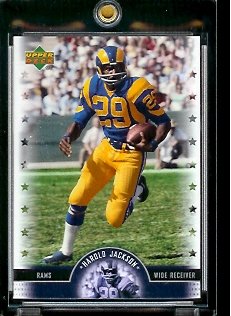
Harold Jackson


Harold Jackson
5'10" 175
Wide Receiver
Los Angeles Rams
Philadelphia Eagles
1968 - 1983
16 Seasons
208 Games Played
579 Receptions
10,372 Yards Receiving
76 Touchdowns
5 Pro Bowls


Harold Leon Jackson was drafted by the Los Angeles Rams in the 12th round of the 1967 NFL Draft, the 323rd player chosen overall. He was just the 11th of a now 56 players drafted from Jackson State University. There have been 92 players from the school to have played pro football so far.

Led by Hall of Famers Walter Payton, Jackie Slater, and Lem Barney with other gridiron legends like Robert Brazile, Coy Bacon, Speedy Duncan, Leon Gray, Wilbert Montgomery, Jimmy Smith, and Rickey Young. Jackson's five Pro Bowls are only exceeded by Payton, Slater, and Barney, and matched by Smith.

He only appeared in two games during his rookie season, not recording a statistic. The Rams then dealt him to the Philadelphia Eagles before the 1968 season, where he would soon be known throughout the league. He was their only offensive Pro Bowler, and one of the three they had that year.

On a Eagles team that struggled to four wins, he caught nearly half of starting quarterback Norm Snead's passing yards and touchdowns with an NFL leading 1,116 yards and 9 scores on a career best 65 receptions. His career best 79,7 receiving yards per game also led the league.

The Eagles struggled in mediocrity the next two years, and juggled Snead, Pete Liske, and Rick Arrington at the quarterback position. They ran the ball mostly, and Jackson caught 88 balls for eight scores over that time. He exploded in 1972 with another Pro Bowl season, leading the NFL with 62 receptions, 1,048 receiving yards, and 74.9 receiving yards per game.

The Rams decided they wanted Jackson back, so they traded three time Pro Bowl quarterback Roman Gabriel for him. The trade benefited both teams, as both men made the Pro Bowl that year with their new teams.

Jackson accrued his only First Team All-Pro honor as well that season, leading the NFL with a career high 13 touchdown catches with a career best 21.9 yards per catch on 40 receptions. One game saw him score four times on seven receptions for 238 yards that year.

He stayed a productive deep threat for the Rams over the next four years, making the Pro Bowl in 1975,, averaging over 16 yards per catch on 160 balls. He made his last Pro Bowl in 1977, then joined the New England Patriots the next year.

He added another component to an explosive Patriots passing attack led by quarterback Steve Grogan with wide receiver Stanley Morgan and tight end Russ Francis. They were called "Grogan's Heroes".

Jackson averaged over 20 yards per catch in three of his four years in New England. Though Grogan never earned a Pro Bowl nod, he enjoyed the finest years of his career with the trio. Morgan also averaged over 20 yards each year, going to a pair of Pro Bowls. Francis was a top tight end during that era, having made his third and final Pro Bowl squad that year. The team was in the top ten in the league in offensive yards and points in Jackson's first three years with the team.

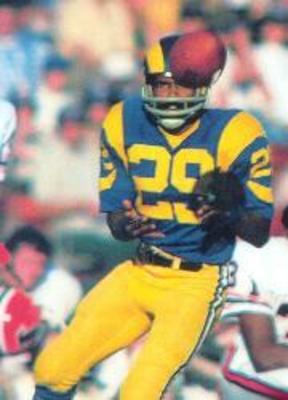
Now 36-years old, he joined the Minnesota Vikings in 1982. It was the only year he did not have the number 29 on his jersey, and it proved to be a jinx. He was hurt in the first game, not getting any statistics and missing the rest of the year. He then joined the Seattle Seahawks the next year, catching eight passes before retiring at seasons end.

He was back in uniform in 1987 with the Patriots at the age of 41. The NFL players had went on strike, so New England asked him to suit up for two games. Though he was their receivers coach, he obliged but did not appear in a game.

In the decade of the 1970's, no other player caught more balls for more yards and more touchdowns than Harold Jackson. His feat is even more of an amazing accomplishment, considering he had over 14 different quarterbacks throwing him the ball in his career on some teams that generally struggled at that position.

He helped Pat Haden make his only Pro Bowl, helped John Hadl make his last and his only First Team All-Pro honor. He caught some of Hall of Famer Joe Namath last passes, and improved the games of Grogan, Liske, James Harris, and John Reaves.

Most people look at his career average of 17.9 yards per catch, or the fact he averaged over 20 yards four times, and assume Jackson was strictly a deep threat. While he was torturous on defensive backs on the long ball, he also ran precision routes and had excellent hands.

Of the four wide receivers that were chosen on the NFL's 1970's All-Decade Team, only two are in Canton. Not only did Jackson outperform them with catches, yardage, and touchdowns, but he averaged more yards per catch than any of them. The closest to him is Hall of Famer Lynn Swann and fellow All-Decade selection Drew Pearson with their 17.1 yards per catch. Pearson played seven years that decade, Swann had six. Jackson averaged 18.2 over the entire ten years.

One probable reason for his not being chosen was the fact he played on just a few teams that made the playoffs a few times. Mostly his teams struggled, where he was all they had as a deep route threat. He often was met with double teams in an era where the ten-yard chuck was legal, thus making it much more difficult to get open. Teams also generally had their defensive backs play man-to-man, another way making getting open much harder in the ten-yard chuck rule era.

If Jackson got to play in this era of zone defenses and the 5-yard chuck rule, you could easily pump up his career statistics to even more astonishing numbers. Yet with all the rules since 1979 that helped the offense, he still ranks 29th in NFL history in receiving yards, 23rd in career yards per touch, and 24th in receiving touchdowns.

Though the casual football viewer might see him as a sexy choice, and the voters in Canton have not really voted much for him since his retirement, the numbers do not lie. The newer fan might not appreciate his numbers, not understanding the game or the rules of his era.

The fact he still ranks 67th on the All-Time receptions list in NFL history shows his productivity and that he was more than a deep threat. Some critics might point to his five Pro Bowls not being enough, but Jackson played in an era where your peers voted him in. Not a computer generated fan vote like today that is a popularity contest seemingly based more of histrionics than actual football play.

Of the 19 wide receivers inducted into Canton, only eight have appeared in more Pro Bowls than Jackson. What got many of those with lesser Pro Bowls inducted was the fact they played on teams that won championships. This is a debate on whether a teams accomplishments should be part of the reasoning for induction or if a players actual individual accomplishments on the gridiron constitutes worthiness.

If he had played on just one championship team, the theory that Harold Jackson already being a member of the Pro Football Hall of Fame seems fathomable. Cliff Branch, though somewhat comparable to Jackson but with lesser numbers, played on three championship teams and came fairly close to induction a few times.

Perhaps it is time to look more at what the player does with what he has to work with around him, than what his team does while with him. Harold Jackson most certainly belongs in Canton.

Notable Players Drafted In 1968 (* Denotes Hall Of Fame)

1. Ron Yary, OT, Minnesota *
2. Bob Johnson, C, Cincinnati
3. Claude Humphrey, DE, Atlanta
4. Russ Washington, DT/ OT, San Diego
8. Larry Csonka, FB, Miami *
9. Haven Moses, WR, Buffalo
11. Greg Landry, QB, Detroit
13. MacArthur Lane, RB, St. Louis Cardinals
14. Tim Rossovich, LB, Philadelphia
15. Forrest Blue, C, San Francisco
23. John Williams, OT, Baltimore Colts
26. Bill Lueck, G, Green Bay
31. Curley Culp, DT, Denver
33. Charlie West, DB, Minnesota
42. Bob Atkins, DB, St. Louis
43. Bill Lenkaitus, C, San Diego
47. John Garlington, LB, Cleveland
48. Mike Livingston, QB, Kansas City
52. Ken Stabler, QB, Oakland
69. Skip Vanderbundt, LB, San Francisco
73. Dick Anderson, DB, Miami
74. Charlie Sanders, TE, Detroit *
77. Elvin Bethea, DE, Houston Oilers *
80. Art Shell, OT, Oakland *
81. Dick Himes, OT, Green Bay
82. Paul Robinson, RB, Cincinnati
84. Jess Phillips, RB, Cincinnati
98. Johnny Fuller, DB, San Francisco
105. Jim Beirne, WR, Houston
110. Charlie H. Smith, RB, Oakland
117. Mike Bragg, P, Washington
118. Jim Kiick, RB, Miami
124. Mark Nordquist, G, Philadelphia
127. Cecil Turner, WR, Chicago
130. Blaine Nye, G, Dallas
156. Essex Johnson, RB, Cincinnati
159. D.D. Lewis, LB, Dallas
167. Oscar Reed, RB, Minnesota
176. Bob Brunet, RB, Washington
181. Willie Holman, DE, Chicago
190. George Atkinson, DB, Oakland
222. Paul Smith, DT, Denver
249. John Outlaw, DB, Boston Patriots
261. Tommy Hart, DE, San Francisco
275. Greg Brezina, LB, Atlanta
277. Marv Hubbard, RB, Oakland
288. Henry Davis, LB, New York Giants
289. Rich Coady, C, Chicago
291. Dennis Partee, K, San Diego
297. John Pergine, LB, Los Angeles Rams
301. Bob Trumpy, TE, Cincinnati
305. Jim Cheyunski, LB, Boston
317. Jeff Queen, RB, San Diego
330. Charlie Greer, DB, Denver
351. Dean Halverson, LB, LA Rams
357. Marlin Briscoe, WR, Denver
375. Robert Holmes, RB, Kansas City
417. Rocky Bleier, RB, Pittsburgh
428. Larry Cole, DE, Dallas
441. Bob Lee, QB, Minnesota


Sunday, March 21, 2010

Roger Brown


Roger Brown
6'5" 300
Defensive Tackle
1960 - 1969
Ten Seasons
138 Games Played
3 Safeties
6 Pro Bowls


Roger Lee Brown was drafted in the fourth round of the 1960 NFL draft by the Detroit Lions, the 42nd player chosen overall. The Lions had obtained that draft pick in 1958 when they dealt Hall of Fame quarterback Bobby Layne to the Pittsburgh Steelers.

He attended college at the University of Maryland-Eastern Shore, then known as Maryland State College. The school was so full of talent in an enrollment class of less than 300 students, that other teams in the CIAA (now known as the MEAC Conference) refused to play them in football and tried to get the school kicked out of the conference due to their dominance on the gridiron.

He played with such future pro players like Sherman Plunkett, Johnny Sample, Ray Hayes, and Bob Taylor while there.The team was coached by Vernon "Skip" McCain, who is a member of the College Football Hall of Fame.

The school stopped fielding a football team in 1979, despite placing 25 men in professional football. Five made the Pro Bowl and one, Art Shell, was inducted into the Pro Football Hall of Fame. In Super Bowl III, there were four alumni members from the school on the field.

Brown is the only player in school history who is a member of the College Football Hall of Fame, and he is also a member of the schools Hall of Fame and the Hampton Roads African American Sports Hall of Fame, the Virginia Sports Hall of Fame, the Maryland Sports Hall of Fame, and the Rockland County Sports Hall of Fame in New York

When he arrived in Detroit, he earned a starting job immediately on a defensive unit that featured Hall of Famers Dick "Night Train " Lane, Joe Schmidt, Yale Lary, and Dick Lebeau, as well as Pro Bowl players like Alex Karras, Bill Glass, Darris McCord, and Wayne Walker.

The unit of Brown, Karras, McCord, and Glass was so good, that sportswriter Bruno Kerns of the Pontiac Press dubbed them "The Fearsome Foursome". It was the first defensive line ever to be given a nickname, and the Los Angeles Rams would later adopt that moniker for their defensive line. They were backed by a secondary dubbed "The Four L's", which consisted of Lane, Lary, LeBeau, and Gary Lowe.

This defense was ranked in the top five in the NFL up until the 1965 season, even after the departures of Lane, Schmidt, Glass, and Lary. One of the biggest reasons this happened was the big Brown collapsing the middle of the pocket on every snap. But he was much more than a run stopping extraordinaire.

He intercepted a pass in both 1961 and 1963, gaining 30 yards overall. He was also a tremendous pass rusher who frequently posted double digit sack seasons. In the first of his six consecutive Pro Bowl seasons in 1962, he sacked Hall of Fame quarterbacks Bart Starr and Johnny Unitas for safeties. His two safeties in one season is still tied as a NFL record.

The game where he sacked Starr for a safety was ranked the second greatest game in Lions history by Detroit media. It happened on Thanksgiving Day, where he had six sacks by himself that game, as the team had 11 total in the 26-14 Lions win

The Lions used to play the Packers every year on Thanksgiving, but Hall of Fame coach Vince Lombardi refused to play again on that day. The NFL then began scheduling other teams to oppose the Lions for future Thanksgiving Day games. Perhaps the vision of Brown tossing around Fuzzy Thurston all game had Lombardi beg out of further repeats?

He was named the Outstanding Defensive Lineman in the league that 1962 season, where he had 19 sacks that was documented by a Lions coach who recorded sacks and tackles that year as a means as an incentive for the players. He was also named to the first of his two consecutive First Team All-Pro honors.

In 1965, Brown recorded the third safety of his career by sacking Starr once again in the end zone to secure a 12-7 victory late in the fourth quarter. He finished the year with 16.5 sacks. His three career safeties is tied with 17 other players as the second most ever in NFL history. His tackling the same player twice for a safety is a record.

In Brown's playing days, the NFL had two divisions called the West and East. It broke up into four divisions in 1967. "I always thought the Western Division was the toughest in football at the time," Brown remembers "We had the Colts, Packers, Bears, Vikings, Lions, Rams, and 49ers then. All really tough teams."

During this time, the Lions put together very good teams. The problem was that the Green Bay Packers was in their division and were a little better. Only the division winners would play the conference championship. The teams in second place in each division participated in the "Bert Bell Benefit Bowl" from 1960 -1969. Proceeds of the game the Bert Bell Retirement Plan, and it was used to determine who finished in third place. The Lions won the first three games also known as the "Playoff Bowl"

In 1967 he was traded to the Los Angeles Rams just before that start of the season for a first, second and third round draft pick. Those picks turned out to be Hall of Fame tight end Charlie Sanders, Earl McCulloch, the 1968 NFL Rookie of the Year, and Jim Yarbrough.

The Rams had just lost starter Rosey Grier to a career ending torn Achilles heel injury, and needed a replacement. Hall of Fame head coach George Allen then orchestrated the trade to get Brown to join the fabled "Fearsome Foursome" defensive line in Los Angeles.


The trade couldn't have worked better for the Rams. Brown was one of ten Rams to make the Pro Bowl that year, as they finished the season 11-1-2 to win the Coastal Division. The defense was ranked first in the NFL in points allowed for the first time in franchise history. They gave up just 14 points per game, were first in interceptions and average yards allowed per rushing attempt. Their Takeaway/Giveaway Differential of plus 16 also led the league.

Brown was teamed up with Merlin Olsen, Deacon Jones, and Lamar Lundy along the defensive line. All were Pro Bowl players in their careers with Olsen and Jones also later being inducted into Canton. The back seven was filled with perennial Pro Bowl players like Maxie Baughn, Jack Pardee, Myron Pottios, Irv Cross, and Eddie Meador.

Though the Rams had the top rated offense that year, their job seemed simple. According to Pro Bowl running back Les Josephson, "Our job was to stay on the field long enough to make sure our defense got rest so we could win."

On a stellar defense that Brown himself says "Was maybe the best team I played on in my career", the Rams dominated their opponents all year before losing in the playoffs to the Green Bay Packers. He was named to his sixth and final Pro Bowl that year.

Around this time, he was having major success as a restaurateur. He had opened a business in Chicago a few years before that was doing very well. He had gotten into cooking while in high school, and had a knack for it. These abilities helped him keep his weight up in becoming the first man who weighed over 300 lbs in NFL history.

After a good 1968 season that saw the Rams finish 10-3-1 and out of the playoffs, his 1969 season was hampered by a broken hand. First year pro Coy Bacon stepped in and performed with excellence. Seeing this, Brown decided to retire to concentrate on his restaurants.

"Coy was a tremendous player", recalls Brown, "I was making more money in my restaurants than I was as a player. I knew I could play another three or four years at a high level, but I decided to walk away while still in good health and concentrate on my off the field ventures. Writers then said I left because of injury, but that wasn't true. I never told Merlin or Deacon why I left then, but the truth is that it was a sound business move at the time".

His last game was in the "Playoff Bowl", which the Rams had also won in 1967. The Rams won 31-0 over the Dallas Cowboys. No other player played in, nor won, more "Playoff Bowls" than Brown did and he is the only player to play in the first and last game of this event.

Because of the era he played in, sacks and tackles were not recorded statistics. His teammates all figure that Brown easily averaged double digits in sacks most of his career. Though he was the biggest man in the NFL at the time, he was extremely nimble and lightening fast off the snap of the ball.

To understand his abilities, listen to the words of Ed Flanagan. Flanagan was a four time Pro Bowl center with the Detroit Lions and San Diego Chargers who played both with and against Brown. He is now a coach for the Fairbanks Grizzlies in the Indoor Football League, and is a member of the Lions 75 Year Anniversary Team.

"He was a bear", recalls Flanagan, " He made a lot of offenses, especially offensive linemen happy, when he retired. He was really smart, tough, and worked hard. He could read what you were going to do before you did it. He had everything. He had size, quickness, and speed, and he ran a 4.8 40-yard dash. He was the consummate All-Pro. I easily put him on the level of Hall of Famers Bob Lilly and Merlin Olsen. Roger should be in Canton himself."

"I remember joining the Lions as a rookie in 1965. He ran over me and through me all day in practice", he continued. "I called my dad and told him I didn't think I was going to make the team because Roger Brown was destroying me in practice every day. His head slap could knock a head off because he was so strong."

He also recalls the bond the Lions shared off the field. "Roger had a restaurant in Chicago that made excellent chicken. Quite a few of us would eat there frequently. I knew he could play several more years at Pro Bowl level when he retired, but can understand if the outside business ventures were more successful because we did not get paid much then. I was working in a brewery for Vic Wertz, who is remembered for being the All-Star first baseman who hit that baseball that Willie Mays made the famous over the shoulder catch on in the 1954 World Series."


At 6'5" 300 he was the model of what the NFL envisioned their future defensive linemen to be. Huge, strong, athletic, hard working, and smart. Of the defensive linemen already enshrined into Canton, he went to more Pro Bowls than Henry Jordan, Art Donovan, Dan Hampton, Fred Dean, Len Ford, Arnie Weinmeister, Willie Davis, and Bill Willis.

For such a big man with a target on his back bigger than most, he was remarkably durable. He did not miss a game in his career, and even played in all games in his last season even though he was injured.

His three recorded safeties was a team record at the time, that was equaled by Bruce Maher in 1967 and passed by Doug English in 1983 by one. Brown is a member of the starting unit on the Lions 75 Year Anniversary Team.

When you look at the current defensive tackles inducted into Canton, it is hard to say any are unworthy. It has been a neglected position by voters historically, with just 12 men enshrined as purely defensive tackles. It is time to right some wrongs by inducting Brown. Recent inductee John Randle got in due to his ability to get the quarterback, but he wasn't nearly the run stopping force Brown was, yet Brown as equally a gifted pass rusher. The fact the league did not record sacks in his era cannot back this claim, but it is said he had easily over 100 sacks in his career.

Some skeptics might point to the fact that neither the Lions nor Rams won a championship in his era, but that demonstrates a lack of real football knowledge. Many men reside in Canton today based purely on their teams success over their on individual abilities. Championships are won by a whole roster, not one individual. Canton is supposed to house the best individual players. If the Pro Football Hall of Fame were to stay on their inaugural mission and just do that, then Roger Brown would already be a member.


Notable 1960 Draftees * Denotes Hall of Fame Inductee

1. Billy Cannon, RB, Los Angeles Rams
3. Johnny Robinson, DB, Detroit
8. Jim Houston, LB, Cleveland
10. Ron Mix, OT, Baltimore Colts *
13. Harold Olson, OT, St. Louis Cardinals
17. Bob Jeter, DB, Green Bay
20. Maxie Baughan, LB, Philadelphia
23. Don Floyd, DE, Baltimore
24. Marvin Terrell, G, Baltimore
32. Don Meredith, QB, Chicago
35. Rod Breedlove, LB, San Francisco
37. Willie West, DB, Green Bay
40. Ted Dean, FB, Philadelphia
41. Johnny Brewer, TE, Cleveland
42. Roger Brown, DT, Detroit
44. Jim Marshall, DT, Cleveland
48. Vince Promuto, G, Washington
55. Abner Haynes, RB, Pittsburgh
56. Don Norton, WR, Philadelphia
59. Len Rohde, OT, San Francisco
63. Gail Cogdill, WR, Detroit
69. Bob Khayat, G, Cleveland
72. George Blair, DB,New York Giants
74. Larry Wilson, S, St. Louis *
75. Jim Norton, S, Detroit
86. Carroll Dale, WR, Los Angeles
88. Bill Mathis, FB, San Francisco
105. Chris Buford, WR, Cleveland
106. Don Perkins, FB, Baltimore
109. Charley Johnson, QB, St. Louis
110. Curtis McClinton, RB, Los Angeles
111. Grady Alderman, OT, Detroit
118. Mel Branch, DE, Detroit
119. Bobby Boyd, DB, Baltimore
157. Bob DeMarco, C, St. Louis
161. Jon Gilliam, C, Green Bay
162. Brady Keys, DB, Pittsburgh
178. Larry Grantham, LB, Baltimore
181. Jim Hunt, DT, St. Louis
203. Goose Gonsoulin, FS, San Francisco
229. Tom Day, DE, St. Louis


Thursday, March 11, 2010

Merlin Olsen : R.I.P. To A Rams Legend


Never before has a man come across our paths like the great Merlin Olsen, who passed away at the age of 69 years old yesterday. He was more than a gridiron great who blessed viewers with his abilities on the field as a Pro Bowl player who became the leader of the greatest defensive line in NFL history, "The Fearsome Foursome".

Merlin wasn't done entertaining America. Even long before he was inducted into the Pro Football Hall of Fame in 1982,. He had become a star actor on television in 1977 in the hit series "Little House on the Prairie", then starred in his own series called "Father Murphy".

During this time, he became a color commentator during NFL games with play by play announcer Dick Enberg. The two became fast friends and they would pair together on the NBC Network throughout the 1980's. Enberg would voice over a video tribute to his friend during a celebration of his life at a Utah State University event last year. He then starred in another show called "Aarons Way" in 1988, then transitioned to commercials. He also hosted multiple telethons benefiting children.

To understand the journey is to remember the beginnings. Born as one of nine children in a family in Utah in 1940, athletics was an important part of the Olsen household. Football was a sport that three of the Olsen boys played best. Merlin and his younger brothers Phil and Orrin all would make it to the NFL, playing together in 1976, making it one of the very few times that three brothers participated in a professional sport at the same time. Phil played with Merlin on the same team from 1971 to 1974.

Merlin attended Utah State University in college, as would Phil later on. Orrin attended Brigham Young University and their brother Clark had a son, Hans, who would later play football for BYU as well. Hans is now a renowned broadcast journalist in the Provo, Utah area.

At Utah State, Merlin quickly became a star. He was named All-Conference twice and All-American in his senior season. That year saw the Aggies lead the nation in run defense, giving up a paltry 50.8 yards per game. This allowed the team to finish ranked tenth, the only time in school history they reached a ranking that high. Merlin was named the winner of the Outland trophy after a stellar season.

He then went on to play in the East-West Shrine Game, and was named MVP. He would later be inducted into the games Hall of Fame, as well as the 75th Anniversary All-Sun Bowl Team. His exploits at Utah State are so legendary that they named their football field after him and will soon have a bronze statue of his likeness standing at the entrance of the stadium.

His jersey was retired by the school, as was Phil Olsen's, and he is a member of the Utah’s Sports Hall of Fame, both the Utah State University Sports Hall of Fame and All-Century Football Team, All-Academic All-America Hall of Fame, and is a member of the Newspaper Enterprise Association All-Time All-America Team. He was also number one of the State of Utah’s Top 50 Athletes of the Century by Sports Illustrated. Phil was listed as the 43rd best. Merlin is a member of the College Football Hall of Fame.

The Los Angeles Rams drafted him in the first round of the 1962 NFL draft, the third player chosen overall, becoming the first player ever from Utah State drafted in the first round in the NFL. The Denver Broncos made him the second player chosen in the first round of their leagues draft, but Olsen chose the Rams because the financial expert that he was thought it a fiscally more sound strategy to choose the Rams. He signed a contact for $50,000 in an era where the average salary was $12,000.

He immediately became a one man wrecking crew in the NFL, standing out as soon as he entered the world of professional football. He was named NFL Rookie of the Y.ear and was selected to the first of his 14 consecutive Pro Bowl appearances. No other Ram has appeared in more Pro Bowls and his five First Team All-Pro honors is tied as the most ever in team history.

No other player in NFL history has ever gone to the Pro Bowl in the first 14 years of their career, and his overall total has been matched only by Hall of Fame offensive lineman Bruce Matthews. He also won the Pro Bowl MVP Award in 1968.

He was lined up on the left side next to Deacon Jones. The two fed off each others excellence, forcing opponents not to be able to double team either. Lamar Lundy played defensive end from the right side, and Rosey Grier completed the quartet team in 1963. The Fearsome Foursome was born and soon was dominating the NFL.

Hall of Fame head coach George Allen was hired by the Rams in 1966, and the groups fortunes began to change upon the arrival of the defensive expert. When Grier had a career ending injury in the 1967 preseason, Allen acquired Hall of Famer Roger Brown to replace him. The unit dominated the NFL again, finishing first in the league in defense.

They continued their excellence throughout the 1960's and even added Coy Bacon to the unit. Bacon started after Brown had a injury issues, and Diron Talbert replaced the retired Lundy. The group continued their excellence, frequently placing multiple players from the unit into the Pro Bowl. Jones, Brown, Bacon, Lundy, and Grier all made the Pro Bowl as members of the Rams.

The one constant was Olsen. Even after the rest of the rest of his excellent unit retired or departed for other teams, he stayed in Los Angeles and kept leading the way. When Hall of Famer Jack Youngblood joined the team in 1971, he was given sage advice buy their leader. " Push to be great not just on every play, but with every heartbeat."

Youngblood says "When you stop and think of Merlin on the field, he accomplished things that will never be accomplished again. If it hadn't been for Merlin Olsen, I wouldn't have turned out to be the football player that he helped mold and make."

He retired after the 1976 season, the only year he failed to make the Pro Bowl. He was a first time inductee into Canton. His list of awards is astounding, and surely will never be duplicated again. When he was named NFL MVP in 1974, he accepted it "on behalf of all who toil in the NFL trenches".

He is a member of both the NFL's 1960's and 1970's All-Decade Teams, is a member of the NFL's 75th Anniversary All-Time Team and was ranked number 25 on The Sporting News' list of the 100 Greatest Football Players. He has also won the Walter Camp Man of the Year Award, and the NFL Alumni Career Achievement Award.

The Rams retired his jersey number and he was placed in the Saint Louis Ring of Honor even though he played his entire career in Los Angeles. He is also a member of the California Sports Hall of Fame, and was named Athlete of the Century for the state of Utah. The man must have had dozens of trophy cases to attempt to hold all of the accolades he achieved.

His charity work perhaps passes his athletic achievements. He was a true hero to countless people, and was especially dedicated to children. A father of three children and a grandfather of four, Olsen had an acute understanding of family and love for humanity.

He is still beloved and respected by his teammates. I was coincidentally working on a article on the 1967 Rams, and the Rams I was able to talk to all stated how important Merlin was to the team. I had just contacted Hans about talking to Merlin yesterday about the team, but this was unfortunately an event that never took place.

"He was ferocious and fearless on the football field and then the other probably more important aspect of his personality was he was a true gentleman,"Youngblood said. "We all know what a wonderful, tremendous football player he was, but he was so much more than that."

NFL commissioner Roger Goodell released this statement, "He was extraordinary person, friend and football player. He cared deeply about people, especially those that shared the game of football with him. Merlin was a larger-than-life person, literally and figuratively, and leaves an enormously positive legacy."

A legacy that will live on for decades more than just in the NFL record books or TV re-runs. This soft-spoken giant of a man has left us a legacy booming, fertile, and everlasting. Just to thank him would be a vast understatement, but would be gracious accepted by a true hero whose kindness had no boundaries.


See Ya Merlin. Thanks Again For Everything!

Sunday, December 27, 2009

The Greatest Washington Redskins Not In Canton


Chris Hanburger
Washington Redskins
Linebacker
6'2" 220
1965 - 1978
14 Seasons
187 Games Played
19 Interceptions
5 Touchdowns
9 Pro Bowls
1972 NFC Defensive Player of the Year


Christian G. Hanburger was an 18th Round draft choice of the Redskins in 1965, played right away and was in the Pro Bowl by his second year in the league.

He would then begin a string of Pro Bowl appearances until 1969. He then resumed that string in 1972 until 1976. Sacks and tackles were not recorded in those days, but Hanburger was a play maker. He is considered one of the best of his era. He was known for his blitzing ability and pass coverage.

Ever the complete player, he returned three fumbles for touchdowns, third most in NFL history, in his career to go with two more on interceptions.

In 1972, Hanburger captained the Over The Hill gangs defense to a Super Bowl appearance, and was named the NFC Defensive Player of the Year.

Hanburger was known not only for good speed, but his exceptional quickness. He had the innate ability to diagnose a play before the ball was hiked. He often would cover the other teams tight end and peel off to knock passes down meant for wide receivers. Coach George Allen liked to have a safety first defense, leaving the rest to Hanburger and his fellow linebackers.

Chris Hanburger's nine Pro Bowl appearances are still the most by any player in the entire history of the Washington Redskins. His four First Team All-Pro honors is tied with Hall Of Famer Sammy Baugh as the most ever by any Redskin.

He is a member of the Redskins Ring Of Fame and 70 Greatest Redskins Team.

The game was played different for the most part in his era. The running game was most teams primary weapon. Tackling with sound fundamentals was a must then. Few players lead with their heads for "kill shots" because they would be injured much faster than today with innovations of modern technology on equipment nowadays.

It also should be remembered that players then did not command the same level of salaries that they do today. Most players would work a second job in the off season, compared to the luxury players have today to train whenever they choose to.

As a kid, I once heard a long time local media type say that he figured Hanburger had over 50 quarterback sacks in his career. This, coupled by the facts that are allowed in the record book truly says that there is NO DOUBT that Chris Hanburger SHOULD BE in the NFL Hall of Fame.

You can help Chris get his respect by signing this petition : http://www.ipetitions.com/petition/chrishanburgerhof/


Pat Fischer
5'9" 170
Cornerback
1961 - 1977
17 Seasons
213 Games
56 Interceptions
941 Yards
4 Touchdowns
3 Pro Bowls


Patrick Fischer was a 17Th round draft choice of the Saint Louis Cardinals in 1961. He returned a few punts and kick offs in his Cardinal career, as well as catching one pass for 22 yards in his rookie year. He made two Pro Bowls in 1964 and '65 for Saint Louis.

He signed with Washington as a free agent in 1968, and made the 1969 Pro Bowl team. He was the teams shut down cornerback on the 1972 Super Bowl team. NFL Films listed Fischer as the Redskins All-Time Neutralizer in the 1980's.

Fischer is still all over the Cardinals record books. He is fifth most interceptions with 29, fifth in interception return yardage with 529, third in interceptions returned for touchdowns with three, third in consecutive games with an interception by accumulating five, ninth longest for the longest interception return for a touchdown when he took it 69 yards in 1967.

In 1964 he returned two interceptions for touchdowns, which ranks second in Cardinals history. Fischer also ranks third for most interceptions in a season for the Cardinals, when he snared 10 in 1964.

He also ranks seventh in Redskin history with 27 interceptions, and fourth ain interception return yardage with 412. When he retired, Fischer had played in a then-NFL record for games played by a cornerback with 213.

Fischer may appear small to those who never saw him play, but those who did know better. His battles with Philadelphia Eagles 6'8" wide receiver Harold Carmichael were legendary. Fisher often was also matched up against Dallas Cowboys wide receiver "Bullet" Bob Hayes, the fastest man in the world at one time.

He was a rough "bump and run" style defender full of tricks. One common move he would use was, if an opponent had to catch a pass over his head, Fischer would punch him in the gut or jaw. He made many plays versus the pass, but also excelled in run support.

Teams would often work away from Fischer and Ken Houston, when passing, due to their propensity of returning interceptions for touchdowns for the Redskins. Pat Fischer played in an era where defenders had to work harder. The 10 yard chuck rule was not changed to 5 yards until the 1979. Wide receivers also had to work harder to get open in that era.

The rushing attack was the primary weapon, and run support from defensive backs was a must in that era. Players like Deion Sanders may have been relegated to only punt return duty back then, possibly nickel back. Fischer also excelled on special teams, which was a must for head coach George Allen and special teams coach Marv Levy, who are both in the Pro Football Hall Of Fame.

He is a member of the Redskins Ring Of Fame and 70 Greatest Redskins Team.

Fischer had an excellent career. Is it worthy of Canton? After seeing how long it took a superstar like Emmitt Thomas to get in, and how a long list of former great cornerbacks like Louis Wright, Ken Riley, Lester Hayes, and others are not in yet, it may be a long shot.

Still, after looking at how his numbers compare with those cornerbacks that are inducted, there is no doubt in my mind that Pat Fischer should be in the Pro Football Hall of Fame.


Jerry Smith
6'3" 208
Tight End
1965- 1977
13 Seasons
168 Games Played
421 Receptions
5,496 Yards Receiving
60 Touchdowns
2 Pro Bowls


Jerry was drafted in the ninth round of the 1965 draft by Washington and wasn't used much by the head coach, Otto Graham, in his rookie year. He caught 19 passes for two touchdowns that year. Charley Taylor, then a halfback, was the primary weapon. Jerry was a back up wide receiver initially, but with two Hall of Famers, Taylor and Bobby Mitchell, as the primary targets of the newly acquired Hall of Fame QB Sonny Jurgensen, Graham decided to move Smith to tight end.

Jerry was used much like you now have seen Sterling Sharpe or Antonio Gates used. This was a trend setting move that allowed Smith to explode onto the NFL scene. In his second season, Smith caught 54 balls for 686 yards and six TD's. Smith had his best season as a pro in his third year. He caught 67 passes for 849 yards and 12 TD's.

He then caught 45, 54, and 43 passes the next three years to go with 24 TD's. Smith was hurt early in 1971 and only managed 16 catches with one score. He was never quite the same again.

In the Redskins Super Bowl year of '72, Smith did catch seven touchdowns on only 21 receptions. The following year he did not get into the end zone on 19 catches.

Finally showing signs of health in 1974, Smith caught 44 passes for 554 yards with three touchdowns from Billy Kilmer, who never threw to the TE much. The next year Smith caught 31 balls for 391 yards and three touchdowns.

Injuries besieged Smith in his final two years, and with newly acquired Jean Fugett now starting, Smith managed eight catches for 2 scores.

Smith retired with a then-NFL record 60 touchdown catches for tight ends. He finished second All-Time behind Mike Ditka for receptions and yards receiving by a tight end.

To this day, he ranks first in Washington Redskin history for tight ends in catches, yards receiving and touchdowns. He is also tied with three others with 12 TD's caught in a season. He is tied with ten other Redskins with three touchdowns in one game, something he did twice.

His team record 67 catches, in 14 games, for a tight end in a single season was surpassed by Chris Cooley, in 16 games, in 2005. Smith still ranks third in Redskin history in touchdown catches, and fourth in receptions overall in Redskins history.

While Smiths statistics may pale in today's modern game, one must remember that the NFL "chuck" rule was 10 yards in his playing days. It was a much rougher game as well back then. Clotheslines were frequent, as were players diving at each others knees. If Smith had the luxury of only a 5 yard chuck rule, his statistics surely would have increased.

Smith may never be inducted into Canton. He died at the age of 43 in 1986 of AIDS. He never had told anyone that he was a homosexual, but was outed by former team mate and lover, running back David Kopay (the first NFL player to announce his being gay) shortly after Smiths death. Kopay has asserted the NFL's homophobia in those days was so prevalent, that once he had announced he was gay, several coaching offers were rescinded.

Not that much has changed nowadays, as Jeremy Shockey's comments on the Howard Stern show revealed, but there is a hope that the NFL Senior Committee can look past the mans lifestyle and the politics involved.

Smith retired with superior stats comparatively to Hall of Fame tight ends such as John Mackey. He retired only 6 catches short of Ditka's then-NFL tight end reception record as well.

He is a member of the Redskins Ring Of Fame and 70 Greatest Redskins Team.

Jerry Smith may be a controversial subject to some. Even after everything that can be said for, or against him, his statistics tell a steadfast story. Smith was lauded by Sports Illustrated as a top pass catching tight end during his era. His legend on the gridiron still shines bright today, 31 years after his retirement. Maybe some will say he is on the fringe for induction, or that I'm being biased due to the Redskins being my favorite team as well.

Maybe these things are true.

Still, in my eyes, Jerry Smith belongs in the Pro Football Hall of Fame.


Russ Grimm
6'3" 273
Guard
1981-1991
11 Seasons
140 Games Played
4 Pro Bowls


Russell Scott Grimm was a third round draft pick by the Redskins in the 1981 draft. He played 14 games that year, and started in 11 of them. This was during a time where a young group of blockers would bond under the leadership of coach Joe Bugel and veteran offensive tackle George Starke to form one of the greatest offensive lines in NFL history. This was when "The Hogs" were born.

This nickname was given to them as they prepared for the 1982 season by Bugel. The season was shortened to nine games because of a players strike, and the WildCard Redskins blew right through the playoffs riding the backs of the Hogs. Washington then won their first Super Bowl, thanks to the blocking of the unit and the running of Hall Of Famer John Riggins.

Grimm made his first Pro Bowl in 1983, and the Redskins returned to the Super Bowl before losing to the Los Angeles Raiders. It was the first of his four consecutive Pro Bowl nods, and the first of three straight First Team All-NFL honors.

He also was a versatile athlete who was listed as the teams emergency quarterback. The 1987 season showed off his athleticism, when he had to start five games at center for the injured Jeff Bostic, then was injured himself. The Redskins went on to win their second Super Bowl.

He battled through injuries the next three years, and started in 24 of the 32 games he was able to play. After starting in just one games in 1991, he retired after the Redskins won their third Super Bowl in ten years that season.

Since his retirement, he has gone on to become one of the top offensive line coaches in the league. His name has come up often when teams are considering who to hire as a head coach. He has also been a finalist for induction into the Pro Football Hall Of Fame four times so far, and hopefully will soon find his way in Canton.

Russ Grimm is usually the first person thought of when "The Hogs" are discussed. He was a gritty blue collar player who was a key component of the Redskins famed counter trey play. His ability to pull was the primary reason the play was unstoppable, even though opponents knew it was coming.

He is a member of the Redskins Ring Of Fame, and is one of the 70 Greatest Redskins.


Gene Brito
6'1" 226
Defensive End
1951 - 1960
Nine Seasons
97 Games Played
47 Receptions
2 Touchdowns
5 Pro Bowls


Genaro Herman Brito was drafted in the 17th round of the 1951 draft by the Redskins. He was a 26 year old rookie, having spent time in the Armed Forces defending the United States in World War II.

The Redskins used him on offense a lot in his first two years, and Brito grabbed 47 passes and two touchdowns over that time. Disenchanted with his role, he then went to play for the Calgary Stampeders of the Canadian Football League with Redskins quarterback Eddie LeBaron. He was named to the All-Conference Team in his lone season with them.

Both players returned to the Redskins in 1955, and Washington put Brito exclusively at defensive end for the rest of his career. He was named NFL Player of the Year by the Washington D.C. Touchdown Club that year, and would go to the Pro Bowl in each of the five seasons he played in Washington.

He was named MVP of the 1958 Pro Bowl, the first Redskin to ever accrue that honor.

Brito was considered on of the best defensive lineman of the 1950's. Hall Of Famer Paul Brown once wanted to put a Cleveland jersey on him because "Brito was more in my backfield than his own". He also received the Presidential “Seal of Approval” from both Richard M. Nixon and John F. Kennedy for his high level of play at the end position. Both presidents referred to him as their favorite player.

He was so popular that he hosted a television show called "The Gene Brito Show", which was shown just before the actual games were played. He is considered one of the first players in NFL history to do this.

He joined the Los Angeles Rams in 1959, but was only able to play two games because of injuries. He returned in 1960 to play 11 games and was named Second Team All-NFL. He then retired.

Gene Brito is a member of the Redskins Ring Of Fame and 70 Greatest Redskins Team, and his three First Team All-NFL accolades are the second most in franchise history. No other defensive end in team history has appeared in as many Pro Bowls as he did in his career. He is one of the most popular Redskins ever, and their best defensive end ever. He is certainly worthy of induction into Canton.


Lemar Parrish
5'11" 181
Cornerback
1970 - 1982
13 Seasons
166 Games Played
47 Interceptions
13 Fumble Recoveries
13 Touchdowns
8 Pro Bowls


Lemar was drafted in the seventh round of the 1970 draft by the Cincinnati Bengals. He was incredible in his rookie season, getting five interceptions, and scoring a touchdown on both a punt return and kickoff return. He averaged 30.1 yards per kick return and also scored on a blocked field goal return. He would go to the Pro Bowl in each of his first two seasons.

He followed that up next season with seven interceptions. He took one interception 65 yards for a touchdown, and one fumble for a touchdown. In 1972, Parrish picked off five passes and took two in for touchdowns. He also returned a punt for a touchdown. In 1973, he has two interceptions and returned a fumble for a touchdown.

The 1974 season saw Parrish returned to the Pro Bowl by setting a still standing Bengals record with an NFL leading 18.8 yards per punt return average. He also scored two touchdowns on punt returns. One went for 90 yards and is presently the second longest in Bengals history. He also recovered a fumble and took it 47 yards for a touchdown.

He would go to the Pro Bowl every year up until the 1977 season. In 1977, Parrish had three interceptions and took one in for the last touchdown of his career.

After the 1977 season, Parrish was traded to the Redskins, after a contract dispute, with defensive end Coy Bacon by the Bengals to Washington for the Redskins’ first-round pick in the 1979 draft. That first-round pick ended up being the 12th overall selection, which Cincinnati used to pick running back Charles Alexander out of Louisiana State.

Parrish was not asked to return kicks on the Redskins, yet still made a immediate impact on the Redskins defense his first year with four interceptions. The next year, he had nine interceptions and was named First Team All-NFL and to the Pro Bowl.. He followed that up with seven interceptions in 1980, and was named to his last Pro Bowl. Parrish left the Redskins after 1981, and joined the Buffalo Bills in 1982. He retired after that year.

Lemar Parrish is the Bengals All-Time leader in touchdowns scored by "return or recovery" with 13. This is still tied third All-Time in NFL history with two others. His two interceptions returned for TDs is still tied for the most in a game, with many others in NFL history. He was also the only player in Cincinnati history ever to score two "return or recovery" touchdowns in a single game, which he did separate 3 times.

When he retired, his three fumble returns for touchdowns tied an NFL record. He still fourth All-Time in Bengals history for interceptions in a career, and second in touchdowns scored by interception.

His four punt returns for touchdowns ranks first in Cincinnati Bengals history. He also is first in career average for kickoff returns with 24.7, touchdowns in a season on kick off returns, interceptions made in one game, and touchdowns returned via interceptions in a season and a single game.

He ranks second in Bengals history with 130 punt returns, and punt return yardage in a season and career. He is third in franchise history in interception return yardage in a career. His 95 yard kick off return currently is the sixth longest in Bengals history.

Parrish did not win the 1970 Rookie of the Year Award probably because the Bengals had two players win the award the two previous seasons, even though he had a superior season to the winner, 49ers CB Bruce Taylor.

Lemar Parrish is a member of the Cincinnati Bengals 40th Anniversary Team.

Parrish epitomized the definition of "play maker" in his career. He was a shut down cornerback who teams tried to avoid. He would make the opponents cringe when he was asked to return kicks or punts. Parrish teamed with Ken Riley to form, perhaps, the best cornerback duo in the NFL in the 1970's.

He was also noted for his ability to stop the run, which is something he had to supply often due to the Bengals porous front seven. Safety Tommy Casanova was a beneficiary of this cornerback tandem, and made 3 Pro Bowls from 1972 to 1977. Casanova retired after Parrish left the Bengals.

Teams could not beat the Bengals by passing the ball, but they would win by running the ball up the middle. The Bengals often challenged the great Steelers teams of the 1970's, but would come up short. The pass defense was never the reason.

While with the Redskins, Parrish also made fellow cornerback Joe Lavender a better player. Lavender made the Pro Bowl twice in his career, the same years that Lemar did. Parrish was a complete player. He could do it all. His penchant for taking the ball to the end zone was prodigious. He made his teams better, his teammates better, and now is teaching his students to be better.

Every year of his career saw him intercept at least one ball, except for his 1974 Pro Bowl season. To be named to the Pro Bowl by your peers, despite having no interceptions, truly shows his greatness and is an example of how opposing teams feared him. The following two Pro Bowl years of 1975 and '76 are further examples to make this fact concrete, because he had three interceptions total over this time.

I find it amazing to see Lemar Parrish yet to be inducted into Canton. Recent inductee Roger Wehrli went in with finally, so hopefully the voters are going to right long standing wrongs. It would be fitting to see Parrish and Riley inducted together.


Len Hauss
6'2" 235
Center
1964-1977
14 Seasons
196 Games Played
5 Pro Bowls


Leonard Moore Hauss was drafted in the ninth round of the 1964 draft by the Redskins. He soon earned a starting job by the fourth game of his rookie year, and would hold onto it the rest of his career. Hauss never missed a game in his entire career. His 14 years with the team is tied as the third most in franchise history.

He made his first Pro Bowl in 1966, then would make it three straight seasons between 1968 to 1970. The 1972 season was his last as a Pro Bowler, but he remained an upper echelon player for years in a decade where great NFC centers like Mick Tinglehoff, Jeff Van Note, Forrest Blue, and others were perennial Pro Bowl players as well.

When he retired after the 1977 season, he was the only center in Redskins history to attain five Pro Bowl honors. Jim Schrader is second with three Pro Bowls.

There is no doubt that Len Hauss is the greatest center in team history. He is a member of the Redskins Ring Of Fame, and is one of the 70 Greatest Redskins.


Coy Bacon
6'4" 270
Defensive End
1968 - 1981
14 Seasons
180 Games Played
130 Sacks
2 Touchdowns
3 Pro Bowls


Leander McCoy Bacon was an undrafted rookie signed by the Los Angeles Rams right before the 1968 season. Bacon had just come from playing in the Continental Football League. Coy had signed with the Charleston Rockets in 1966, after leaving Jackson State University upon completion of his sophomore year. While playing with the Rockets, Coy was named an CFL All-Star in 1966. Other NFL luminaries like Bill Walsh, Ken Stabler, and Garo Yepremian also were in the Continental Football League. .


Coy joined a Rams team that had one of the best defensive lines in football, featuring Hall Of Famers Deacon Jones and Merlin Olsen. They were called "The Fearsome Foursome", and Bacon played just seven games as a reserve in his rookie year.

He cracked the starting lineup the next year, and started 13 games at defensive tackle. He was moved to defensive end in 1970, recorded 20 sacks,and took a fumble 14 yards for a touchdown. Bacon then had 21 sacks and intercepted a pass the next year. He made his first Pro Bowl Team in 1972, and then was traded to the San Diego Chargers after that season as part of a blockbuster deal.

He picked off a pass that year for San Diego, and took it 80 yards for a touchdown. Bacon also led the Chargers in sacks in two of his three seasons with them.

Right after the 1975 season, the Chargers traded Bacon to the Cincinnati Bengals for Hall Of Fame Wide Receiver Charlie Joiner. Coy responded with 21.5 sacks, 2 fumble recoveries for 48 yards and a safety. He was named to the Pro Bowl Team. He then made his last Pro Bowl Team the next year for the Bengals, despite missing two games.

The Bengals then traded Bacon to the Washington Redskins right before 1978. Coy was the pass rusher the Redskins desperately needed, and he recorded double digits in sacks in each of his first three seasons with them.

He was 39 years old in 1981, and started the three games he played before being injured for the rest of the season. The Redskins released him in the off season, but Coy was not done playing. He joined the Washington Federals of the USFL in 1983, and had a few good games. He then retired for good after that year.


Bacon played in an era where sacks were not a recorded statistic. Some researchers have credited him with over 130 sacks in his career. If you discount the three games he played in 1981, you can easily see he averaged 10 sacks every year of his career. That includes his first two seasons as a defensive tackle.

He was one of the best pass rushers I have seen play the game. He was noted as a character who would not like to practice during the week of a game, reserving his energies for Sunday. He wasn't always stout against the run in the latter part of his career, but he made several spectacular plays when his team needed it most.

Coy recently passed away, and may be a fringe player for many as far as induction into Canton. Yet I look at a guy like Fred Dean get in and wonder why Coy is not. He was just as good a pass rusher, played on lesser defensive lines, meaning the primary focus was on him, and was better versus the run than Dean.

Coy Bacon is a victim of times passing, as the newer voters don't probably know who he is. He never played on any teams that won anything, so he never got the press he probably deserved. But even if you look at the statistics, you can see he is worthy of induction into the Pro Football Hall Of Fame.


Others?

There are other current and former Redskins who will possibly be inducted into Canton one day, and others who appear on their way.

Brian Mitchell


Chris Samuels


Champ Bailey


Joe Jacoby


Jim Lachey


Jason Taylor


Chris Cooley