Showing posts with label Minnesota Vikings. Show all posts

Saturday, March 19, 2011

Cris Carter


Cris Carter
6'3" 202
Wide Receiver
Minnesota Vikings
16 Seasons
234 Games Played
1,101 Receptions
130 Touchdowns
8 Pro Bowls
1990s All-Decade Team


Cristopher D. Carter was drafted in the fourth round of the Supplemental Draft in 1987 by the Philadelphia Eagles. He had to go into the supplemental draft because he lost his senior year of eligibility at Ohio State University after signing a contract with an agent.

While in college, Carter was the Buckeyes big-play receiver. Though he lost a year of college, he had the most receptions in Ohio State history when he left. Not only is he a member of the Buckeyes All-Century Team, but Carter is inducted into the Ohio State Varsity "O" Hall of Fame.

The 1987 season is best known as being shortened by a players strike. Carter was rarely used, catching two touchdowns off five receptions, though he did return 12 kicks. He would only return one kick the rest of his career.

Kenny Jackson, the Eagles first-round draft pick in 1984, was not working out as a starter opposite Pro Bowler Mike Quick. Carter was inserted into the starting lineup and grabbed 17 touchdowns off 84 receptions over two seasons.

The Eagles were known for their swarming defense and athletic quarterback during this time. Their head coach, Buddy Ryan, was a defensive expert, but the Eagles offense could not score in the playoffs and were bounced out in their first game in both years Carter started.

Ryan suddenly cut Carter after the 1989 season, with the reason was that all Carter did for the Eagles was "catch touchdown passes". The truth was that Carter was abusing drugs and the wide receiver credits his being cut as the wake up call that saved his life.

Minnesota claimed him off the waiver wire right away. He spent his first year in Minnesota backing up Anthony Carter (no relation) and Hassan Jones. Though the Vikings started three receivers seven times in 1991, he supplanted Jones as the starter and would hold that spot the remainder of his Vikings career.

One of Carter's strengths was his conditioning and durability. Though he missed four games because if injury in 1992, he played every other game possible for Minnesota. Except for his rookie and final seasons, those would be the only four games that he missed.

His 1993 season was the first of eight straight Pro Bowl years. He became one of the very best receivers in the NFL over this time. Carter caught a career best 122 pass in both 1994 and 1995, becoming the only player in NFL history to have that many receptions twice. He led the NFL in receptions in 1994, and his career best 17 touchdown receptions in 1995 led the league as well.

The Vikings had a revolving door at quarterback during Carter's time there. Seven different men were the primary starter in his 12 seasons with the team. Despite all the lunacy and confusion, Carter was a beacon of steady leadership and consistent production.

Carter had 86 or more receptions in seven of his eight Pro Bowl years. He had 90 or more catches five times. He also grabbed those touchdowns Ryan mentioned. Other than the 17 scores in 1995, he led the NFL with 13 touchdown catches two times. He was in double figures in touchdown receptions in five of his Pro Bowl years.

What made his production even more special, other than the ever changing quarterback, is the fact he had to share receptions with future Hall of Fame wide receiver Randy Moss, Pro Bowl wide receivers Jake Reed and Anthony Carter, and Pro Bowl tight end Steve Jordan.

Besides his eight consecutive Pro Bowls, he was named First Team All-Pro twice. He holds the Vikings record for Pro Bowls by a wide receiver, and only Moss has been named First Team All-Pro more. Just two Vikings, Hall of Famers Alan Page and Randall McDaniel have represented Minnesota more at the Pro Bowl than Carter.

Though he caught 73 balls for six scores in 2001, the Vikings let the 36-year old receiver go. He joined the Miami Dolphins the next year, but appeared in just five games and retired. Carter hold the Vikings records of receptions, receiving yards, and touchdown catches for a career. He also holds the single-season Vikings record for receptions and is tied with Moss with touchdown receptions.

Carter has been a finalist for induction into the Pro Football Hall of Fame three times so far. He ranks third in NFL history with 1,101 career receptions, fourth in career receiving touchdowns with 130, and eighth in career receiving yards, and total career touchdowns.

He was blessed with long arms and a lot of strength, making it very hard to cover him in a five-yard chuck. The two modern receivers he is jockeying for induction into Canton is Tim Brown and Andre Reed.

Brown had seven less receptions, but 1,035 more receiving yards. He went to one more Pro Bowl, but was never named First Team All-Pro and had 26 less touchdowns. What might get him in ahead of Carter is the fact he was an incredible return specialist.

Reed got most of his receptions off the arm of Hall of Fame quarterback Jim Kelly. He has less Pro Bowls,receptions, receiving yards, and touchdown catches that both Brown and Carter. Yet he played in four Super Bowls, where Brown appeared in one and Carter never did.

Then there are the old school fans who point to the obvious fact none of these three receivers ever dealt with the ten-yard chuck rule, which makes it much harder to excel as a receiver, as opposed to the offensive-friendly rules the trio participated in. Rules that greatly inflated statistics, perhaps making a player look better than an older player because the modern numbers dwarf the statistics from the ten-yard chuck era.

Men like Mac Speedie, Lionel Taylor, Harold Carmichael, Drew Pearson, Gino Cappelletti, Sonny Randle, Cliff Branch, Harold Jackson, Pete Retzlaff, and LaVern Dilweg are just a few great receivers on par with Carter, Brown, and Reed still awaiting their inductions. Men who dealt with a much rougher game, let alone the ten-yard chuck.

Carter has a feel-good story attached to his career, one that has now extended to where he provides analysis on television. With career on the ropes because of drugs, he rebounded and became a leader. Most recall him serving as a mentor to Moss.

He won the Bart Starr Man of the Year Award in 1994, the Bryan "Whizzer" White NFL Man of the Year Awards in 1998, and the Walter Payton Man of the Year Award in 1999.

Besides the 17 NFL records he either owns or shares, he is a member of the NFL's 1990s All-Decade Team. He is one of the 50 Greatest Minnesota Vikings as well as being a member of their 40th Anniversary Team.

The Vikings have retired his jersey and inducted him into their Honor Roll. His induction into Canton is inevitable, the only question left is the year it will happen. The Vikings have had a huge amount of great receivers to play for them, but Cris Carter may be the best ever.


Notable Players Drafted in 1987 * Denotes Hall of Fame Member

1. Vinny Testaverde, QB, Tampa Bay Buccaneers
2. Cornelius Bennett, OLB, Indianapolis Colts
8. Shane Conlin, MLB, Buffalo Bills
9. Jerome Brown, DT, Philadelphia Eagles
10. Rod Woodson, CB, Pittsburgh Steelers *
13. Chris Miller, QB, Atlanta Falcons
20. Haywood Jeffries, WR, Houston Oilers
22. Harris Barton, OT, San Francisco 49ers
23. Bruce Armstrong, OT, New England Patriots
26. Jim Harbaugh, QB, Chicago Bears
29. Nate Odomes, CB, Buffalo
34. Tim McDonald, SS, Saint Louis Cardinals
35. Christian Okoye, FB, Kansas City Chiefs
63. Jerry Ball, NT, Detroit Lions
72. Henry Thomas, DT,Minnesota Vikings
98. Rich Gannon, QB, New England
110. Steve Beuerlein, QB, Oakland Raiders
122. Hardy Nickerson, MLB, Pittsburgh
150. Greg Lloyd, OLB, Pittsburgh
183. Bo Jackson, RB, Oakland
206. Kevin Gogan, OG, Dallas Cowboys
261. Merril Hoge, Pittsburgh
276. Frank Winters, Cleveland Browns
283. Howard Ballard, OT, Buffalo
292. Elbert Shelly, DB, Atlanta
334. Tyrone Braxton, DB, Denver Broncos


1987 Supplemental Draft

1. Brian Bosworth, MLB, Seattle Seahawks


Saturday, March 12, 2011

Grady Alderman


Grady Alderman
6 '2" 247
Offensive Tackle
Minnesota Vikings
1960-1974
15 Seasons
204 Games Played
13 Fumbles Recovered
6 Pro Bowls


Grady Charles Alderman was drafted by the Detroit Lions in the 10th round of the 1960 draft. He went to college at the nearby University of Detroit Mercy. Alderman and Kansas City Chiefs guard George Daney hold the distinction of being the last players from the school to have played in the NFL.

The football program at Detroit Mercy was disbanded in 1964 despite having put 62 players in the NFL and once winning a national championship. Alderman is a member of the schools Hall of Fame.

He spent his rookie year on the bench, playing both guard and tackle. Detroit left him exposed to the Vikings expansion draft in 1961. Though Minnesota got several good players, including Hall of Fame halfback Hugh McElhenny, Alderman was their finest selection.

He started at left tackle day one. Alderman started every game he played over the next nine seasons, missing just one game over that span. Though the Vikings were struggling as a team, he quickly stood out.

The 1963 season was his first of five consecutive Pro Bowl honors. The team have five losing seasons in their first seven years of existence, but people recognized the work of Alderman. He played in an era where players and coaches voted on who would get that honor.

The Vikings steadily improved, and Alderman was a consistent force each year. The offensive line was one of the reasons for the improvement, with Pro Bowlers Mick Tingelhoff at center and Milt Sunde at guard. It would get even better when Hall of Famer Ron Yary and Pro Bowler Ed White were added later on.

Though his Pro Bowl streak ended in 1968, it was the first year the Vikings won their division. Minnesota repeated as division champions the next year by winning 12 of 14 games. Though the team would win 12 games three more times up until 1973, it was a franchise record until the 1998 team won 15.

The Vikings are the last NFL Champion before the NFL and American Football League officially merged in 1970. They reached Super Bowl V that year before losing. Alderman was named to his last Pro Bowl, as well as earning his lone First Team All-Pro nod.

The last five years of his career was peppered with injuries, but he helped Minnesota keep winning. The team lost just 11 games in four of those years. Alderman would miss the first three starts of his career in 1970, and miss three more the next year. He also missed the second game of his career in 1971.

Now 36-years old in 1974, Minnesota took him out of the starting lineup for the first time in his career. He appeared in every game but one as a reserve. The Vikings reached their third Super Bowl in his career with them, but lost. Alderman then retired as the last of the original Vikings.

His 194 games played is still the seventh most in Vikings history. Few players in the history of the game were as reliable. Alderman missed just three games in his 14 years with Minnesota.

A masterful technician, he always took on the other teams best pass rusher. He also had to block with knowledge of the avenues Hall of Fame quarterback Fran Tarkenton might take off running to. Tarkenton was known as the "Mad Scrambler", so blockers would have to stay blocking on plays longer for him than other teams had to.

He is one of the 50 Greatest Minnesota Vikings as well as being a member of both their 25th and 40th Anniversary Teams. Alderman was an alert player who pounced on 13 fumbles in his career.

Alderman was somehow left off the NFL's 1960s All-Decade Team despite going to the Pro Bowl more than two of the three tackles selected. One, Bob Brown, is in the Pro Football Hall of Fame. Brown went to the Pro Bowl four times in the 1960's and the other selection, Ralph Neely of the Dallas Cowboys, went twice.

The six Pro Bowls he played in are tied with 11 other Vikings as the fifth most in franchise history, and it is the most ever by a Vikings left tackle. He is the first tackle in team history to be named First Team All-Pro. Alderman was named Second Team All-Pro five times.

What fans forget with all of his longevity, durability, and excellence is how he accomplished all of this despite being one of the smaller left tackles in the game. Alderman stood 6'2" and weighed 247 lbs. in an era where blockers were not allowed to extend their arms and use their hands like today.

Surviving alone shows how stellar he was with his technique. Then you factor in all of the accolades he attained in his career as his teams went from the basement of the NFL to becoming a dominant squad for many years.

I can only guess his exclusion from Canton is some sort of punishment for the Vikings failing to win a Super Bowl. He hasn't even gotten close in the voting process, which is a head scratcher.

There are many men in Canton because their teams won championships, but the Pro Football Hall of Fame is not a team honor. It is supposed to honor individual achievement. This is somehow forgotten by voters too many times to count. Just because the Vikings failed to win, they have several extremely worthy players still waiting on induction.

Inferior players go in today as time forgets the greatness of these men of the past. The expression that no one remembers second place seems to get louder in the case of men like Alderman, yet the voters seem clueless how hard it is to reach a title game or even just make an NFL team.

Six Pro Bowls in a career is an excellent number for a offensive tackle, but it looks less thanks to how the National Football League ruined the Pro Bowl in both the game and how they sullied the honor by allowing no-nothing fans to vote within the last few decades ago. Where showboats or media whores get the honor instead of the deserving.

Offensive tackle is a position neglected by Canton's voters the last few decades. Yet Alderman's numbers match or exceed a few inducted. He has as many Pro Bowl appearances as Mike McCormack and Rayfield Wright and more than Bob St. Clair or Joe Stydahar.

It would be the right thing for the voters to do by getting the trenches some respect in Canton. Minnesota has three blockers worthy and two, Alderman and Tingelhoff, really should have been in long ago. Those who toiled in the trenches in virtual anonymity for the sake of victory.

The list of legendary tackles is long waiting for induction. Opening up the seniors pool to include a few more candidates would be the intelligent move as well, because watching inferior modern players get inducted first due to these rules is infuriating and diseased.

Not only is he still the greatest left tackle in the history of the Minnesota Vikings, but Grady Alderman is most certainly worthy of induction into the Pro Football Hall of Fame.


Notable 1960 Draftees * Denotes Hall of Fame Inductee

1. Billy Cannon, RB, Los Angeles Rams
3. Johnny Robinson, DB, Detroit Lions
8. Jim Houston, LB, Cleveland Browns
10. Ron Mix, OT, Baltimore Colts *
13. Harold Olson, OT, St. Louis Cardinals
17. Bob Jeter, DB, Green Bay Packers
20. Maxie Baughan, LB, Philadelphia Eagles
23. Don Floyd, DE, Baltimore
24. Marvin Terrell, G, Baltimore
32. Don Meredith, QB, Chicago Bears
35. Rod Breedlove, LB, San Francisco 49ers
37. Willie West, DB, Green Bay
40. Ted Dean, FB, Philadelphia
41. Johnny Brewer, TE, Cleveland
42. Roger Brown, DT, Detroit
44. Jim Marshall, DT, Cleveland
48. Vince Promuto, G, Washington Redskins
55. Abner Haynes, RB, Pittsburgh Steelers
56. Don Norton, WR, Philadelphia
59. Len Rohde, OT, San Francisco
63. Gail Cogdill, WR, Detroit
69. Bob Khayat, G, Cleveland
72. George Blair, DB, New York Giants
74. Larry Wilson, S, St. Louis *
75. Jim Norton, S, Detroit
86. Carroll Dale, WR, Los Angeles
88. Bill Mathis, FB, San Francisco
105. Chris Buford, WR, Cleveland
106. Don Perkins, FB, Baltimore
109. Charley Johnson, QB, St. Louis
110. Curtis McClinton, RB, Los Angeles
111. Grady Alderman, OT, Detroit
118. Mel Branch, DE, Detroit
119. Bobby Boyd, DB, Baltimore
157. Bob DeMarco, C, St. Louis
161. Jon Gilliam, C, Green Bay
162. Brady Keys, DB, Pittsburgh
178. Larry Grantham, LB, Baltimore
181. Jim Hunt, DT, St. Louis
203. Goose Gonsoulin, FS, San Francisco
229. Tom Day, DE, St. Louis


Friday, August 20, 2010

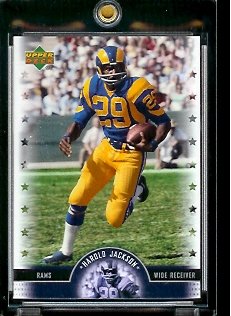
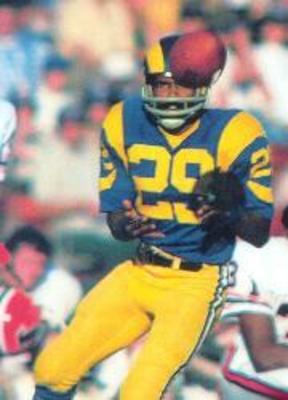
Harold Jackson


Harold Jackson
5'10" 175
Wide Receiver
Los Angeles Rams
Philadelphia Eagles
1968 - 1983
16 Seasons
208 Games Played
579 Receptions
10,372 Yards Receiving
76 Touchdowns
5 Pro Bowls


Harold Leon Jackson was drafted by the Los Angeles Rams in the 12th round of the 1967 NFL Draft, the 323rd player chosen overall. He was just the 11th of a now 56 players drafted from Jackson State University. There have been 92 players from the school to have played pro football so far.

Led by Hall of Famers Walter Payton, Jackie Slater, and Lem Barney with other gridiron legends like Robert Brazile, Coy Bacon, Speedy Duncan, Leon Gray, Wilbert Montgomery, Jimmy Smith, and Rickey Young. Jackson's five Pro Bowls are only exceeded by Payton, Slater, and Barney, and matched by Smith.

He only appeared in two games during his rookie season, not recording a statistic. The Rams then dealt him to the Philadelphia Eagles before the 1968 season, where he would soon be known throughout the league. He was their only offensive Pro Bowler, and one of the three they had that year.

On a Eagles team that struggled to four wins, he caught nearly half of starting quarterback Norm Snead's passing yards and touchdowns with an NFL leading 1,116 yards and 9 scores on a career best 65 receptions. His career best 79,7 receiving yards per game also led the league.

The Eagles struggled in mediocrity the next two years, and juggled Snead, Pete Liske, and Rick Arrington at the quarterback position. They ran the ball mostly, and Jackson caught 88 balls for eight scores over that time. He exploded in 1972 with another Pro Bowl season, leading the NFL with 62 receptions, 1,048 receiving yards, and 74.9 receiving yards per game.

The Rams decided they wanted Jackson back, so they traded three time Pro Bowl quarterback Roman Gabriel for him. The trade benefited both teams, as both men made the Pro Bowl that year with their new teams.

Jackson accrued his only First Team All-Pro honor as well that season, leading the NFL with a career high 13 touchdown catches with a career best 21.9 yards per catch on 40 receptions. One game saw him score four times on seven receptions for 238 yards that year.

He stayed a productive deep threat for the Rams over the next four years, making the Pro Bowl in 1975,, averaging over 16 yards per catch on 160 balls. He made his last Pro Bowl in 1977, then joined the New England Patriots the next year.

He added another component to an explosive Patriots passing attack led by quarterback Steve Grogan with wide receiver Stanley Morgan and tight end Russ Francis. They were called "Grogan's Heroes".

Jackson averaged over 20 yards per catch in three of his four years in New England. Though Grogan never earned a Pro Bowl nod, he enjoyed the finest years of his career with the trio. Morgan also averaged over 20 yards each year, going to a pair of Pro Bowls. Francis was a top tight end during that era, having made his third and final Pro Bowl squad that year. The team was in the top ten in the league in offensive yards and points in Jackson's first three years with the team.

Now 36-years old, he joined the Minnesota Vikings in 1982. It was the only year he did not have the number 29 on his jersey, and it proved to be a jinx. He was hurt in the first game, not getting any statistics and missing the rest of the year. He then joined the Seattle Seahawks the next year, catching eight passes before retiring at seasons end.

He was back in uniform in 1987 with the Patriots at the age of 41. The NFL players had went on strike, so New England asked him to suit up for two games. Though he was their receivers coach, he obliged but did not appear in a game.

In the decade of the 1970's, no other player caught more balls for more yards and more touchdowns than Harold Jackson. His feat is even more of an amazing accomplishment, considering he had over 14 different quarterbacks throwing him the ball in his career on some teams that generally struggled at that position.

He helped Pat Haden make his only Pro Bowl, helped John Hadl make his last and his only First Team All-Pro honor. He caught some of Hall of Famer Joe Namath last passes, and improved the games of Grogan, Liske, James Harris, and John Reaves.

Most people look at his career average of 17.9 yards per catch, or the fact he averaged over 20 yards four times, and assume Jackson was strictly a deep threat. While he was torturous on defensive backs on the long ball, he also ran precision routes and had excellent hands.

Of the four wide receivers that were chosen on the NFL's 1970's All-Decade Team, only two are in Canton. Not only did Jackson outperform them with catches, yardage, and touchdowns, but he averaged more yards per catch than any of them. The closest to him is Hall of Famer Lynn Swann and fellow All-Decade selection Drew Pearson with their 17.1 yards per catch. Pearson played seven years that decade, Swann had six. Jackson averaged 18.2 over the entire ten years.

One probable reason for his not being chosen was the fact he played on just a few teams that made the playoffs a few times. Mostly his teams struggled, where he was all they had as a deep route threat. He often was met with double teams in an era where the ten-yard chuck was legal, thus making it much more difficult to get open. Teams also generally had their defensive backs play man-to-man, another way making getting open much harder in the ten-yard chuck rule era.

If Jackson got to play in this era of zone defenses and the 5-yard chuck rule, you could easily pump up his career statistics to even more astonishing numbers. Yet with all the rules since 1979 that helped the offense, he still ranks 29th in NFL history in receiving yards, 23rd in career yards per touch, and 24th in receiving touchdowns.

Though the casual football viewer might see him as a sexy choice, and the voters in Canton have not really voted much for him since his retirement, the numbers do not lie. The newer fan might not appreciate his numbers, not understanding the game or the rules of his era.

The fact he still ranks 67th on the All-Time receptions list in NFL history shows his productivity and that he was more than a deep threat. Some critics might point to his five Pro Bowls not being enough, but Jackson played in an era where your peers voted him in. Not a computer generated fan vote like today that is a popularity contest seemingly based more of histrionics than actual football play.

Of the 19 wide receivers inducted into Canton, only eight have appeared in more Pro Bowls than Jackson. What got many of those with lesser Pro Bowls inducted was the fact they played on teams that won championships. This is a debate on whether a teams accomplishments should be part of the reasoning for induction or if a players actual individual accomplishments on the gridiron constitutes worthiness.

If he had played on just one championship team, the theory that Harold Jackson already being a member of the Pro Football Hall of Fame seems fathomable. Cliff Branch, though somewhat comparable to Jackson but with lesser numbers, played on three championship teams and came fairly close to induction a few times.

Perhaps it is time to look more at what the player does with what he has to work with around him, than what his team does while with him. Harold Jackson most certainly belongs in Canton.

Notable Players Drafted In 1968 (* Denotes Hall Of Fame)

1. Ron Yary, OT, Minnesota *
2. Bob Johnson, C, Cincinnati
3. Claude Humphrey, DE, Atlanta
4. Russ Washington, DT/ OT, San Diego
8. Larry Csonka, FB, Miami *
9. Haven Moses, WR, Buffalo
11. Greg Landry, QB, Detroit
13. MacArthur Lane, RB, St. Louis Cardinals
14. Tim Rossovich, LB, Philadelphia
15. Forrest Blue, C, San Francisco
23. John Williams, OT, Baltimore Colts
26. Bill Lueck, G, Green Bay
31. Curley Culp, DT, Denver
33. Charlie West, DB, Minnesota
42. Bob Atkins, DB, St. Louis
43. Bill Lenkaitus, C, San Diego
47. John Garlington, LB, Cleveland
48. Mike Livingston, QB, Kansas City
52. Ken Stabler, QB, Oakland
69. Skip Vanderbundt, LB, San Francisco
73. Dick Anderson, DB, Miami
74. Charlie Sanders, TE, Detroit *
77. Elvin Bethea, DE, Houston Oilers *
80. Art Shell, OT, Oakland *
81. Dick Himes, OT, Green Bay
82. Paul Robinson, RB, Cincinnati
84. Jess Phillips, RB, Cincinnati
98. Johnny Fuller, DB, San Francisco
105. Jim Beirne, WR, Houston
110. Charlie H. Smith, RB, Oakland
117. Mike Bragg, P, Washington
118. Jim Kiick, RB, Miami
124. Mark Nordquist, G, Philadelphia
127. Cecil Turner, WR, Chicago
130. Blaine Nye, G, Dallas
156. Essex Johnson, RB, Cincinnati
159. D.D. Lewis, LB, Dallas
167. Oscar Reed, RB, Minnesota
176. Bob Brunet, RB, Washington
181. Willie Holman, DE, Chicago
190. George Atkinson, DB, Oakland
222. Paul Smith, DT, Denver
249. John Outlaw, DB, Boston Patriots
261. Tommy Hart, DE, San Francisco
275. Greg Brezina, LB, Atlanta
277. Marv Hubbard, RB, Oakland
288. Henry Davis, LB, New York Giants
289. Rich Coady, C, Chicago
291. Dennis Partee, K, San Diego
297. John Pergine, LB, Los Angeles Rams
301. Bob Trumpy, TE, Cincinnati
305. Jim Cheyunski, LB, Boston
317. Jeff Queen, RB, San Diego
330. Charlie Greer, DB, Denver
351. Dean Halverson, LB, LA Rams
357. Marlin Briscoe, WR, Denver
375. Robert Holmes, RB, Kansas City
417. Rocky Bleier, RB, Pittsburgh
428. Larry Cole, DE, Dallas
441. Bob Lee, QB, Minnesota


Friday, January 22, 2010

Matt Blair


Matt Blair
6'5" 232
Linebacker
Minnesota Vikings
1974 - 1985
12 Seasons
160 Games Played
16 Interceptions
20 Fumble Recoveries
20.5 Blocked Kicks
6 Pro Bowls


Blair was drafted in the second round of the 1974 draft by the Minnesota Vikings, and was the 51st player chosen overall. He had went to college at Iowa State University, where he is a legend. He was the most outstanding defensive player of the Cyclones loss in the 1971 Sun Bowl, and was named All-American in his 1973 season. He was also a two time Kodak All-American team member. He is a member of the schools athletic Hall of Fame.

The Vikings started him in six games during his rookie year, and he was named to the NFL's All-Rookie Team after getting an interception and fumble recovery. Minnesota would go on to appear in Super Bowl IX that year, where Blair would block a punt leading to the Vikings only points in their 16-6 defeat.

He played as a reserve next season, but earned the starting left outside linebacker job in 1976. He had a career high five fumble recoveries and had two interceptions that year, as the Vikings made it to Super Bowl XI before losing. In the NFC Championship Game two weeks earlier, he had helped block a field goal attempt that Vikings cornerback Pro Bowl Bobby Bryant took 90 yards for a touchdown that accounted for the first points of the game.

The 1977 season saw Blair make the first of six consecutive Pro Bowl appearances. His penchant for the big play was widely known throughout the league, as was his solid, steady play backed by great fundamentals. The entire defensive personnel around him changed at every position except his. He was named the captain of the defense in 1979 and held that position until he retired.

Gone were Hall Of Famers like defensive tackle Alan Page, defensive end Carl Eller, and free safety Paul Krause, along with Vikings legends like defensive end Jim Marshall, defensive tackle Doug Sutherland, linebackers Jeff Sieman and Wally Hilgenberg, and defensive backs Bobby Bryant and Nate Wright. Blair continued to be a top echelon linebacker in the league despite these massive changes.

Many other changes occurred on the Vikings offense after 1977 as well. Minnesota went to four Super Bowls between 1969 and 1976, but none after that. After making it to the NFC Championship Game in 1977, the Vikings made the playoffs in 1978 and 1980 and lost in the first round each time. Blair would not appear in a postseason game again.

It was in that 1977 season that he scored his first touchdown, which came off a blocked kick. He scored again for the final time the next season off of a lateral that went 49 yards. It set the stage for maybe the finest year of his career, which happened during the 1980 season.

He was named to his only First Team All-Pro team that year, and was named the Most Valuable Linebacker of the NFC. Blair was also being recognized for all of the work he did away from the gridiron. Working in several charities that included the Children's Miracle Network, Multiple Sclerosis Society, March of Dimes, American Cancer Society, Big Brothers/Big Sisters, Lupus Foundation of Minnesota, Special Olympics, and the United Way, he was named the 1981 NFL Man of the Year. He also was the Top 10 Outstanding Young Men of America by the Jaycees in 1983. His work with the homeless and hungry has raised millions of dollars as well.

He missed the first games of his career in 1983 after becoming injured enough to miss five games. The Vikings drafted Chris Doleman in the first round before the 1985 season, and Hall Of Fame head coach Bud Grant had Blair teach him how to play linebacker and rush the quarterback from the edge. After appearing in a career low six games because of injury that year, Blair decided to retire.

The Vikings have never had a linebacker better than Matt Blair. His 1,452 career tackles still ranks second in team history. No other Vikings linebacker has intercepted more passes than him either.

Though sacks were not a recorded statistic until the 1982 season, he was known for his ability to come hard off the edge and create havoc on opposing teams. But he was more than just an excellent player who supported the run and rushed the passer. Minnesota liked to keep him on the field as much as possible, because he was so excellent defending the pass and creating turnovers on special teams as well.

His athleticism was on display in the 1975 season. The Vikings could not find a consistent punt returner that year, and used six different players that year. One of them was Blair, who took two punt returns that year. He may be the last linebacker ever in NFL history to be asked to field a punt.

His ability to block kicks was amazing. It didn't matter if it was a field goal, extra point, or punt, because he was a force each time the ball was snapped. His 20.5 blocked kicks in the regular season is a Vikings record, and this stat becomes even more spectacular when you factor in the fact Page blocked 16 more as well. In all, counting post season, he blocked 23.5 kicks. It is the second most in NFL history.

His 20 career fumble recoveries is tied as the 11th most by any defender in NFL history. What makes this statistic more impressive is the fact his teammates(Marshall, Page, and Eller) all had more in their careers. It is a testament to the Vikings defense being able to create multiple turnovers, and Blair's abilities around so many teammates who shared his proclivity to jump on loose footballs.

How the voters of the Pro Football Hall Of Fame can induct a one dimensional linebacker like Andre Tippett, while ignoring better players like Blair, shows a process full of politics where the actual play on the field is disregarded. Tippett just rushed the passer and went to the Pro Bowl a measly four times, while Blair did everything and more a linebacker could be asked to do and had more accolades.

Some may point to his six Pro Bowls and question if it is enough, especially when nine time Pro Bowl linebackers like Chris Hanburger and Maxie Baughn still await their call to the hall. What puts Blair over the top for induction over many other outside linebacker legends is his ability to play all over the field in every aspect of the game on defense and special teams.

He is a member of both the Vikings Silver and the 40th year anniversary teams, and soon will be inducted into the teams Ring of Honor. If one looks at the fact he continued his greatness long after all of the other "Purple People Eaters" had left the team, it should become quite apparent that Matt Blair deserves to be inducted into Canton.


Notable Players Drafted In 1974 ( * Denotes Hall Of Fame Inductee )

1. Ed "Too Tall" Jones, DE, Dallas
5. John Dutton, DT, Baltimore Colts
14. Randy Gradishar, MLB, Denver
19. Henry Lawrence, OT, Oakland
21. Lynn Swann, WR, Pittsburgh *
24. Roger Carr, WR, Baltimore
34. Steve Nelson, MLB, New England
35. Keith Fahnhorst, OT, San Francisco
45. Dave Casper, TE, Oakland *
46. Jack Lambert, MLB, Pittsburgh *
49. Devlin Williams, RB, San Francisco
53. Danny White, QB, Dallas
65. Dexter Bussey, RB, Detroit
67. Robert Pratt, G, Baltimore
68. Claudie Minor, OT, Denver
75. Mark van Eeghen, FB, Oakland
78. Nat Moore, WR, Miami
82. John Stallworth, WR, Pittsburgh *
89. Frank LeMaster, OLB, Philadelphia
105. John Teerlinck, DT, San Diego (Notable Coach)
116. Steve Odom, WR, Green Bay
125. Mike Webster, C, Pittsburgh *
134. Don Woods, RB, Green Bay
144. Jon Keyworth, RB, Washington
161. Noah Jackson, G, Baltimore
169. Efren Herrera, K, Detroit
174. Freddie Scott, WR, Baltimore
199. Eddie Brown, DB, Cleveland
232. Sam McCullum, WR, Minnesota
236. Ray Rhodes, DB, New York Giants (Notable Coach)
249. Don Calhoun, RB, Buffalo
250. Tom Condon, G, Kansas City (Notable Superagent)
365. Billy "White Shoes" Johnson, WR, Houston Oilers
374. Sam Hunt, LB, New England
376. Dave Wannstedt, OT, Green Bay (Notable Coach)
388. Bob Thomas, K, Los Angeles Rams


Monday, February 16, 2009

MICK TINGELHOFF


Mick Tingelhoff
6' 2" 237 lbs
Center
Minnesota Vikings
1962 - 1978
17 Seasons
240 Games Played (Consecutive)
6 Pro Bowls


Henry Michael Tingelhoff was an undrafted rookie signed by the Vikings before the 1962 season. Mick earned three letters during his collegiate football career at Nebraska University, but did not start until his senior year in 1961. Mick was a co-caption on that team, which had its biggest offensive output in over five seasons. Tingelhoff participated in the Senior Bowl in Mobile , Ala. , and in the All-American Bowl after the season was over. Mick Tingelhoff is a member of the Nebraska Football Hall of Fame.


Mick earned the starting job at Center in the second preseason game of his rookie year. It was a role he would not relinquish until he retired after 1978. He made his first All Pro team in 1964, and would attain that honor every year until 1969. 1969 was the year the Vikings were crowned NFL Champions, and went on to play the AFL Champion Kansas City Chiefs in Super Bowl IV and lose. He was named to the 1,000-Yard Club in 1969, honoring the NFL’s top blocker. In 1970, he was named to the First Team All NFL by both the Pro Football Writers and Pro Football Weekly. He was named First Team All Conference by the Associated Press and Pro Football Weekly. He was named Second Team All NFL by Newspaper Ent. Association and Second Team All Conference by the UPI. The Vikings went back to the Super Bowl in 1973, before losing to the Miami Dolphins. The Vikings returned to the Super Bowl the following season, but lost to the Pittsburgh Steelers. The Vikings continued to be an NFL powerhouse throughout the decade and returned to Super Bowl XI in 1976, but lost to the Oakland Raiders. Mick returned after the 1978 season having started every game the Vikings played his entire career. His 240 consecutive starts were then the second most in NFL history, thirty starts behind his Vikings team mate Jim Marshall. The only player in Nebraska University history to enjoy a longer NFL career was Tingelhoff's Husker teammate, Ron McDole, who spent 18 years in the league from 1961 to 1978. Mick has been inducted into the Vikings Ring of Honor and has had his #53 jersey retired by the franchise.


Mick's omission from Canton is one of the most confusing in all of my CCC profilees. The numbers are obvious. Mick was one of the most dominant Center's of his era, and defined the true definition of an iron horse. You can easily note his consecutive starts streak, the fact he was a Pro Bowler six straight seasons, and was part of the most dominant team in the NFC during the 1970's. The Vikings were a well balanced offense that scored points off the ground and via the air. Tingelhoff snapped the ball to such great NFL QB'S like Hall Of Famer Fran Tarkenton and Joe Kapp. He also helped pave the way for Vikings great Chuck Foreman, and others, to gain huge chunks of yardage. Much of the yardage Tarkenton acquired thru the air to set a then NFL record in passing yards and passing touchdowns were helped along by Mick's protection. He was a sound technical blocker who used his intelligence, grit, and determination to get the job done better than most Centers who ever played the game. The fact that the voters have passed on him over these years truly shows many hardly pay attention to the battles in the trenches. There is absolutely no question that Mick Tingelhoff belongs in the NFL Hall Of Fame.


Notable Players Noted in 1962 (* Denotes Hall Of Famer)

1. Ernie Davis, RB, Washington
2. Roman Gabriel, QB, Los Angeles Rams
3. Merlin Olsen, DT, LA Rams *
4. Gary Collins, WR, Cleveland
8. Lance Alworth, WR, San Francisco *
10. John Hadl, QB, Detroit
12. Irv Goode, G, Saint Louis Cardinals
16. Joe Carollo, G, LA Rams
40. Pat Holmes, DE, Philadelphia
43. Billy Neighbors, G, Washington
66. Dan Birdwell, DT, Detroit
82. George Andrie, DE, Dallas
88. Jim Bakken, K, LA Rams
93. Fred Miller, DT, Baltimore Colts
104. Gary Ballman, WR, Pittsburgh
115. Ike Lassiter, DE, LA Rams
151. Clifton McNeil, WR, Cleveland
163. Bake Turner, WR, Baltimore
211. Tommy Brooker, DE, Washington
220. Tom Sestak, DT, Detroit
249. Sonny Bishop, G, Cleveland

Friday, September 26, 2008

JIM MARSHALL


Jim Marshall
6'4" 248
Defensive End
Minnesota Vikings
1960 - 1979
20 Seasons
282 Games Played
(Consecutive)
127 Sacks
29 Fumbles Recovered
1 Safety
2 Pro Bowls


Jim Marshall was a 4th round draft choice of the Cleveland Browns in 1960. He was the 44th player picked overall. He had played the year before in the Canadian Football League for the Saskatchewan Roughriders after leaving Ohio State University upon the completion of his junior year. Marshall teams won two National Championships and one Rose Bowl. In 1958 against Purdue, Jim scored on a 25 yard interception return, and another touchdown on a 22 yard blocked punt return. He also kicked both extra points, as the Buckeyes tied the Boilermakers 14-14. Jim earned All American honors at OSU and is a member of the OSU Hall of Fame and the College Football Hall of Fame. A two-sport star, he also set the school discus and shot put records as a member of the track and field team in 1958.


His CFL exploits are sketchy at best, due to the lack of records available from that era. He was listed as a Defensive Tackle. The following year he submitted his name into the NFL Draft. When Marshall came to the Browns, he started right away at right Defensive End. He started the first three games, but had a falling out with legendary head coach Paul Brown. He soon lost his starting job, but continued to play the rest of the season. In the off season, Brown had plans to move Marshall to offensive tackle, but Marshall contracted encephalitis, and lost a great deal of weight. This fact, coupled with the problems Marshall and Paul Brown were having, did not bode well for Marshall's future in Cleveland. Both teams have different versions on how Marshall became a member of the expansion Vikings. The Vikings state that Marshall was traded with DT's Jim Prestel (8 NFL seasons), Paul Dickson (13 seasons), RB Jamie Caleb (3 seasons), LB Dick Grecni (1 season), and CB Billy Gault (1 season) while Cleveland received a 2nd-round choice and an 11th-round choice. These picks turned out to be DT Chuck Hinton, who played 9 NFL seasons for other teams, and End Ronnie Meyers, who never played in the NFL. The Browns state that "Jim Marshall was released by the Browns on Sep. 11, 1961. His rights were picked up by the Minnesota Vikings soon after, and the Browns, in a “gentleman’s agreement”, which is how Paul Brown carried out many deals, received cash and “future considerations”.


Regardless, Marshall was then a Viking until 1979. Marshall was with the team through the good and bad times. He led the team in sacks their first 6 years in the NFL. He may best be remembered for his 66 yard "wrong way" run, the longest safety and shortest play in NFL history. Billy Kilmer, then a running back with the San Francisco 49ers, had fumbled the ball. Marshall scooped it up and bolted for the wrong end zone. The Vikings won the game, as Marshall came up with a key sack in the 4th quarter. The "wrong way run" is truly a NFL classic moment to this day. But Marshall also achieved many more great feats on the field. Many fans know he played in a then league-record 282 consecutive games for the Cleveland Browns and Minnesota Vikings. 302 counting his playoff appearances. Punter Jeff Feagles just passed this number, but the NFL still recognizes Marshalls consecutive starts streak. Marshall also owns the NFL record of 282 consecutive games played by a Defensive End. Marshall also recovered 29 fumbles, an NFL record. He is listed as the Vikings franchises second leading All Time leading sack totals leader, behind Hall of Famer Carl Eller, with 127. Marshall was the Vikings team captain for 17 seasons. In all, discounting CFL games, Marshall played in 409 games (pre-season, season, post season and pro-bowls), had over 1050 tackles, and over 133 sacks. His teams won 11 Divisional Championships. He played in 4 Super Bowls. Twice he kept his streak intact by walking out of hospitals where he was recuperating from pneumonia and ulcers. On another occasion, he played after accidentally shooting himself in the side while cleaning his shotgun. In the final home game of his illustrious career, Marshall sacked Buffalo's Joe Ferguson twice. Marshall even played offensive tackle during the Vikings final series. Minnesota won 10-3, and Marshall was carried off the field by his teammates. Marshall was awarded the game ball, the first one ever given to a Viking player by Head Coach Bud Grant.


Many fans may best remember Marshall in his days of the Purple People Eaters. Teamed with Alan Page and Carl Eller, Gary Larsen, then Doug Sutherland, Marshall helped lead one of the greatest front fours in NFL history. Paige and Eller are in the NFL Hall of Fame. The Vikings may not have won the Super Bowl, but their teams were annually amongst the most feared and respected during the era.


Jim Marshall was one of a kind. We have seen Darrell Green and Jackie Slater play as long since, but neither matched Marshalls consecutive games streak. Marshall played in 270 games in 19 seasons with the Vikings and never missed a game. These are probably records that will stand for a very, very long time. Marshall was versatile enough to play on either side of the ball, and anywhere along the defensive line. His toughness is legendary. Many in the Twin Cities remember how Marshall and 16 others on snowmobiles got caught in a blizzard in Wyoming. Many of the party broke up in small groups as the snowmobiles conked out one by one. A bank president from Minnesota died. Marshall was with 5 other people (Dickson was one of the five) as they tried to walk through snow that was 10-15 feet deep. They made a snowcave to rest for the night by burning everything they had. Marshalls money, checkbook, and other papers. They made it another 24 hours as they froze in their camp before help arrived. Marshall called the experience " “the toughest thing I’ve ever encountered in my life.” When you look at Jim Marshalls stats, he is Canton worthy. When you factor in his legendary streak, it should be concrete proof that he is undeniably a Hall of Fame player. Maybe the voters won't let him him because of Eller and Paige? This same thought comes to mind for Steeler great L.C. Greenwood. That should not be a deterrent. Paige and Eller finished their careers elsewhere, but certainly are worthy. Marshall? He was as consistent as they come. He should have been in the NFL Hall of Fame years ago.


Notable 1960 Draftees * Denotes Hall of Fame Inductee


1. Billy Cannon, RB, LA Rams
3. Johnny Robinson, DB, Detroit
8. Jim Houston, LB, Cleveland
10. Ron Mix, OT, Baltimore *
20. Maxie Baughan, LB, Philadelphia
32. Don Meredith, QB, Chicago
42. Roger Brown, DT, Detroit
55. Abner Haynes, RB, Pittsburgh
74. Larry Wilson, S, St. Louis Cardinals *
109. Charley Johnson, QB, St. Louis Cardinals
110. Curtis McClinton, RB, LA Rams
119. Bobby Boyd, DB, Baltimore